Italian foothold
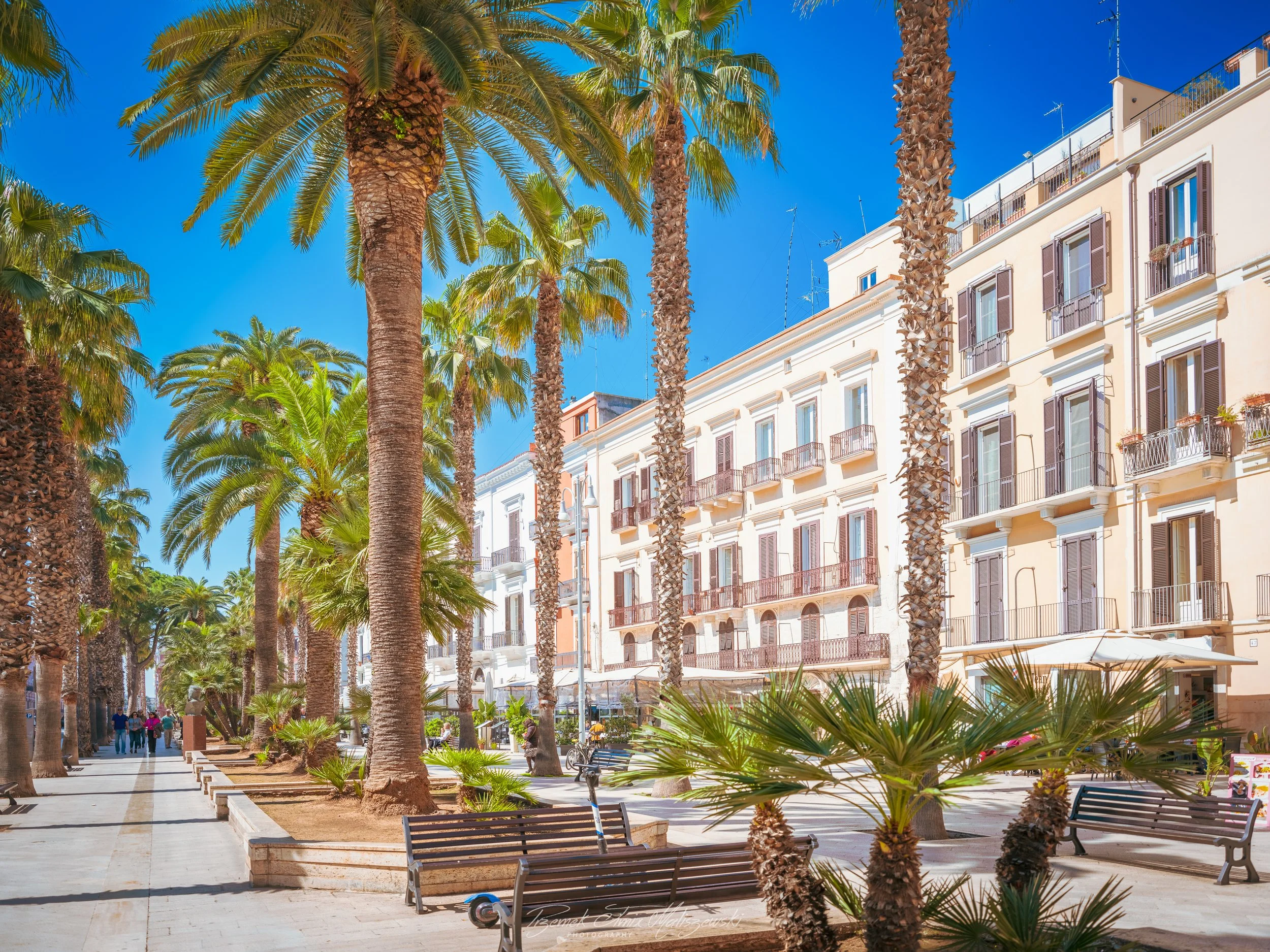
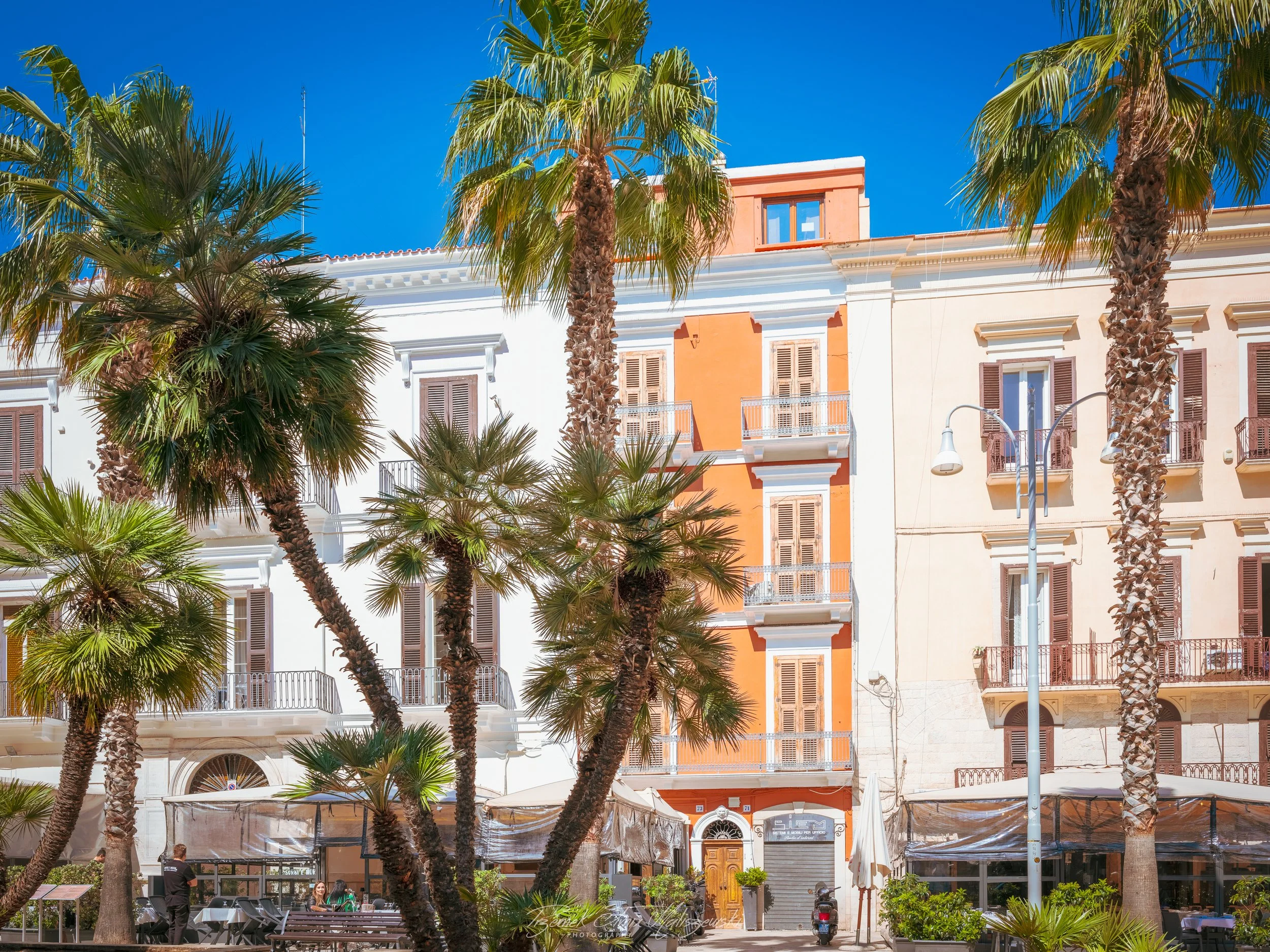
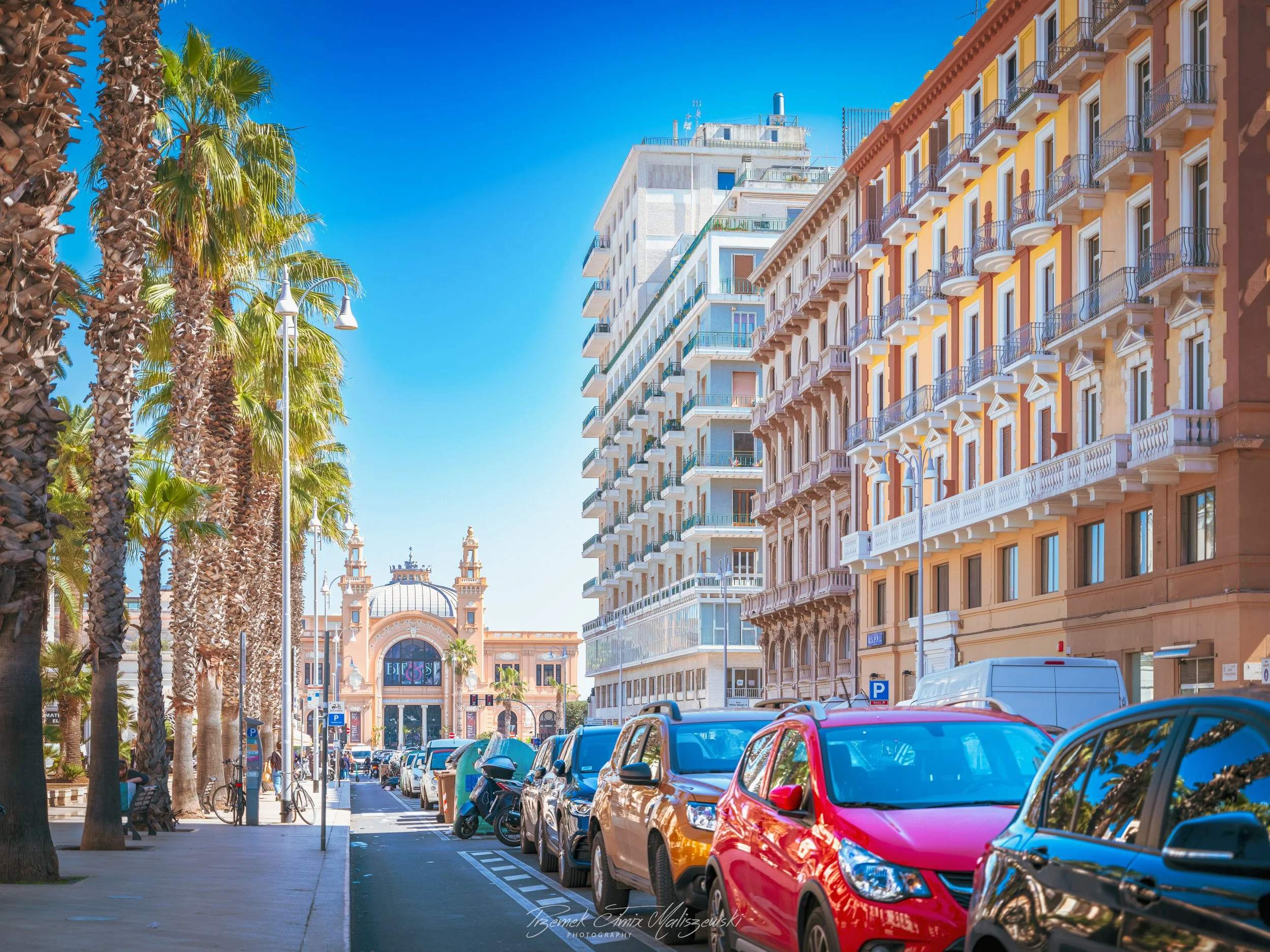
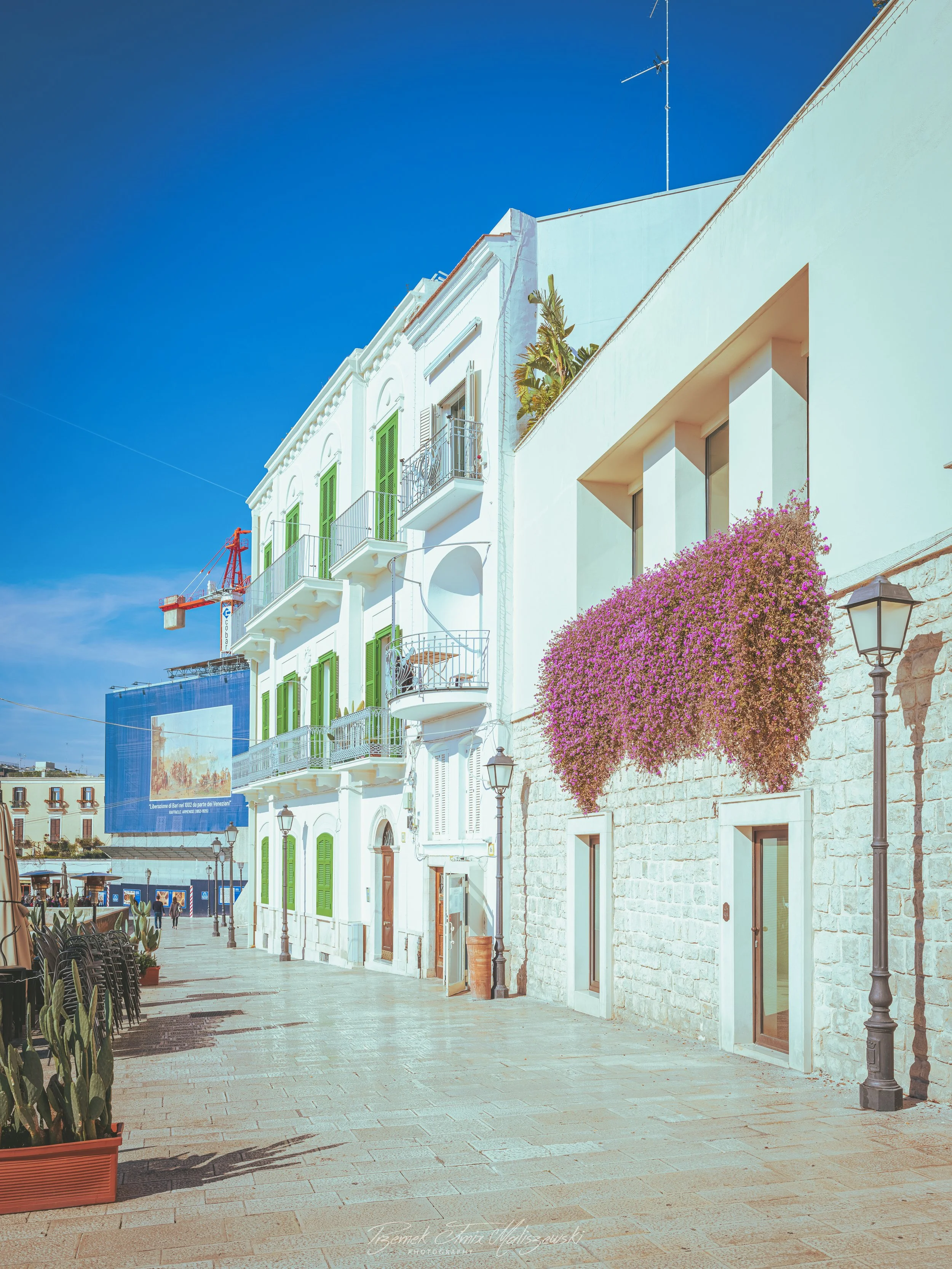
Via Venezia - a pedestrian promenade and a view of the marina, Piazza Ferrarese, Teatro Margherita, and the rising buildings of the 'new' Murat district (Borgo Murattiano).
In our Polish social consciousness, much like in the consciousness of other nations, many myths function. Interestingly, some have even seeped into schools, not as part of mythology classes, but as regular history. One such myth is that a certain Italian woman, the daughter of the Duchess of Naples and Bari, Isabella of Aragon, a certain Bona Sforza, introduced – to use modern language – so-called włoszczyzna ("italian veggies") to the market. This „włoszczyzna” reportedly included cauliflowers, artichokes, broccoli, cabbage, carrots, lettuce, and spinach, as well as oregano, rosemary, thyme, and other spices beloved by Bona. Currently, however, we know this is not entirely true.
Bari Karol Wojtyła Airport. From Warsaw's slush straight into a pleasant twenty-five degrees. Traditionally, we, "la gente del Nord", in T-shirts. The locals in jackets.
Here is the fact: on April 18, 1518, the widowed king of Poland, Sigismund Jagiellon, called the Old, marries Bona in Kraków. Thus, according to the myth, from this day onwards Poles supposedly begin to discover the abovementioned vegetables. The fact that back then, for a long time already, noble tables were bending under the weight of fatty meats, game, capons, and mead cannot be denied. But it is not as if the aforementioned vegetables and spices were introduced to Polish society only by Sigismund's new (second) Italian wife. This did not happen overnight and was not a sudden revelation.
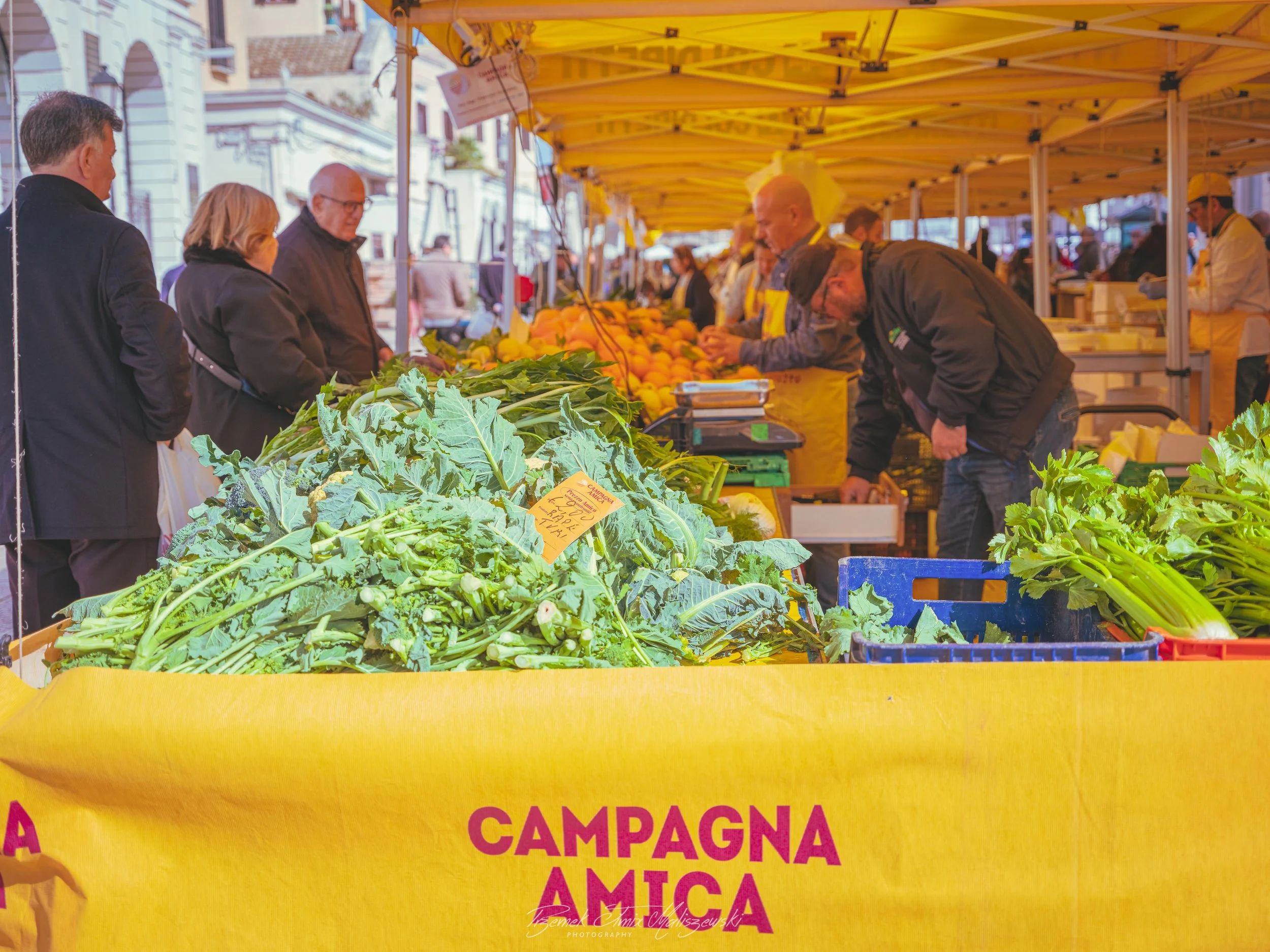
If I show Italians a photo of onions, beets, or cucumbers from my local market in Białystok, can I title it “vegepolacchi”? In the photo is the famous “włoszczyzna” (Italian veggies) – in Italy, of course.
Not all, true, but many of those living at the time knew foreign – let's call them – food products. We must remember that in those days many people traveled to Southern Europe, whether to study or on business. Many representatives of Polish noble families went to Italy for their education. Moreover, a doctorate could be obtained, for an appropriate fee, in places like Rome in two weeks time, which many took advantage of. There were intense business contacts between the two countries, and several hundred Italians were already living in Kraków alone. Many people were very mobile for those times, with broad horizons and equally broad connections.
Lungomare Imperatore Augusto - Emperor Augustus Promenade
There was already a fairly intensive cooperation between people from the north and those from the south, so it is hard to believe that culture, customs, fashion, and culinary arts did not trickle from the south onto our soil. In other words: it’s not just me and my missus who have been bringing artichokes and guanciale from Southern European travels; people back then simply must have brought something back with them from time to time as well. And this long before Bona Sforza not only became Queen of Poland, but even heard about our country at all.
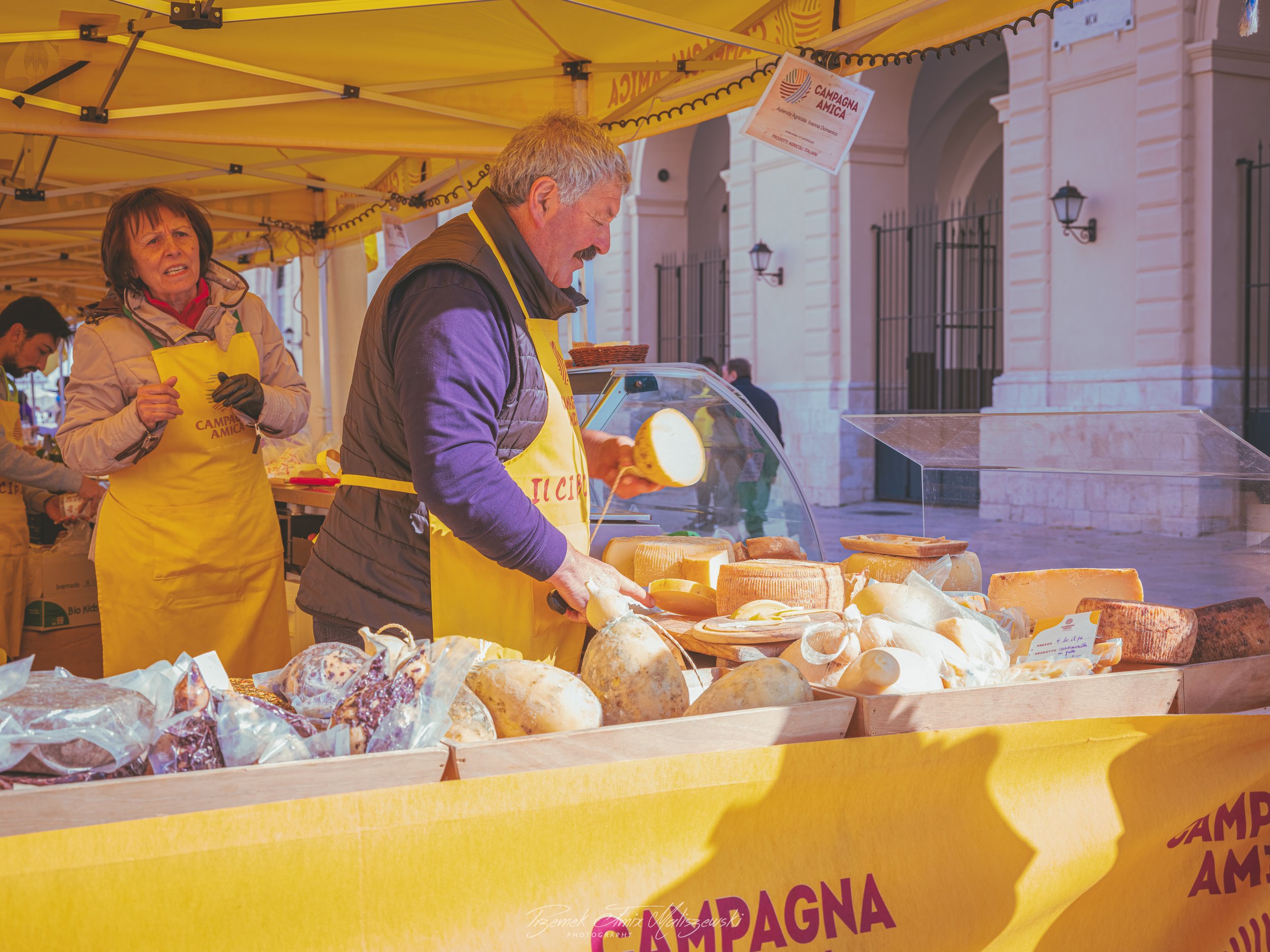
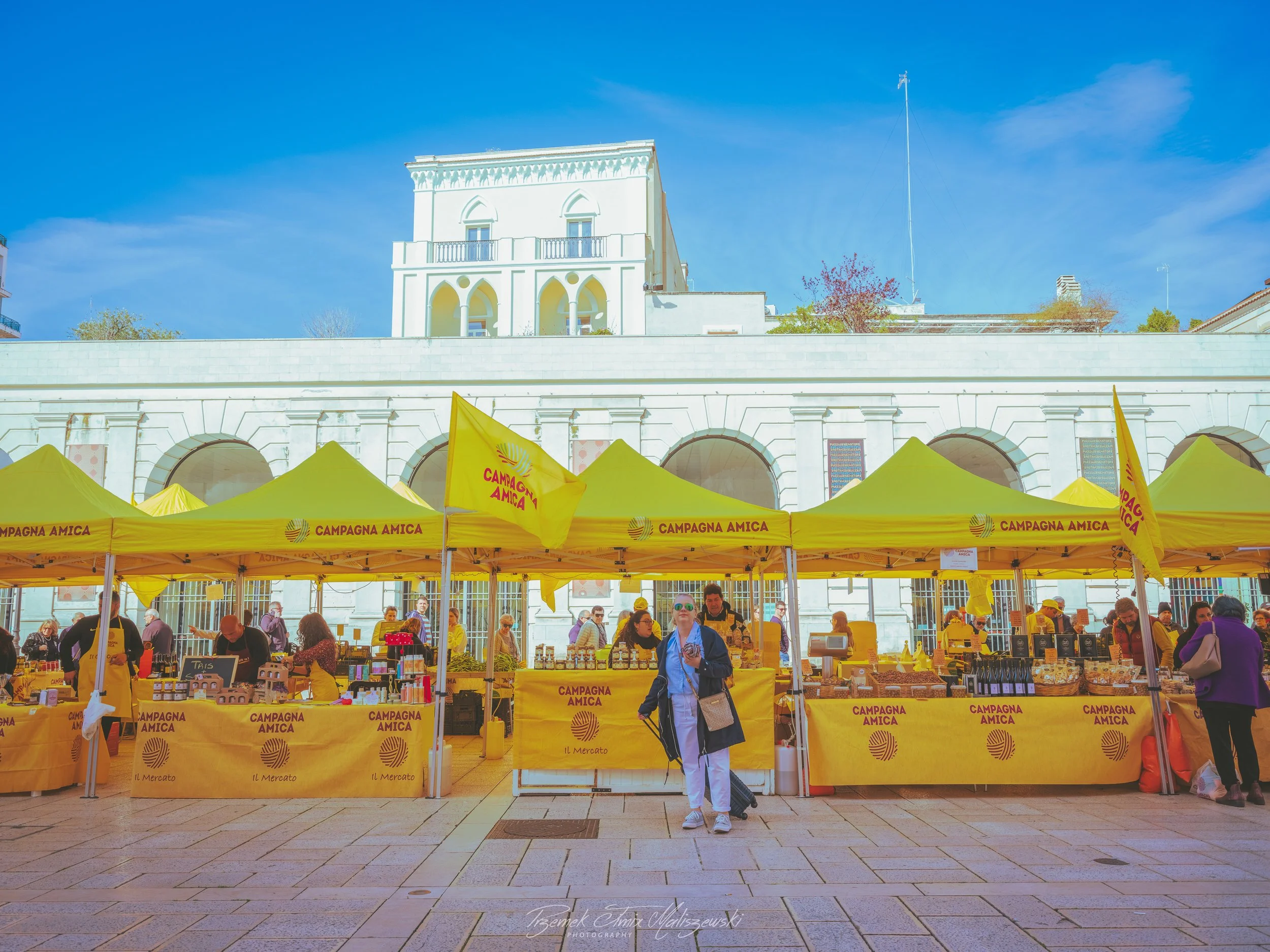
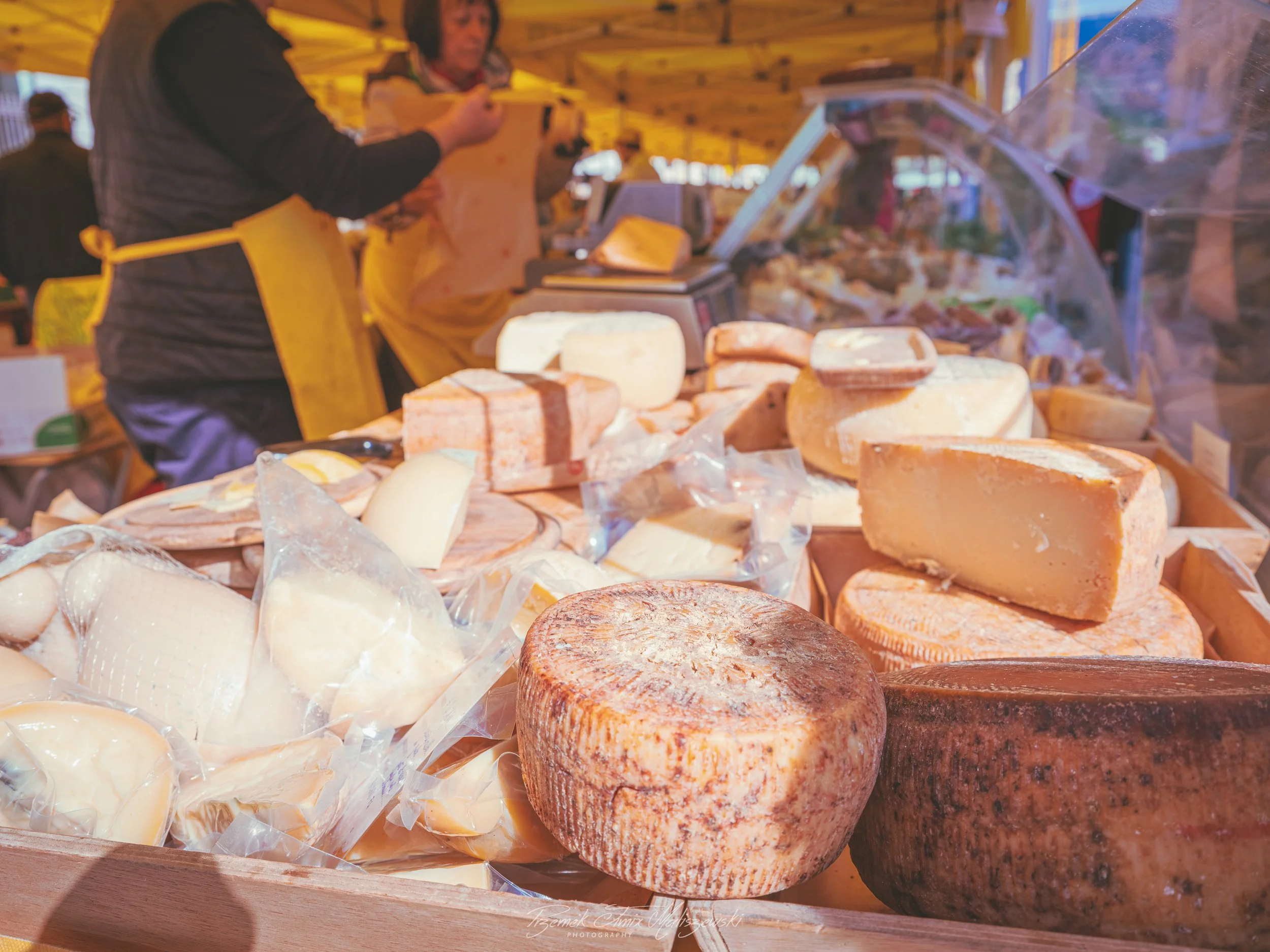
Bona did not so much „bring” the "new" vegetables to Poland as popularized them. And not just the veggies. Also drinks, more precisely wines. It was during her reign that wine consumption in Poland grew, and she herself established and expanded vineyards in Mazovia, mainly on the slopes of the Castle Hill in Czersk and around Gostynin. She imported grapevine cuttings directly from her native Italy for them. It is true that for her own and her court's use she imported a multitude of goods, vegetables, fruits, and spices from her homeland, just as it is true that despite this natural propagation of Italian cuisine and cooking techniques, Poles still preferred to eat what had been eaten for hundreds of years. This is vividly shown by the court cuisine of Bona and Sigismund. Bona believed that one should eat less and better, which in her case also meant more expensively. The preserved accounts of the royal court present specific figures. The queen's court and the king's court were culinarily two polar opposites. An account from 1539 shows the amount of 6,429 florins, representing the costs of ingredients and kitchen maintenance with staff incurred by the queen's court, whereas in the king's case, this amount was 4,065 florins.
Contemporary Polish courtiers did not harbor any excessive sympathy for Italian cuisine. This cuisine was commonly mocked, with claims that Italians ate sparsely. They did not remain indebted and were disgusted by Polish gluttony and drunkenness. The Polish common folk did not suddenly start eating so-called "włoszczyzna" or including it to any significantly greater extent in their daily diet. It is simply a myth. No one, and certainly not Queen Bona, „taught” anyone to eat vegetables and fruits imported from southern Europe. No one taught anyone new and more extravagant culinary techniques. In the Poland of Sigismund the Old, people ate too much, too heavily, and too greasy (as they do today, unfotunately).
Corso Vittorio Emanuele II.
The fact that Bona imported food products from Italy to her own court should not be surprising, especially on a simple, human level. Cuisine is not only a testimony of culture, it not only manages to bring people together at one table, but it is also one of the strongest anchors of national mentality and cultural belonging. Longing for home regions while abroad or being in emigration, we usually value the dishes of our homeland's cuisine exceptionally strongly. Bona, as we must remember, was also a representative of the upper class, the social elite of contemporary Italy; she was, after all, a duchess and a queen. Her daily menu was obviously more complex than the menu of cucina povera – the poor cuisine of ordinary people – and her palate was much more refined than the palate of the common folk.
It is no surprise then that, having the means, she imported from her homeland what she needed, what she fancied, and what, according to her, should have found a place on courtly, especially representative tables. Perhaps (this must also be taken into account) a specific flaunting of foreignness also served the purpose of showing a certain kind of superiority over what she treated as more primitive. However, it is known that her revolutionary for the times approach to culinary arts, of which she was a huge lover, did not meet with the understanding and acceptance she might have expected.
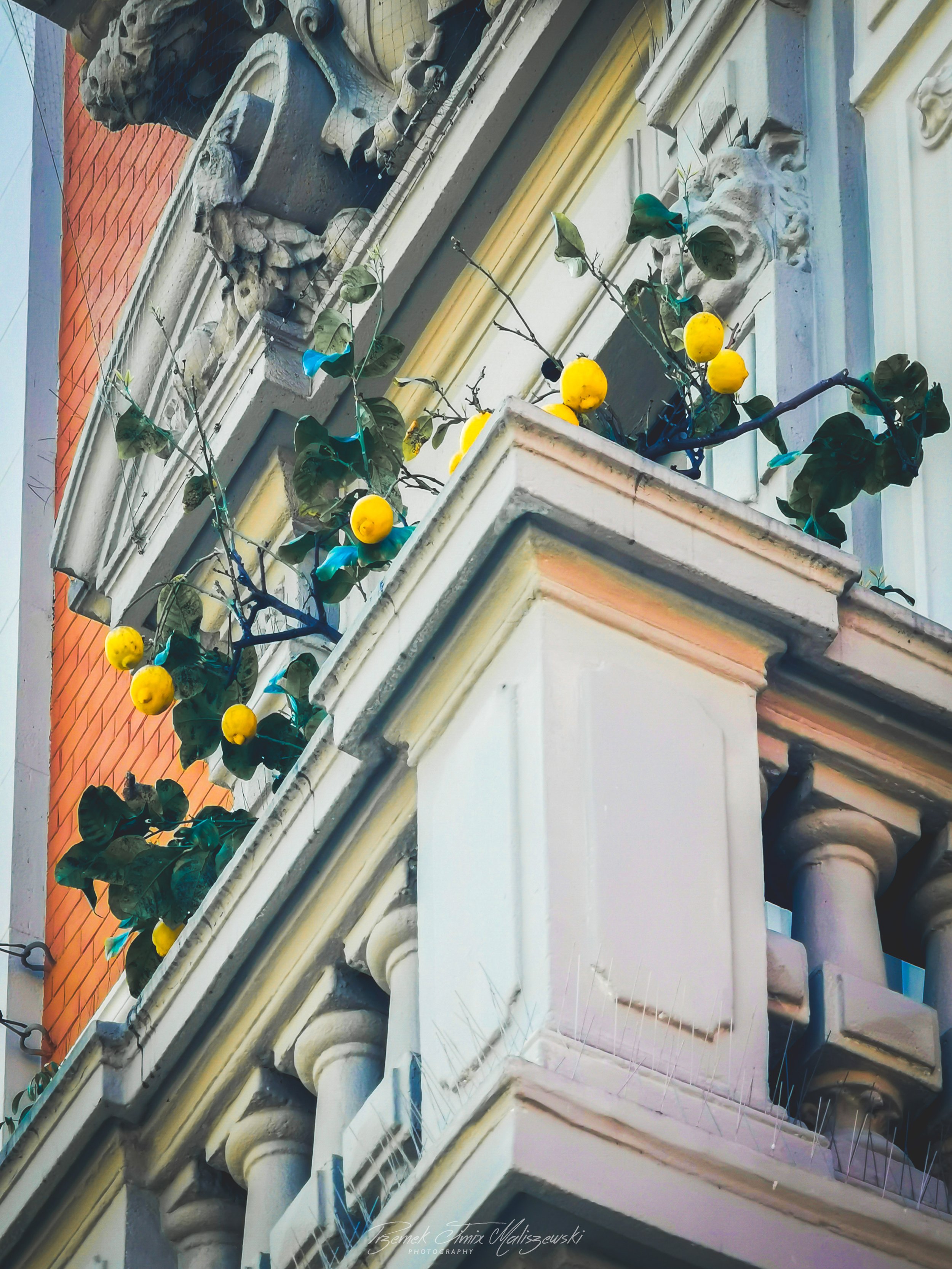
And completely apart from culinary matters, imagine that we once had a queen from Italy: Bona of the House of Sforza (born February 2, 1494, died November 19, 1557) – who was also Queen of Poland in the years 1518–1548, wife of Sigismund the Old and mother of, among others, Sigismund Augustus, descendant of the Aragonese dynasty ruling Naples.
What is more, our country at the time, thanks to the reigning Polish-Italian royal couple, was in a sense formally like a sovereign of both of Bona's duchies: Bari and Rossano. It is a bit like having your own colonies in today's Puglia. On May 22, 1526, a delegation from Rossano even swore an oath of allegiance before Sigismund and Bona in Wawel Cathedral.
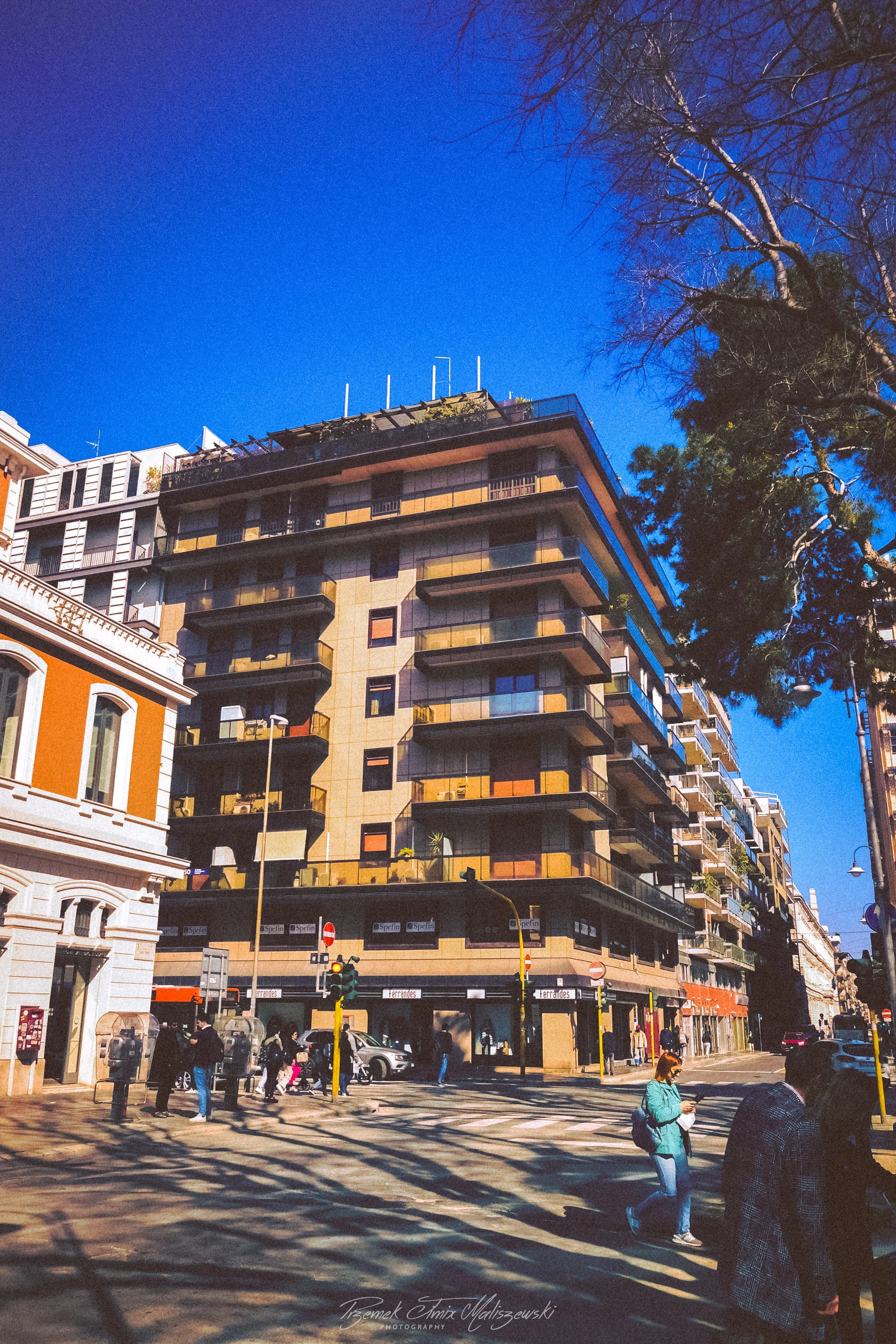
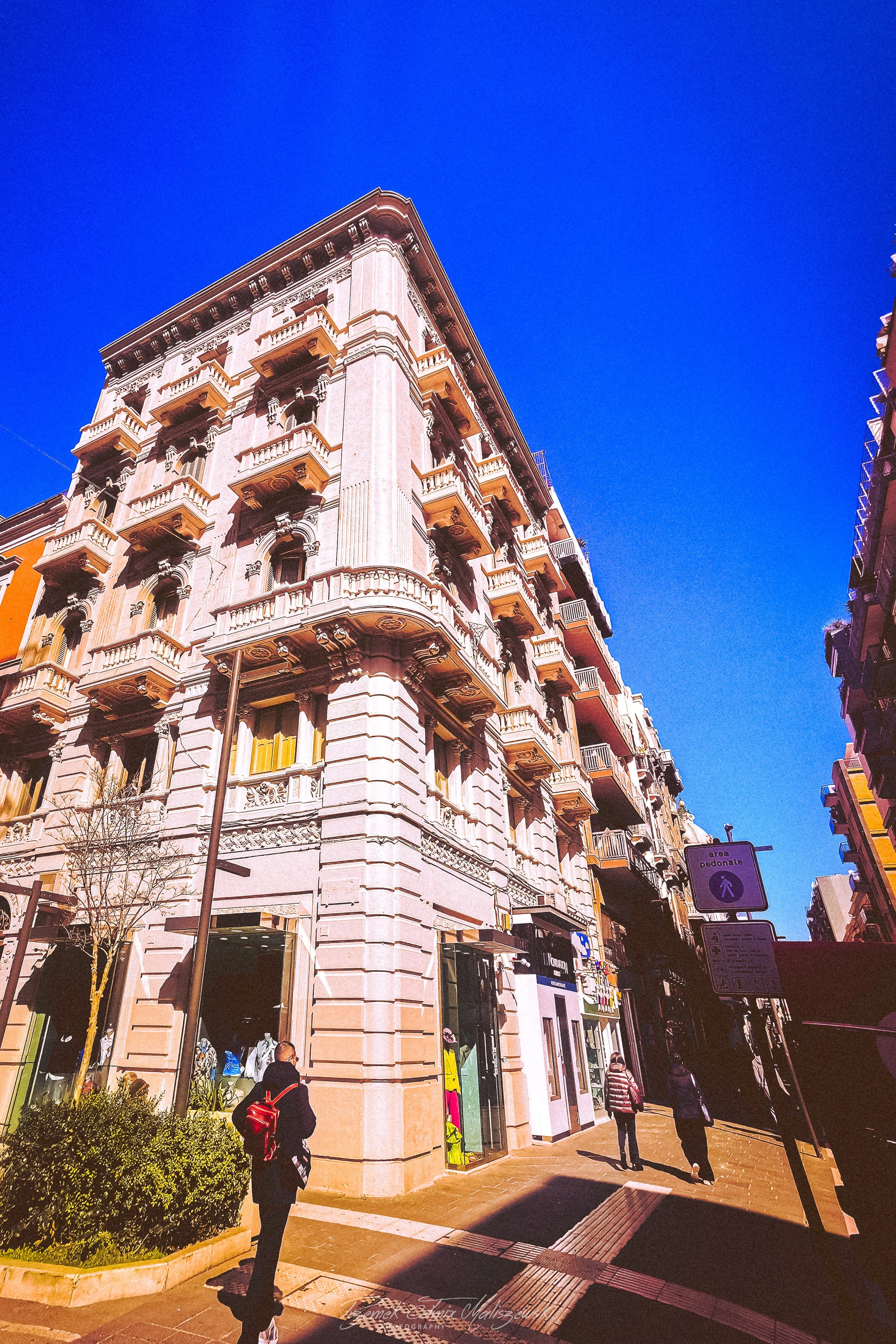
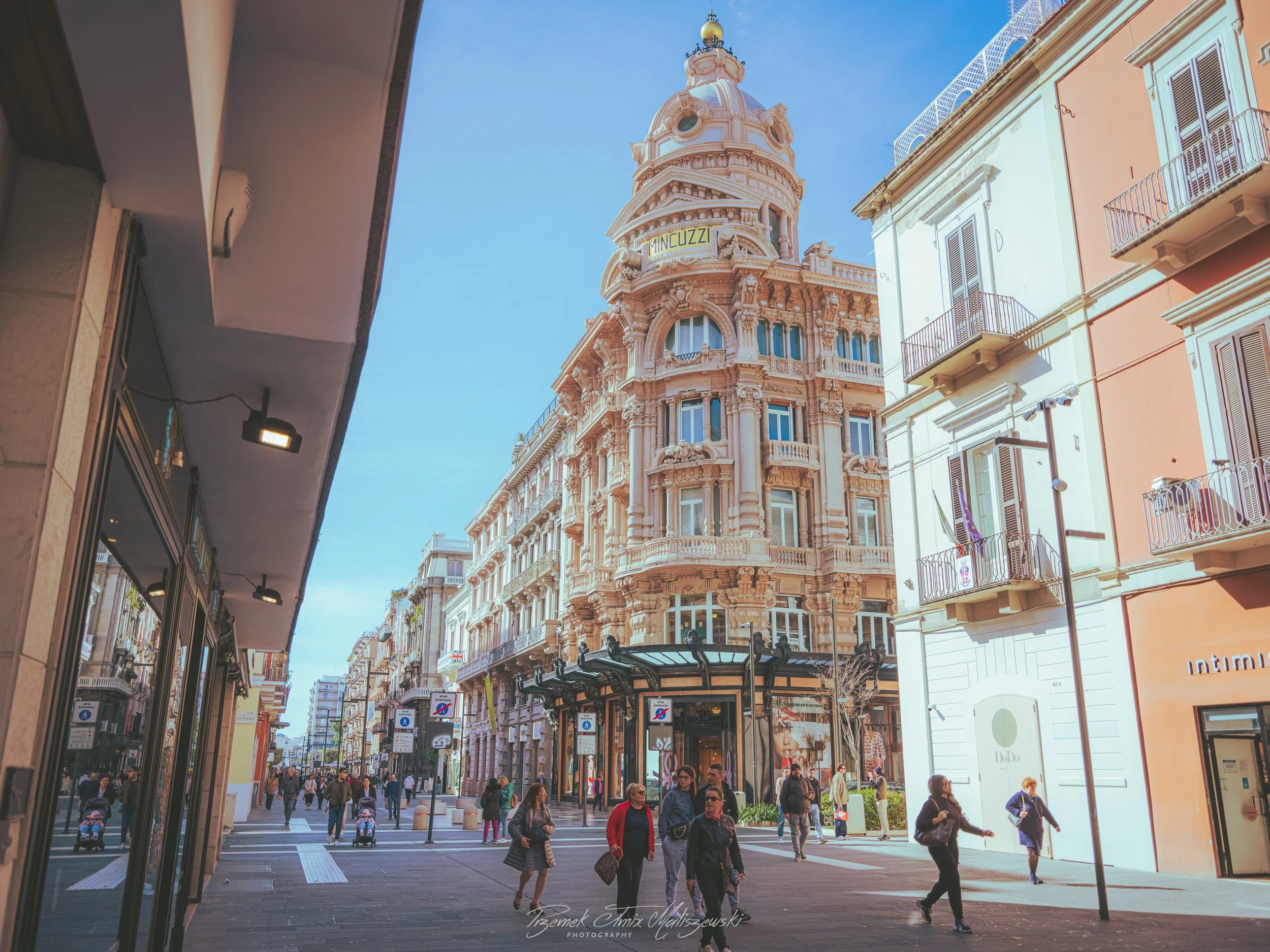
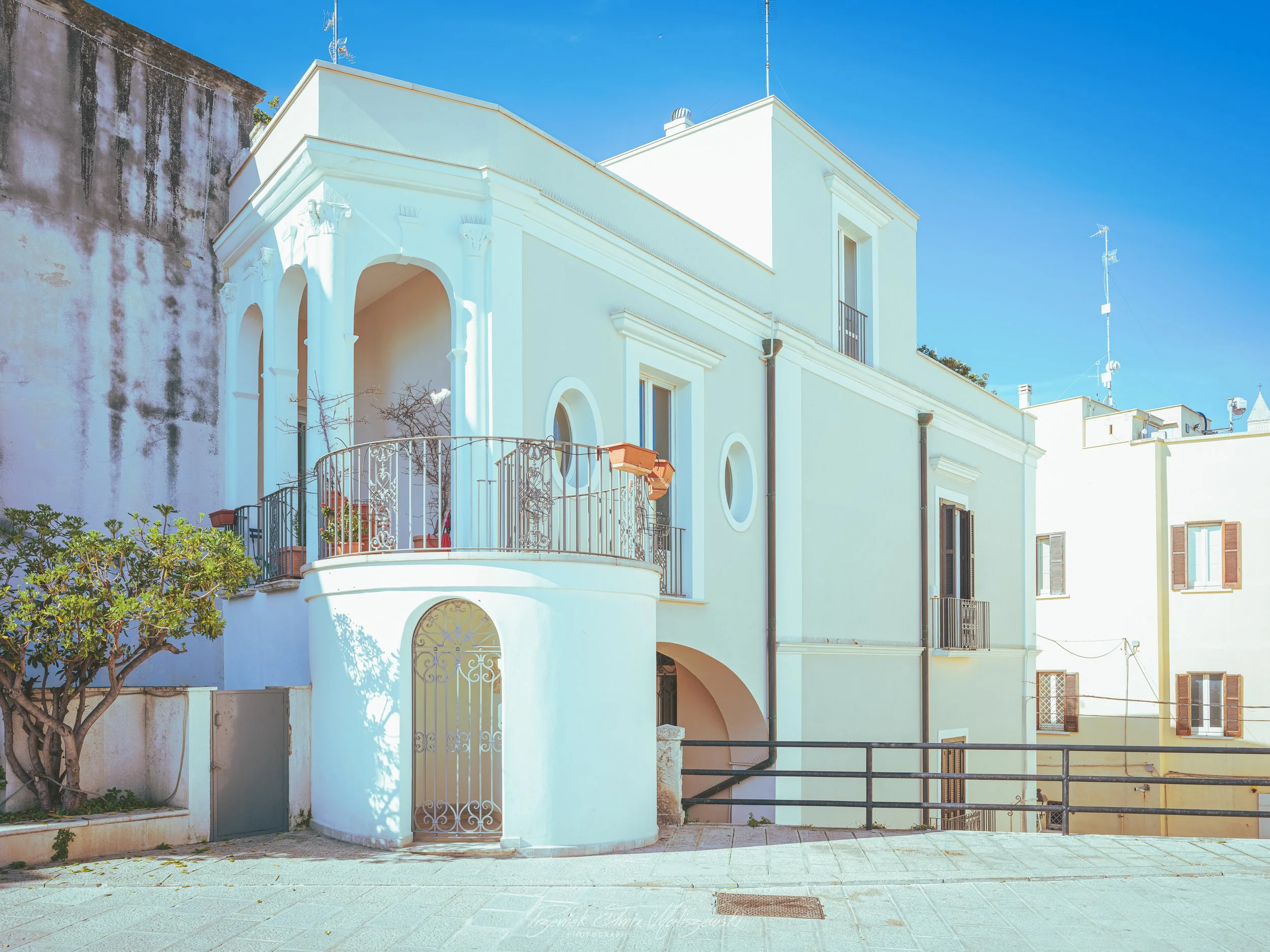
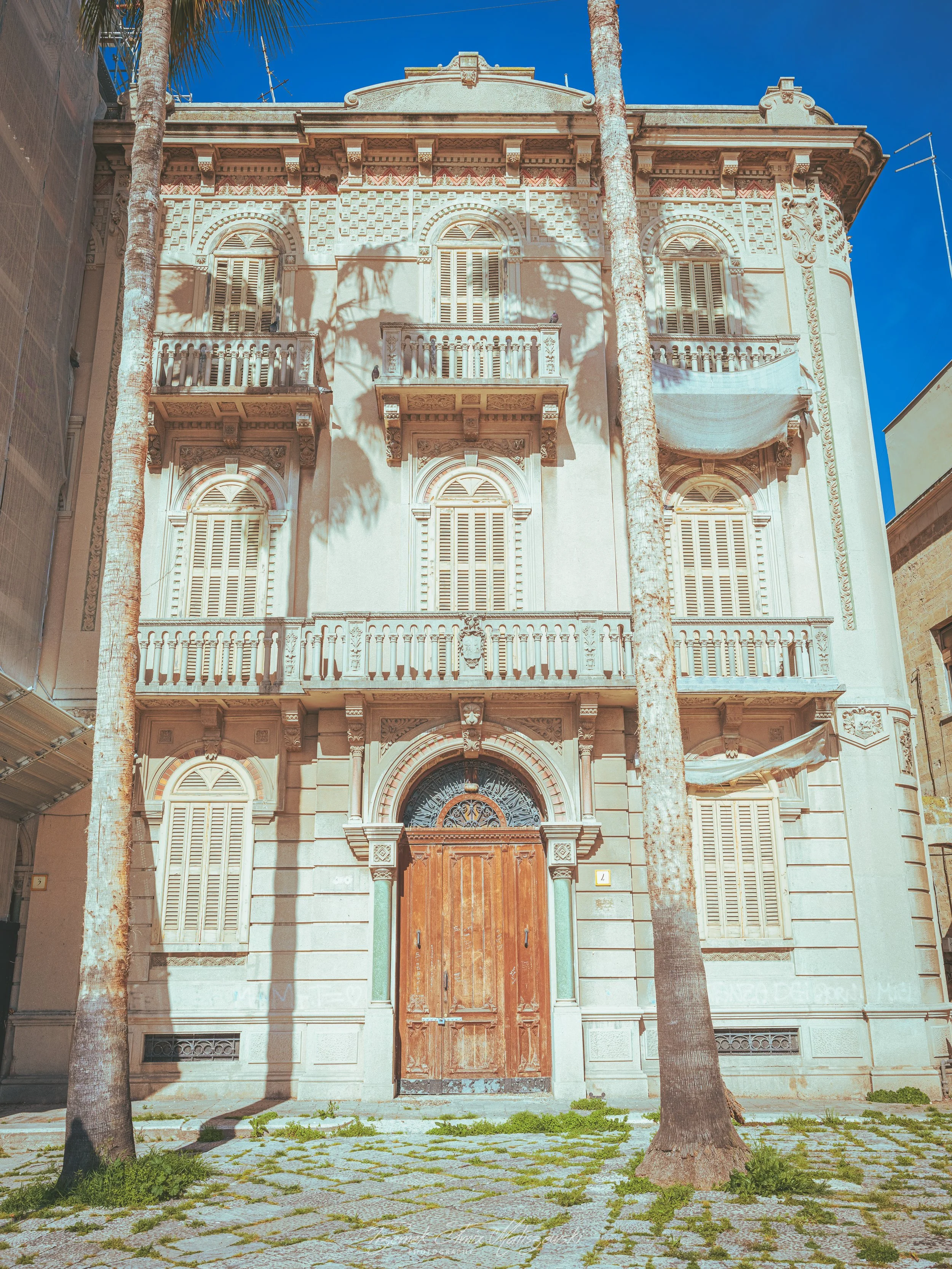
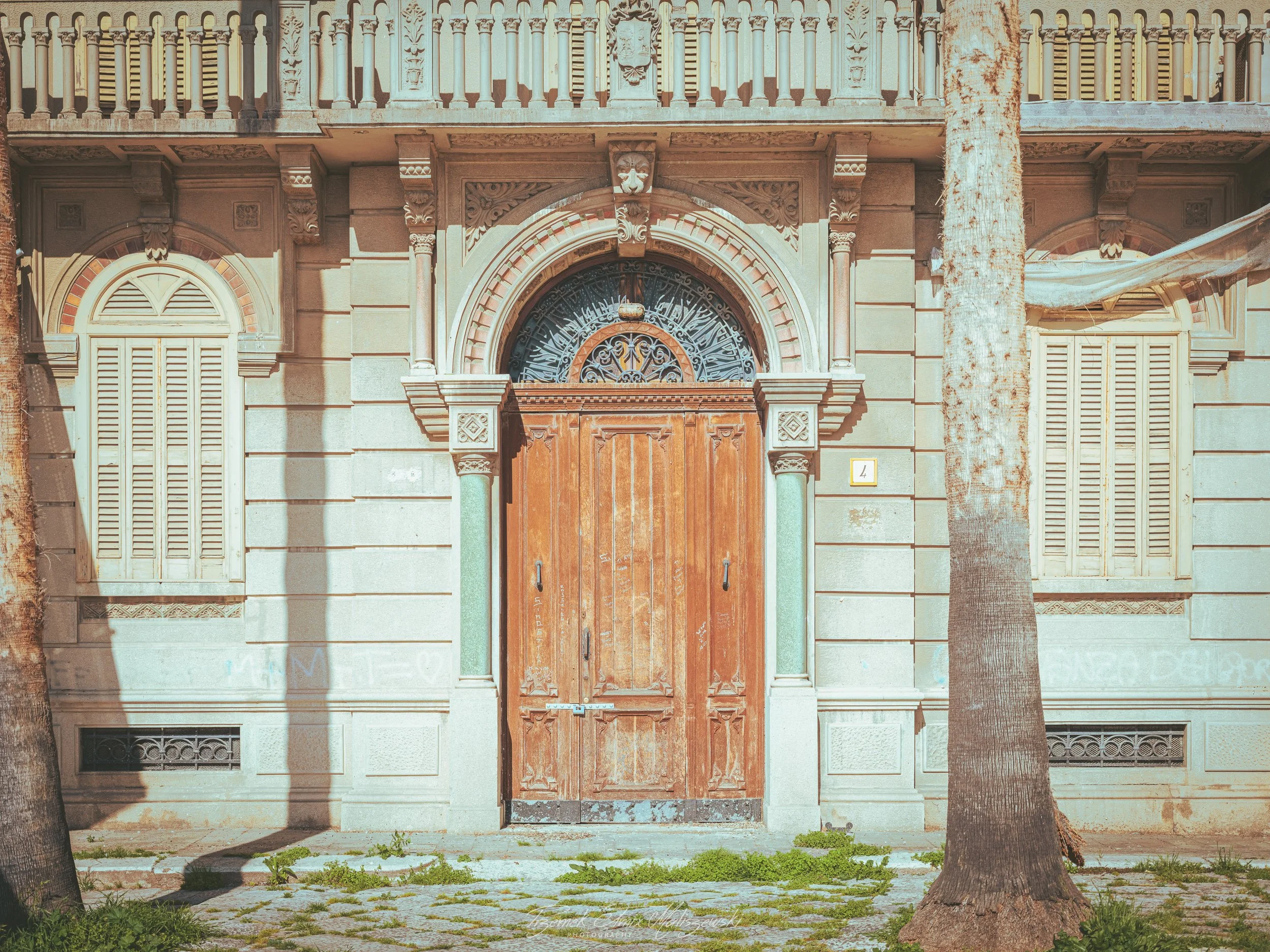
The intricate Art Nouveau of Palazzo Mincuzzi (1928) on Via Nicolo Putignani, in the 'new' Murat district.
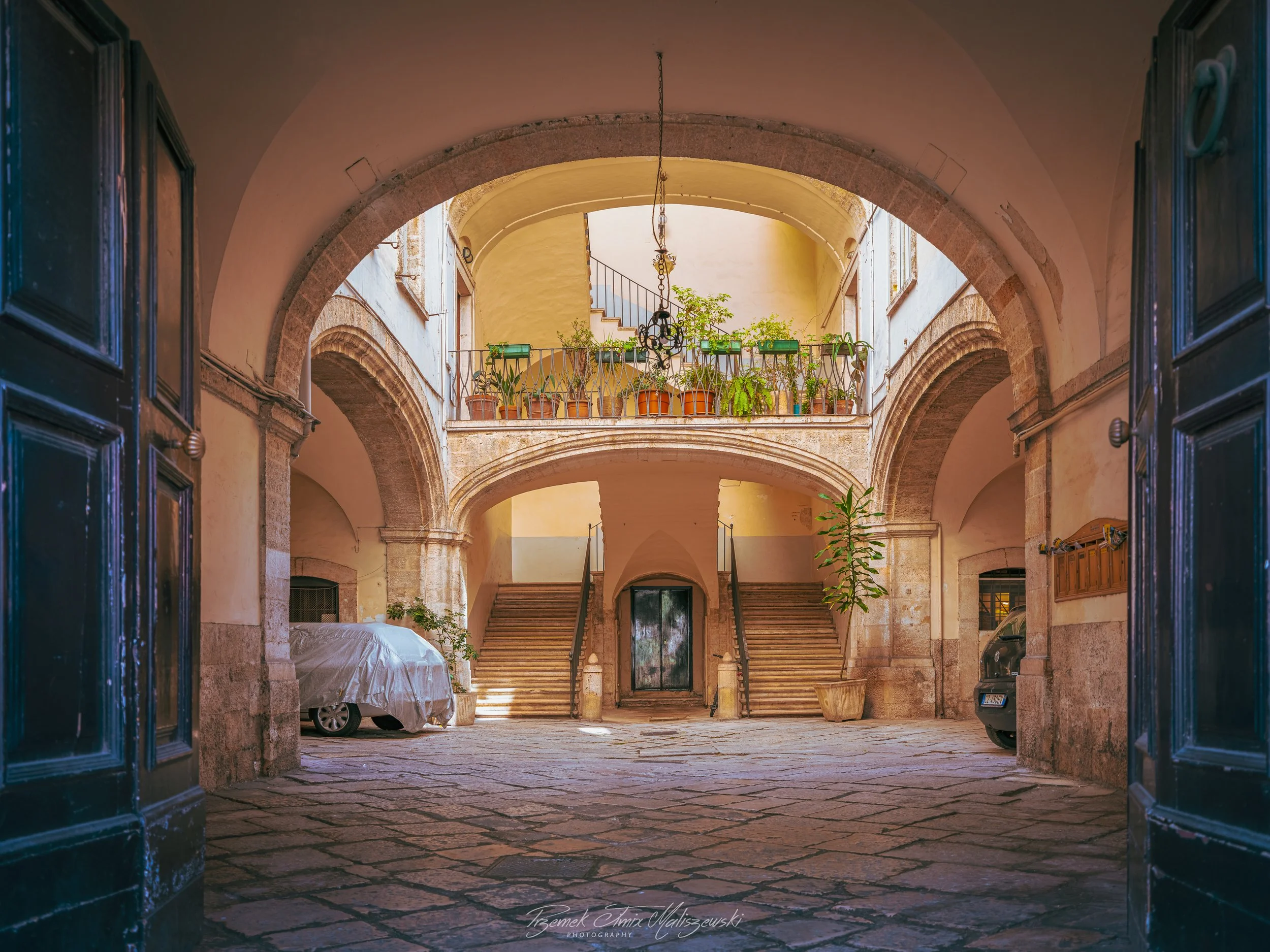
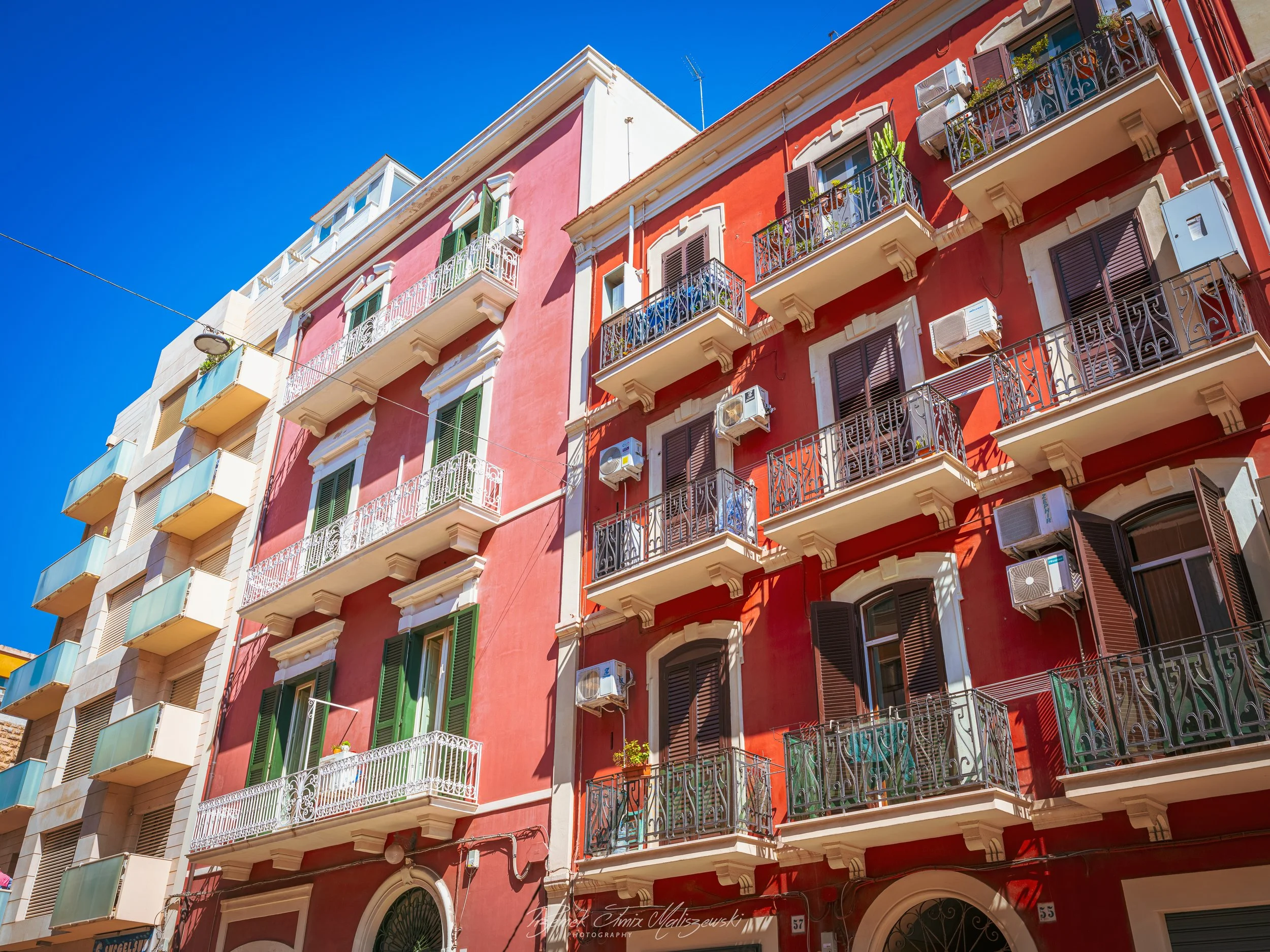
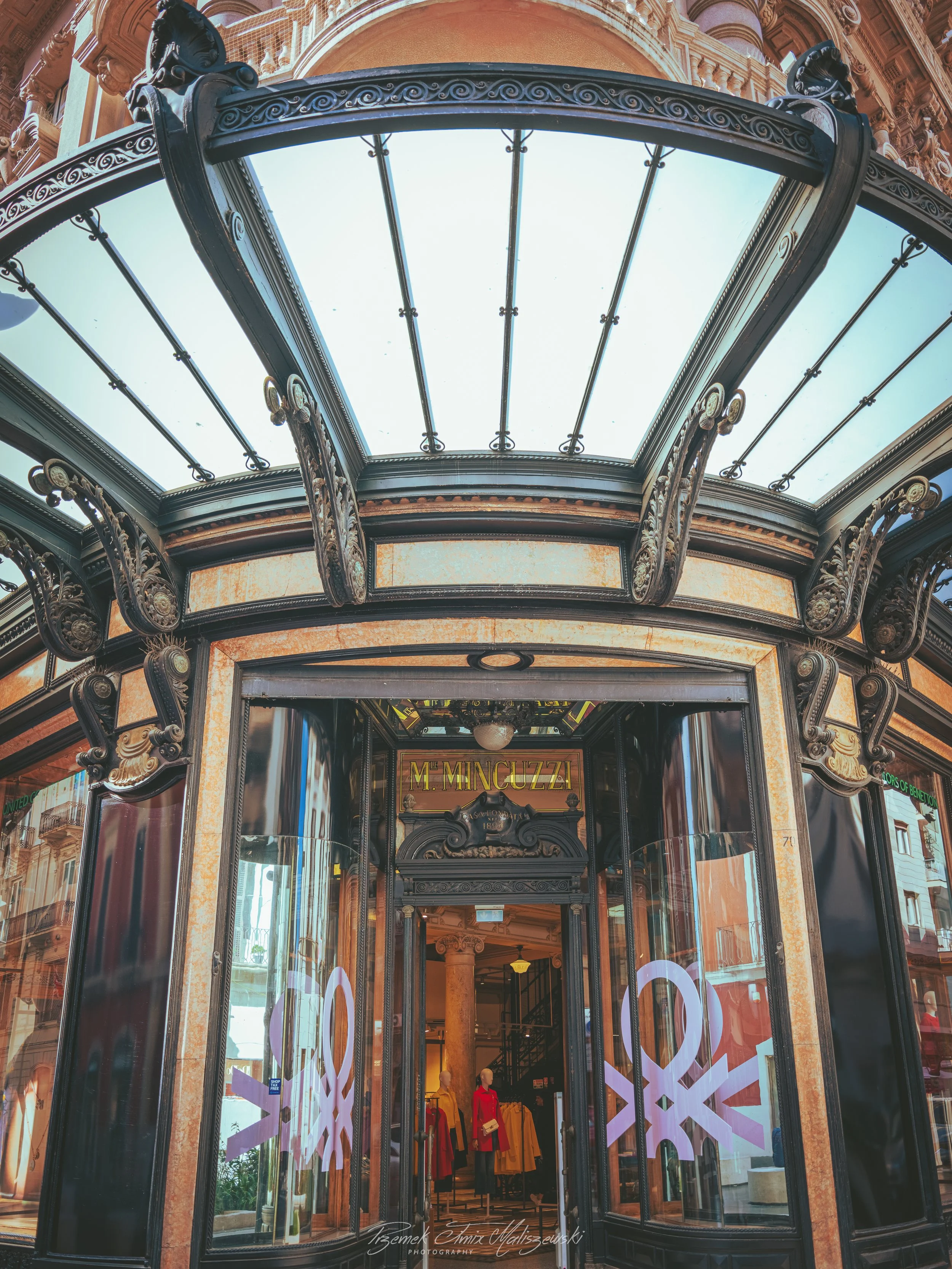
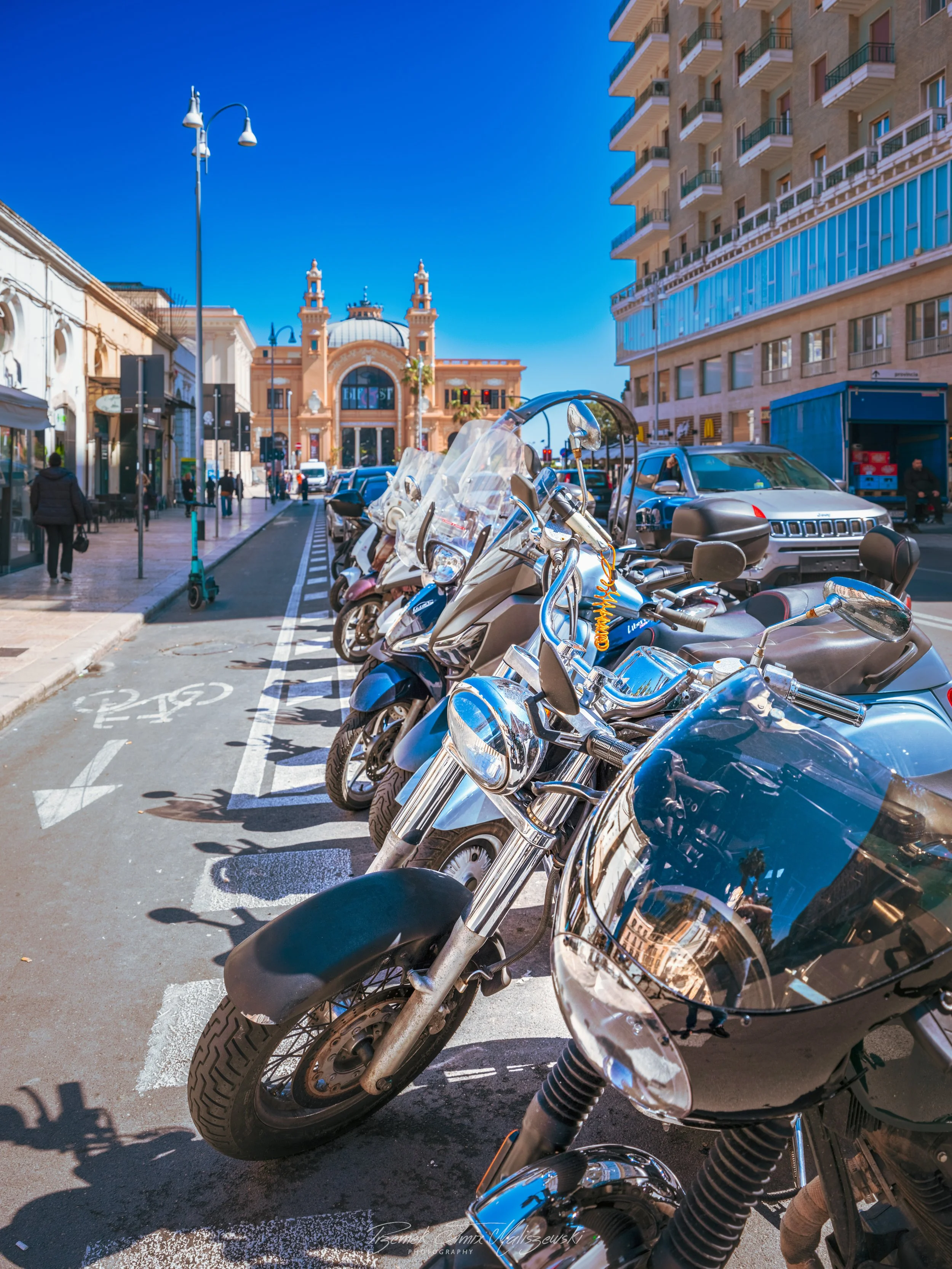
I have already mentioned that relations between contemporary Poland and Italy were strong, and in Kraków itself, right next to the royal couple, one might say, a fairly large Italian diaspora existed. One of its members was the lawyer Vincenzo Massilio, living in contemporary Kraków at the time, who, on Bona's orders, created the customary law code of Bari. Bona thus stayed in Poland, carrying out the duties of the Polish monarch, but she still had to manage her possessions in her homeland, even if this management took place at a distance and through proxies.
According to the will drawn up by Bona, her son, Sigismund Augustus, became the heir to the duchies of Bari and Rossano. Bari, as a city and also a duchy, was actually under Bona's rule during her lifetime, but after her death, despite the aforementioned will, the Polish side was nevertheless unable to regain full control over the Italian possessions.
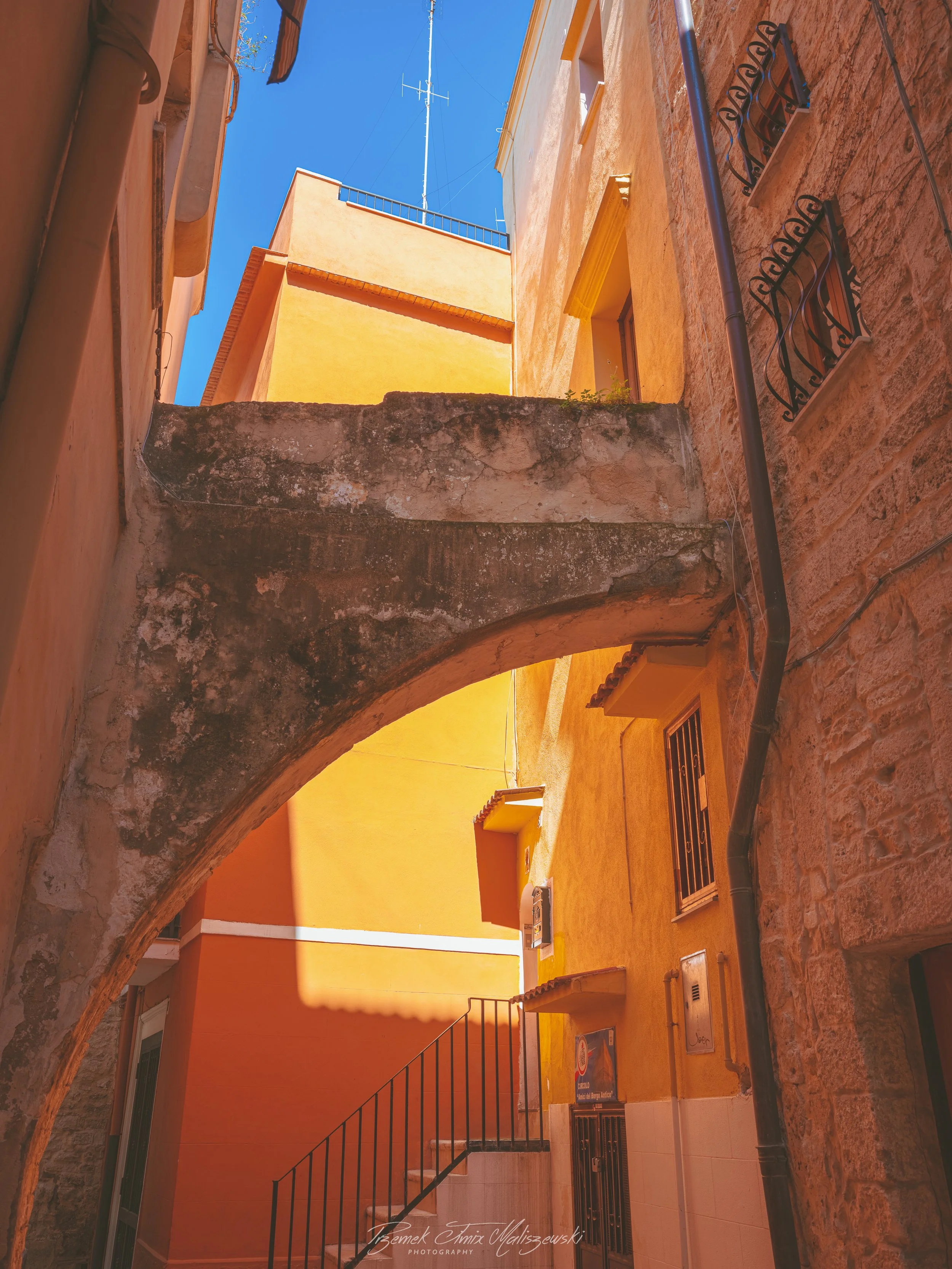
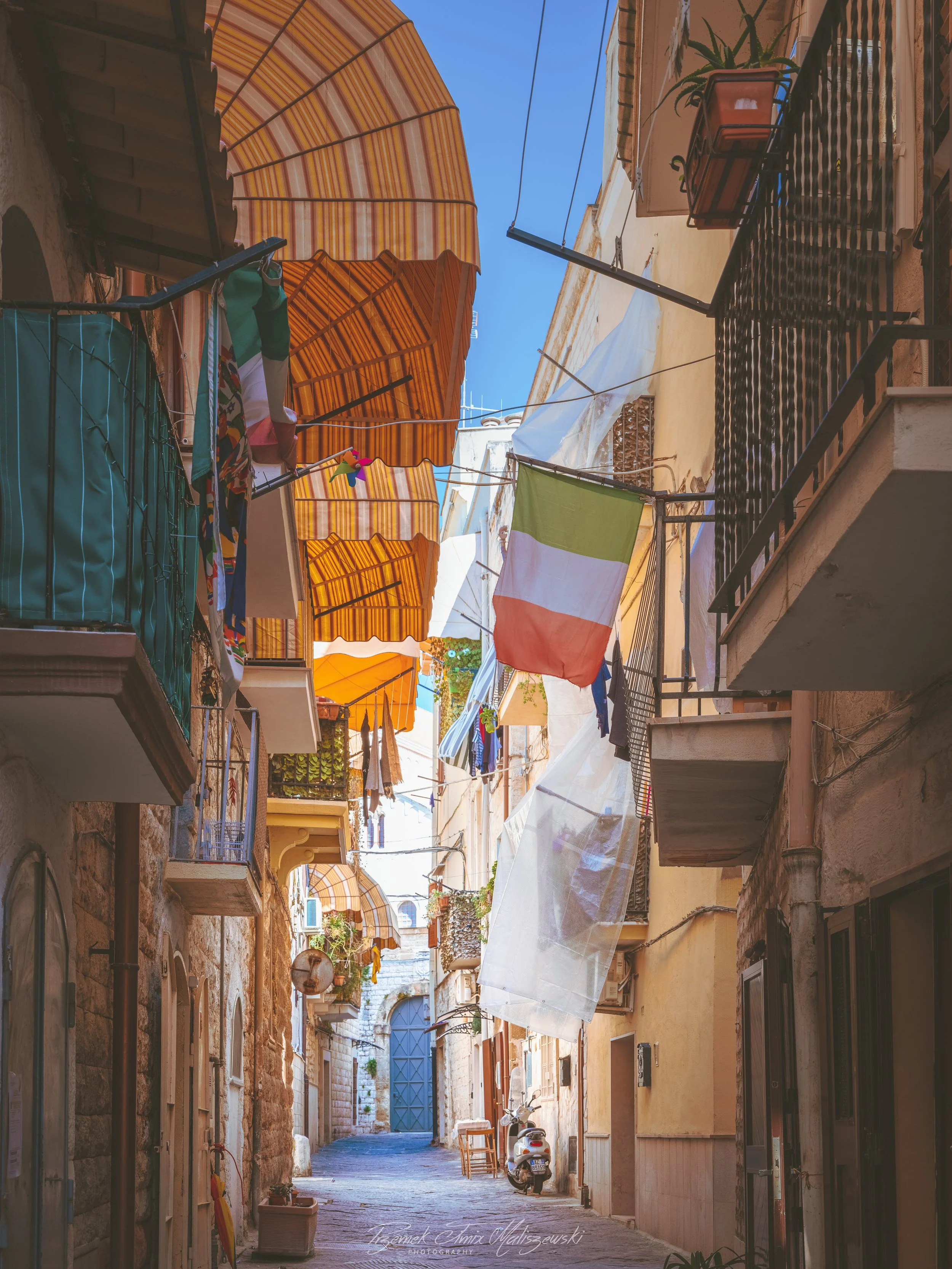
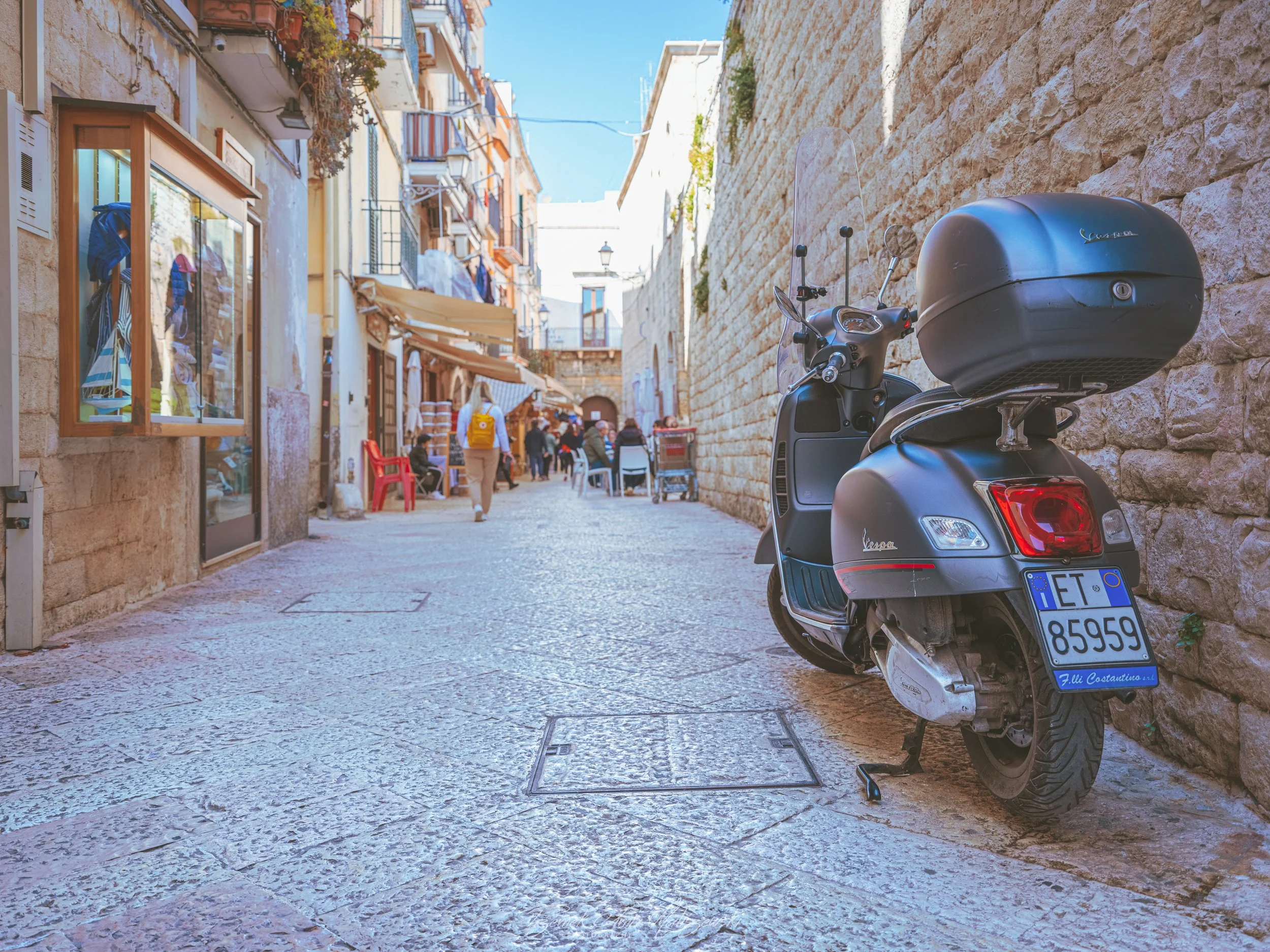
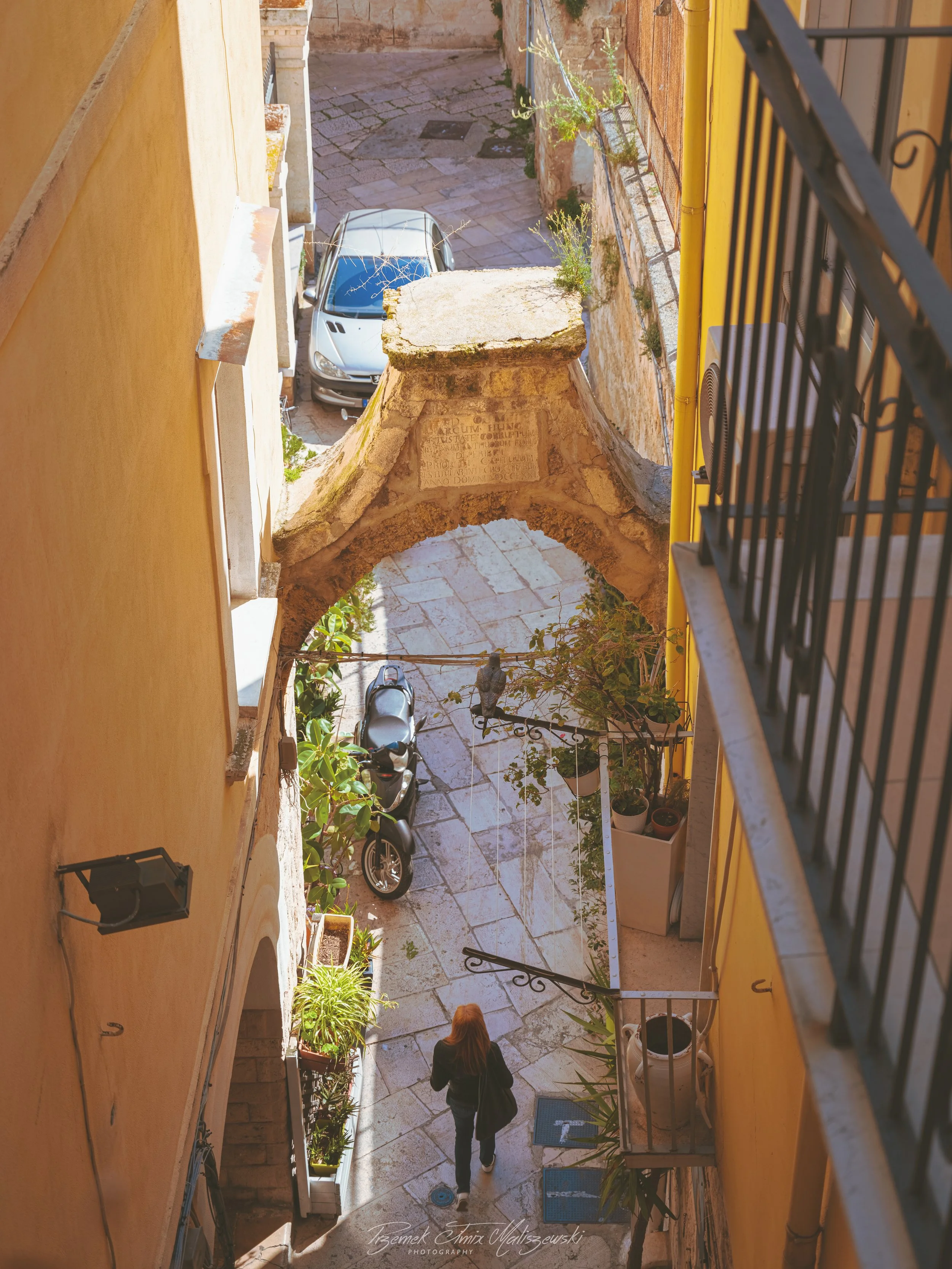
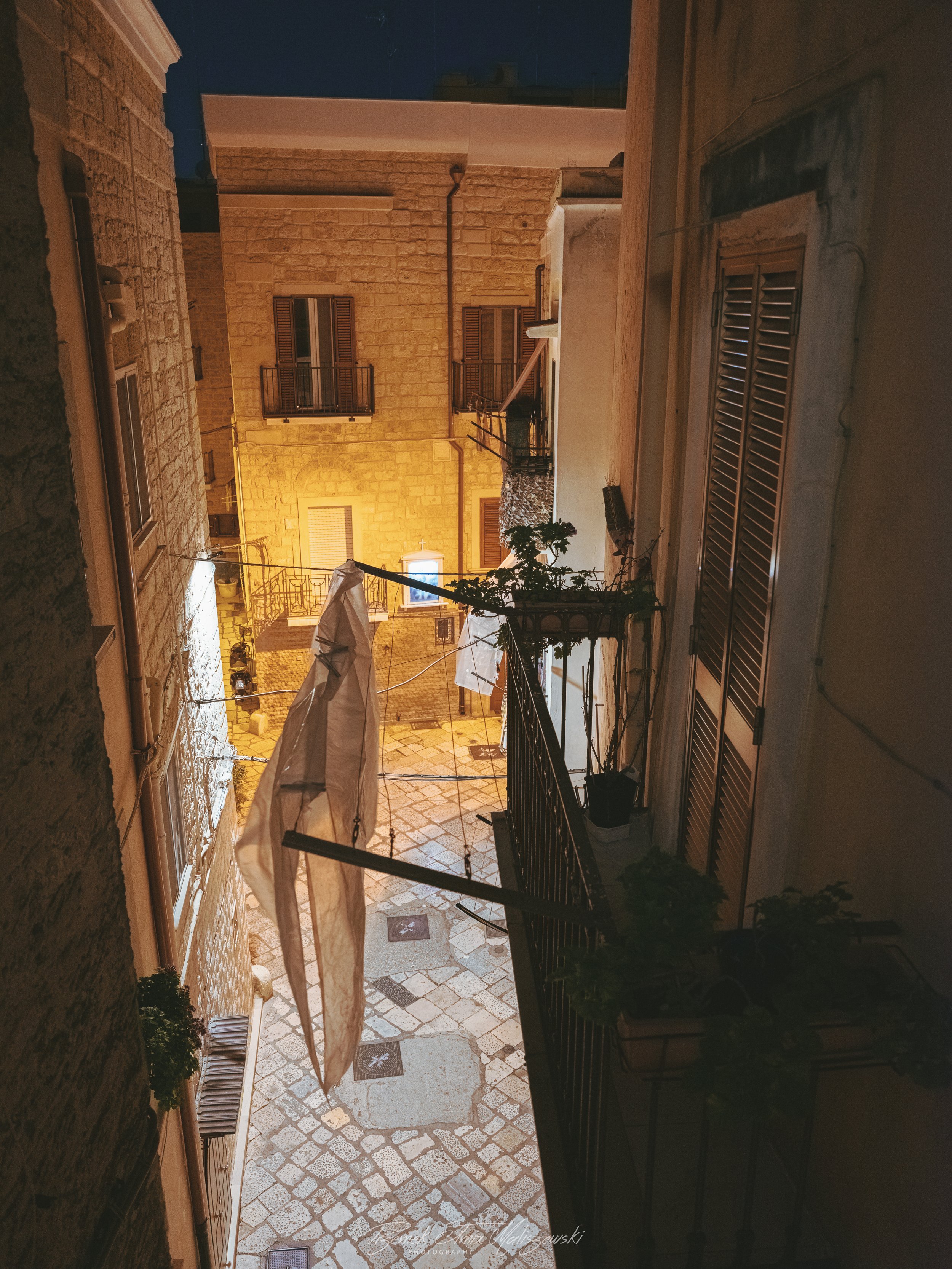
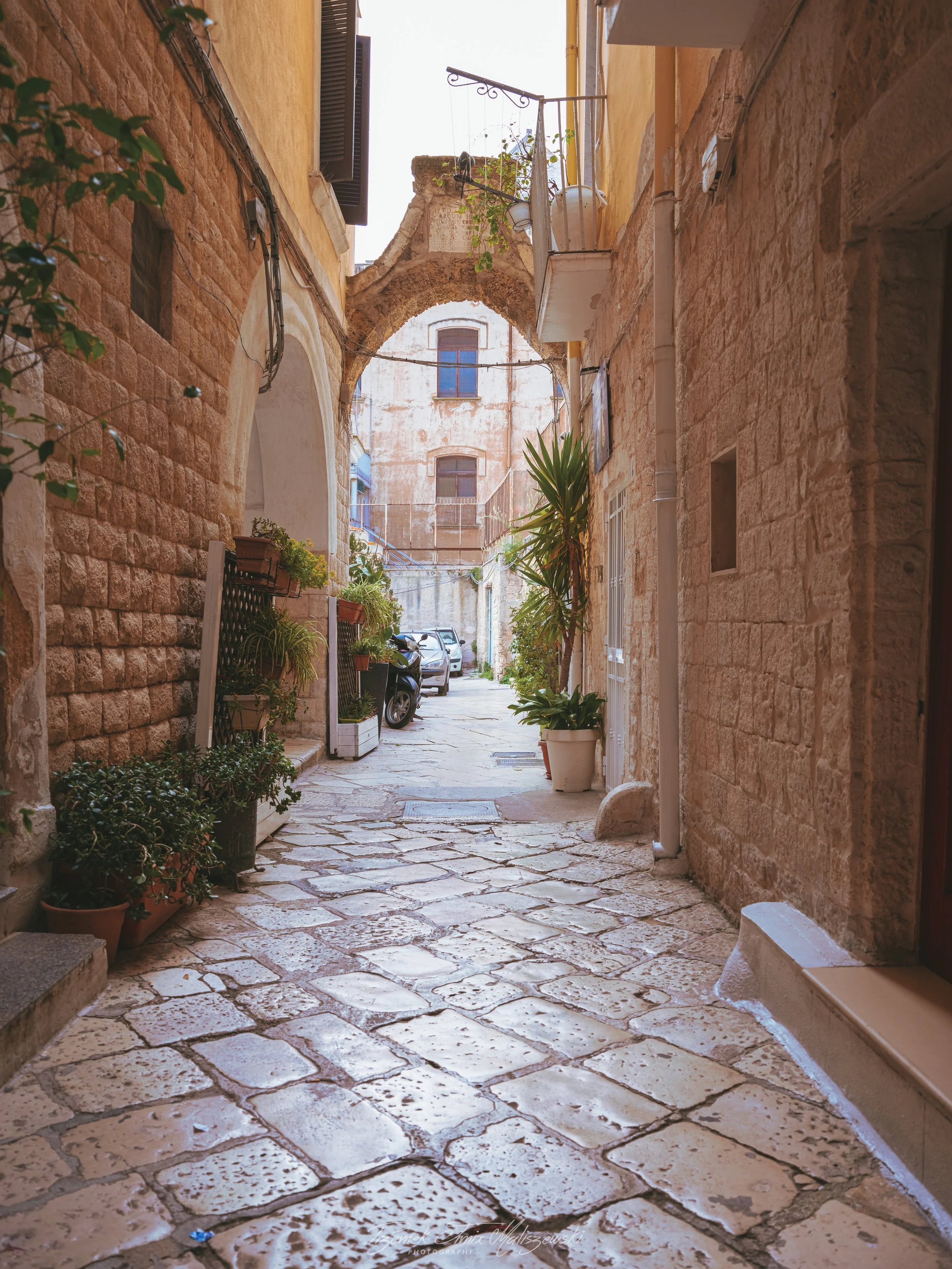
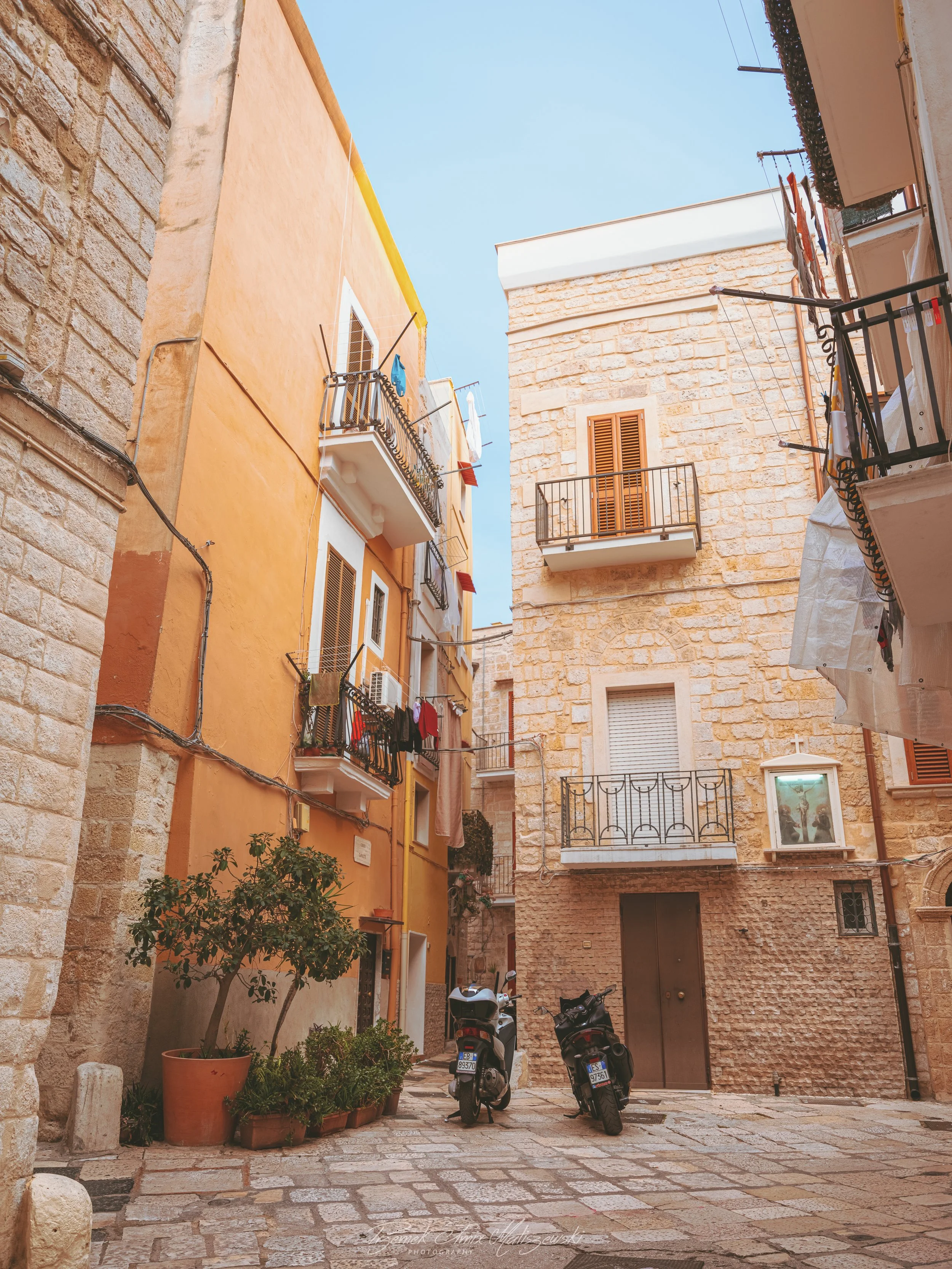
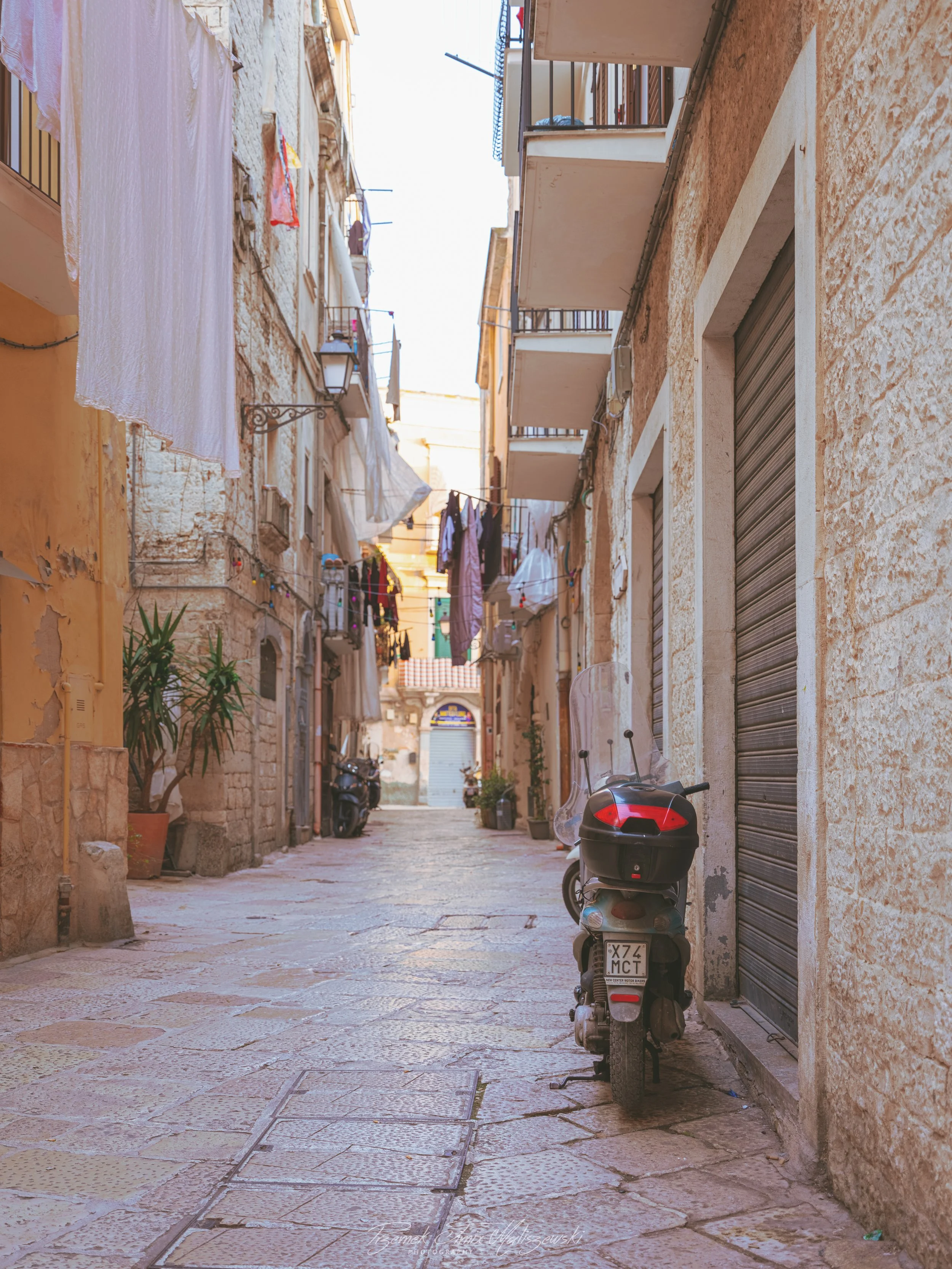
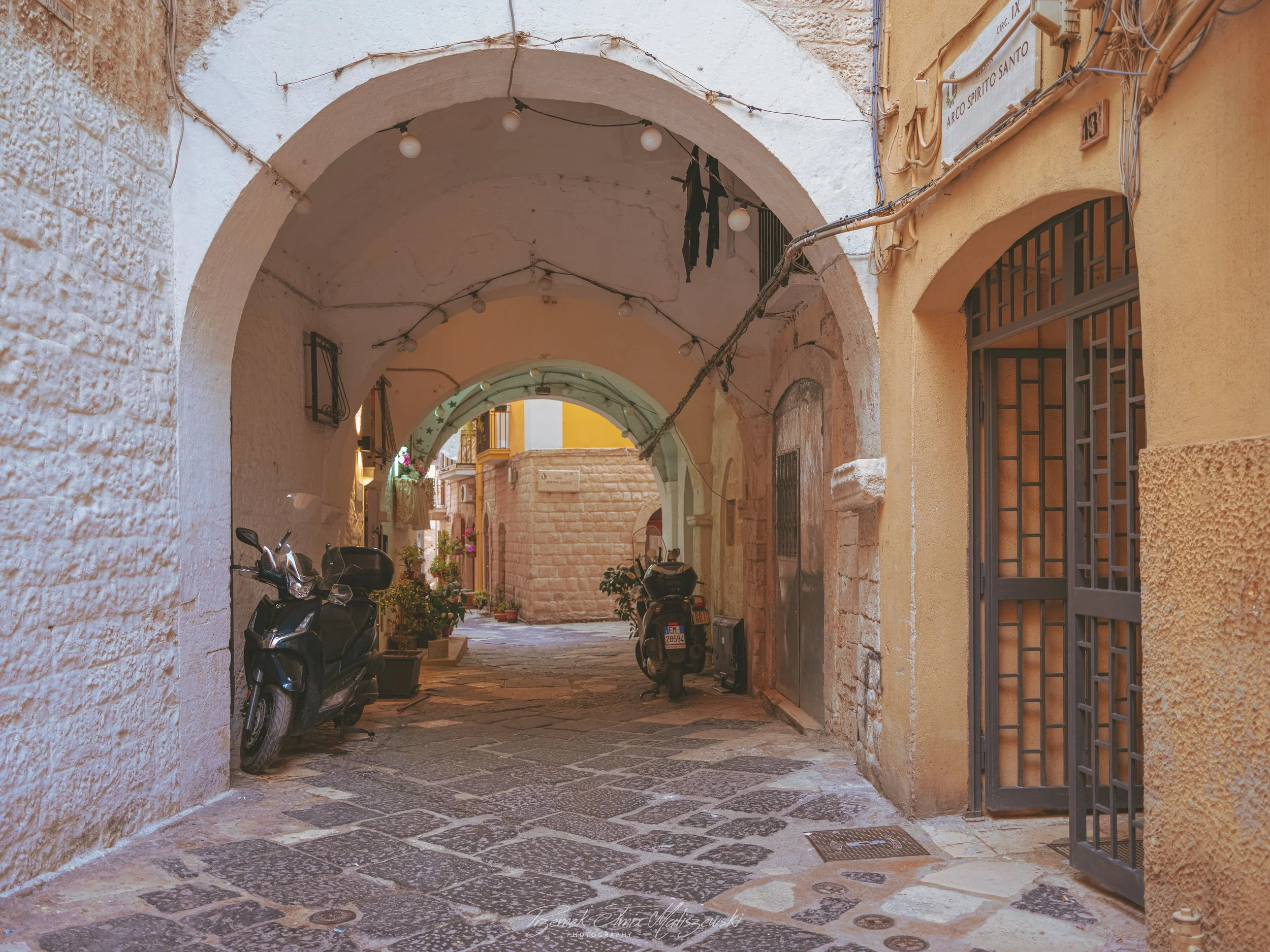
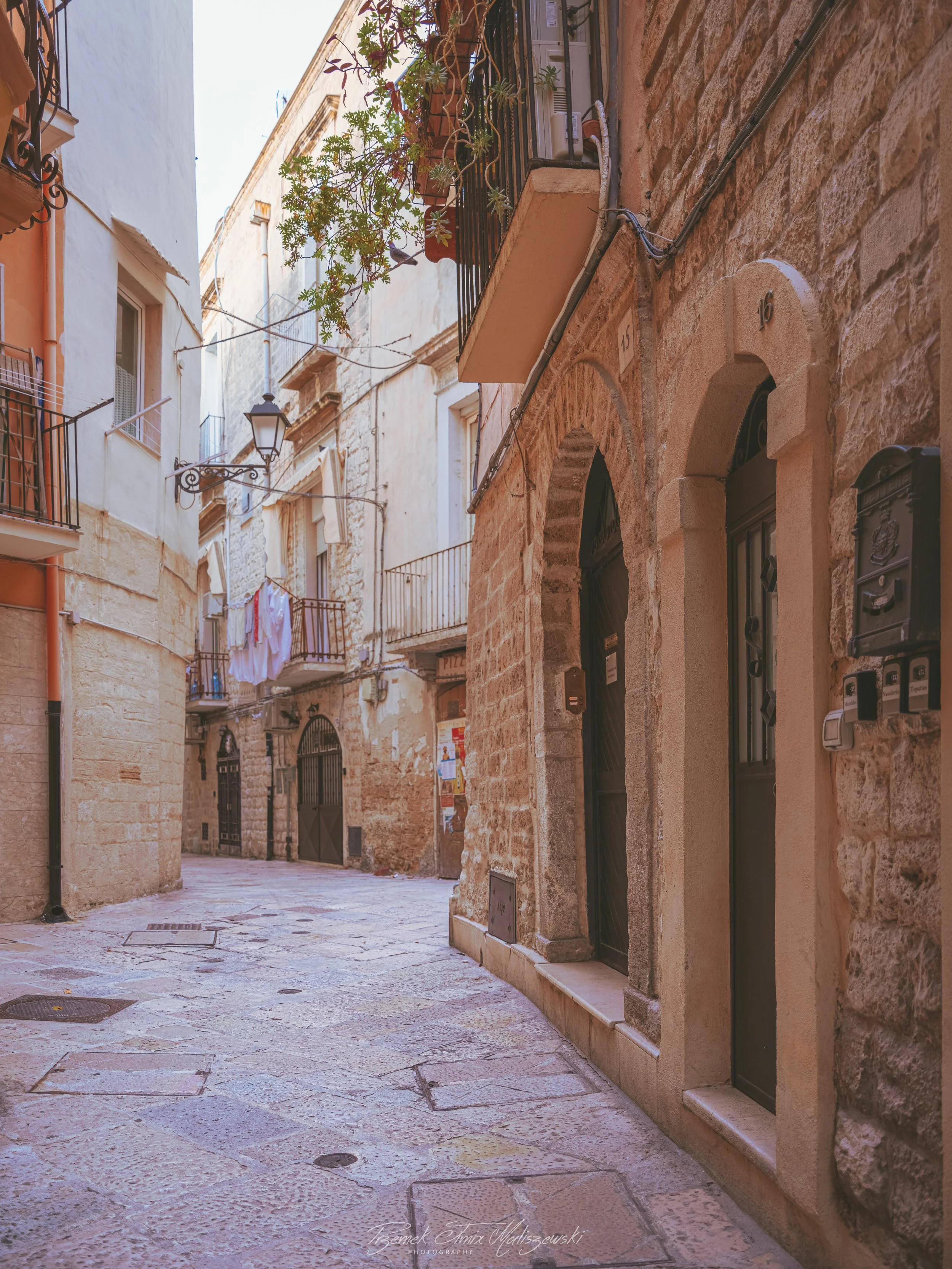
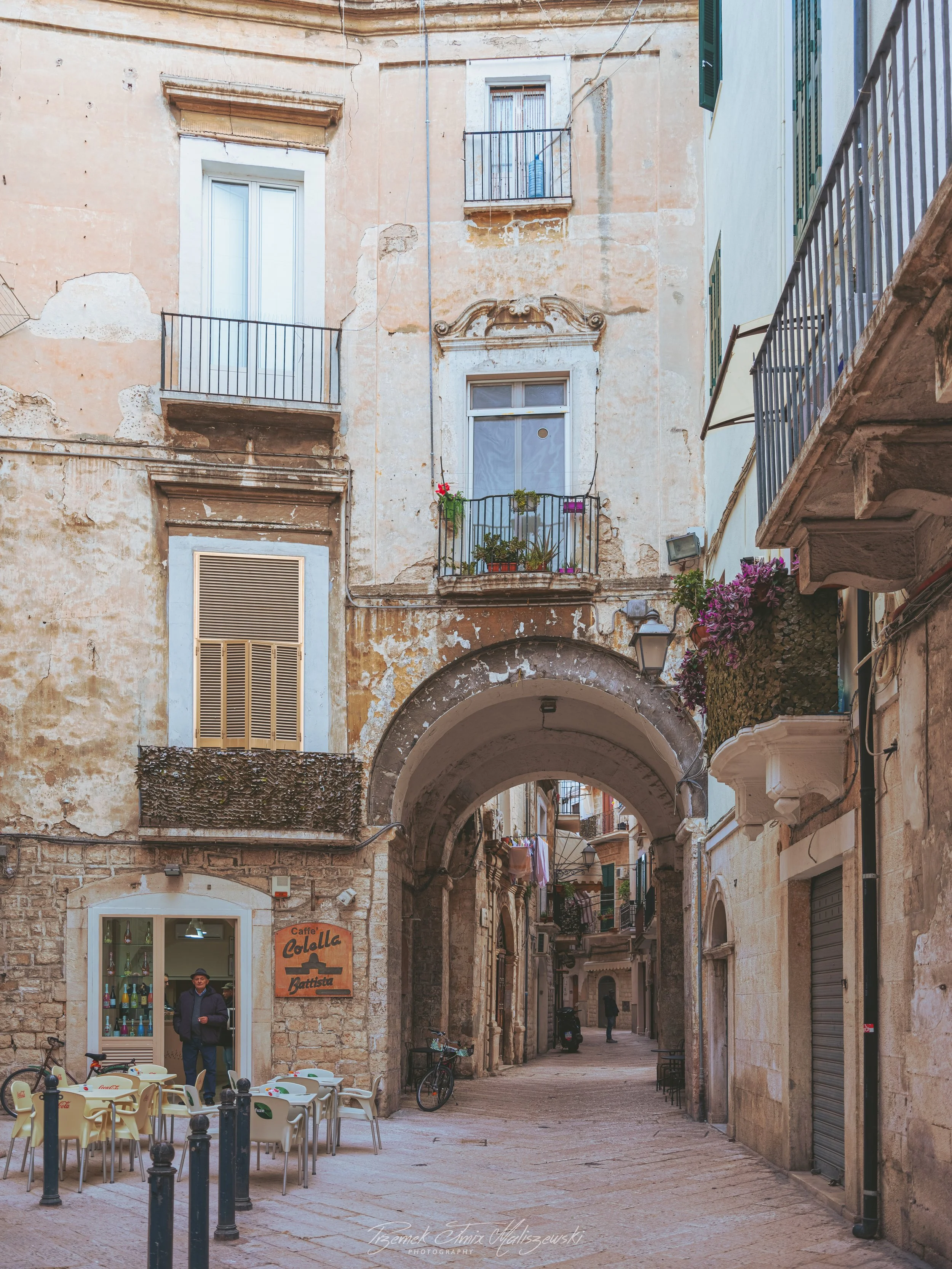
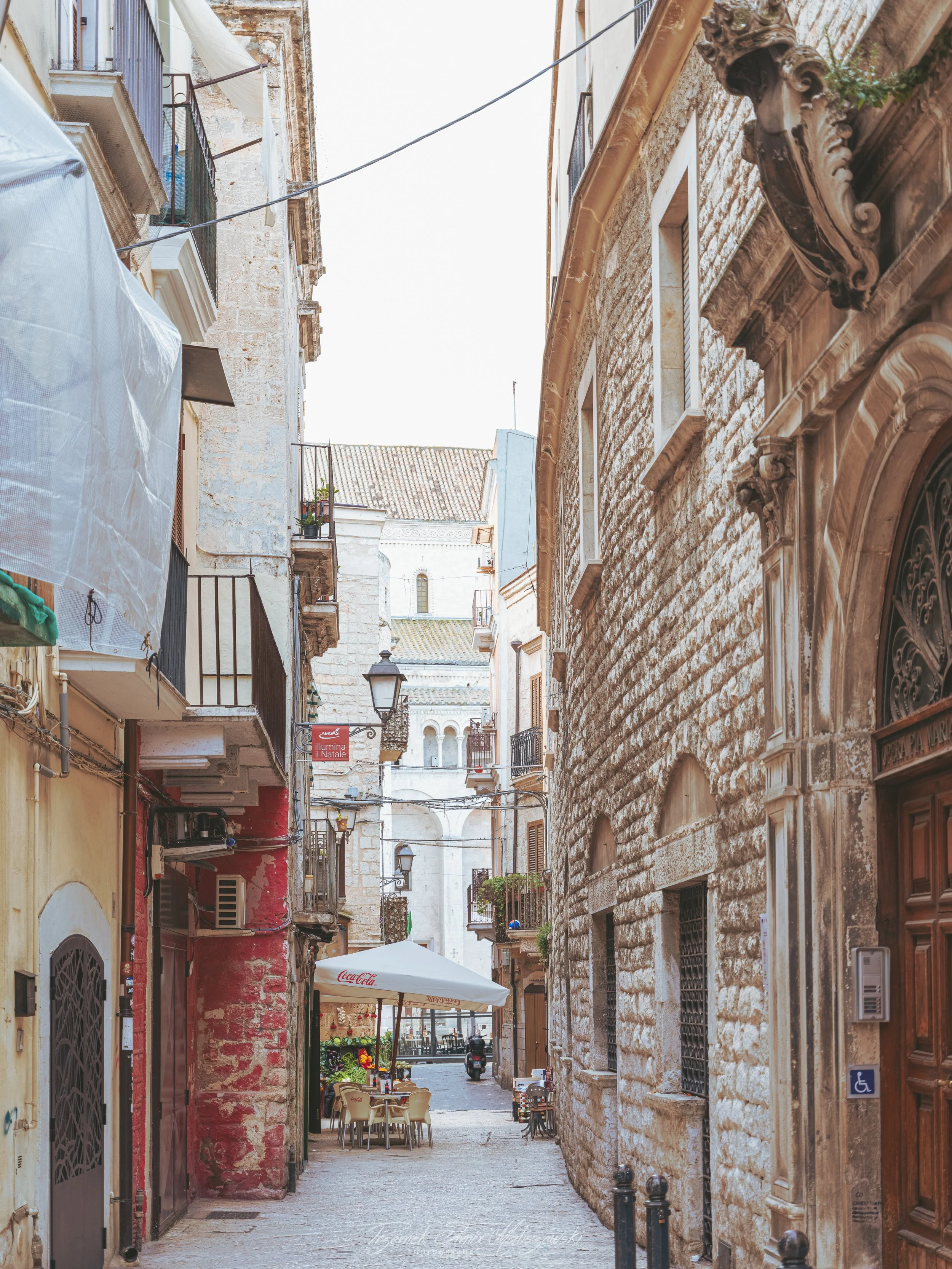
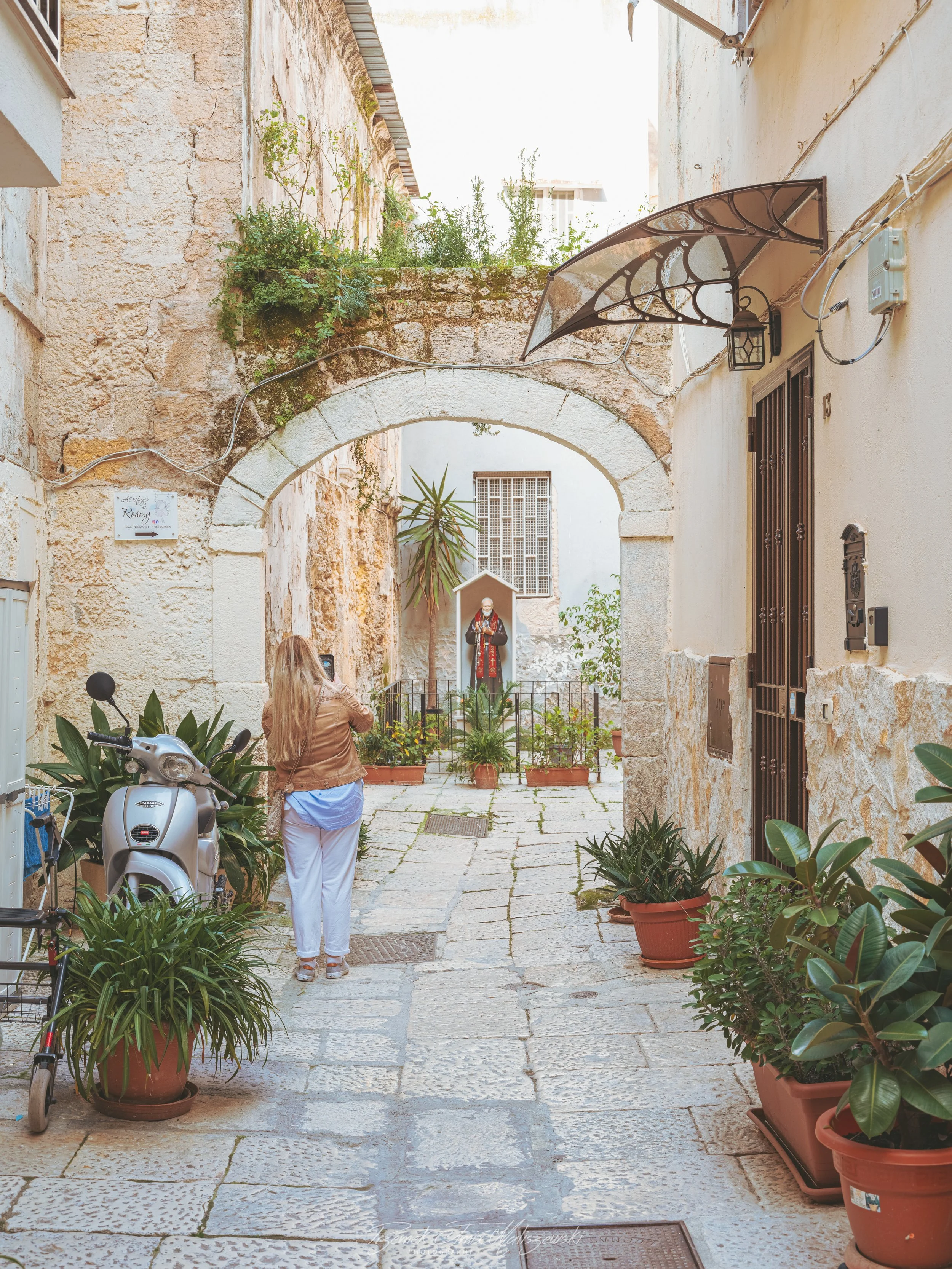
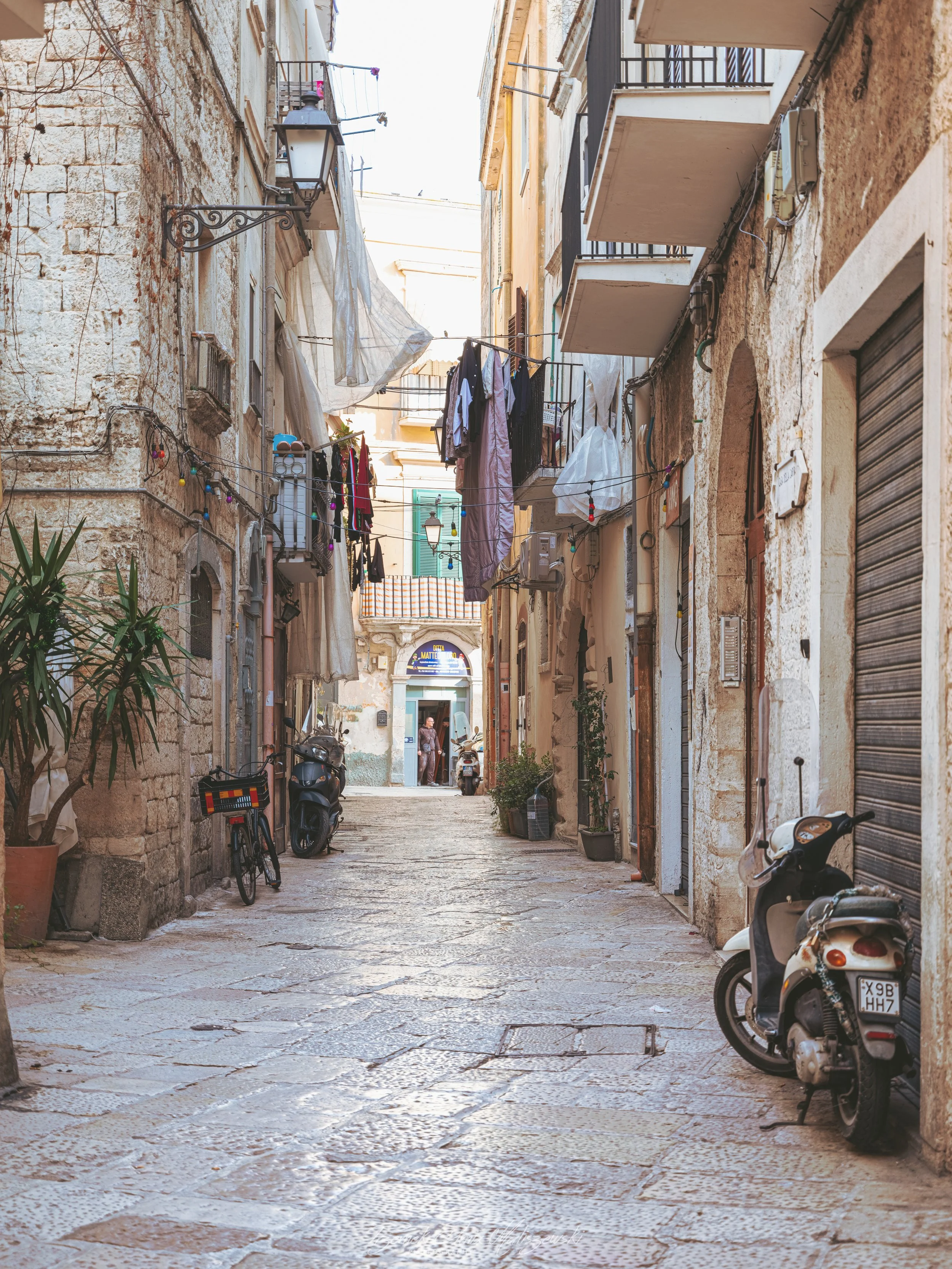
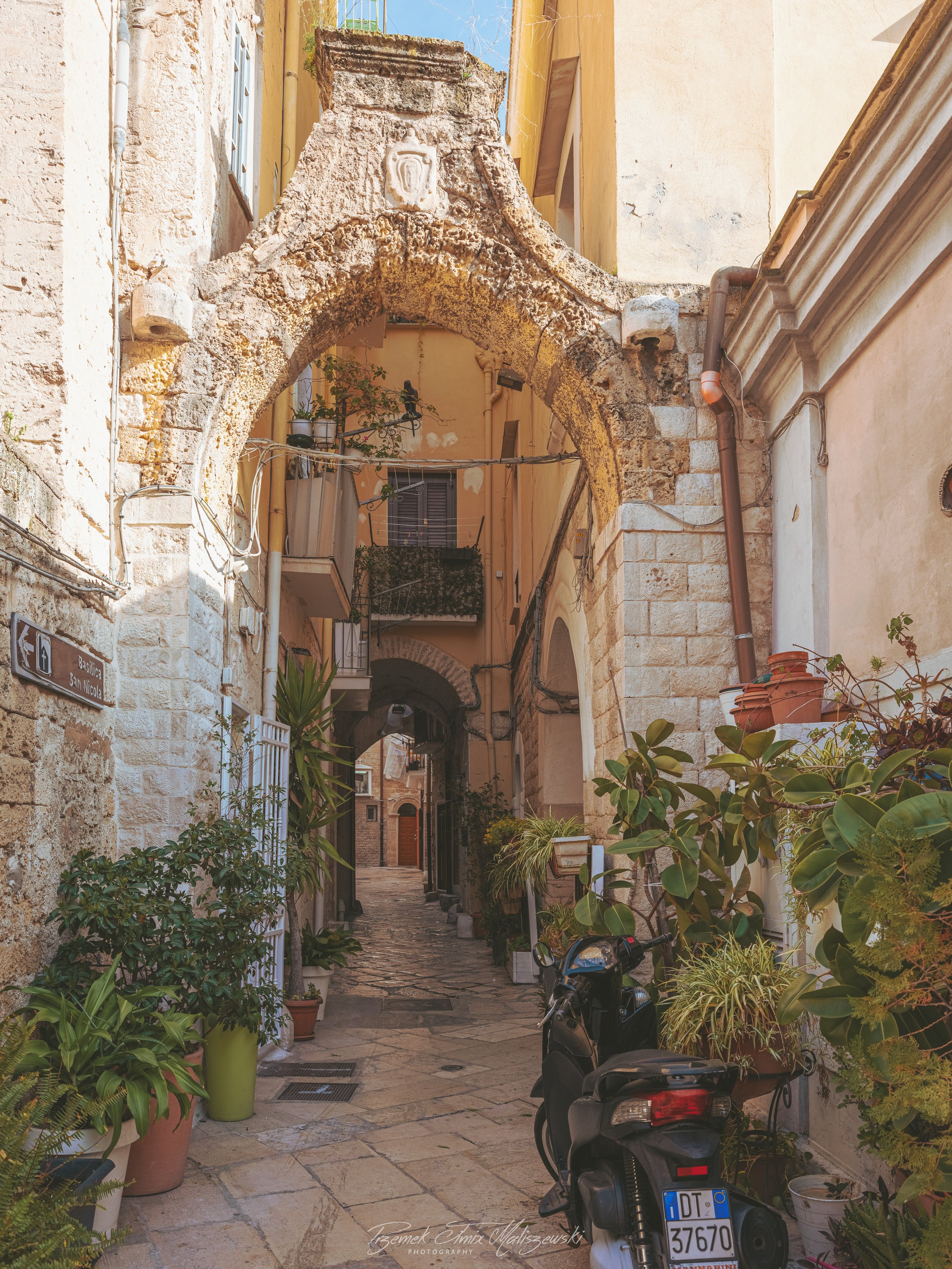
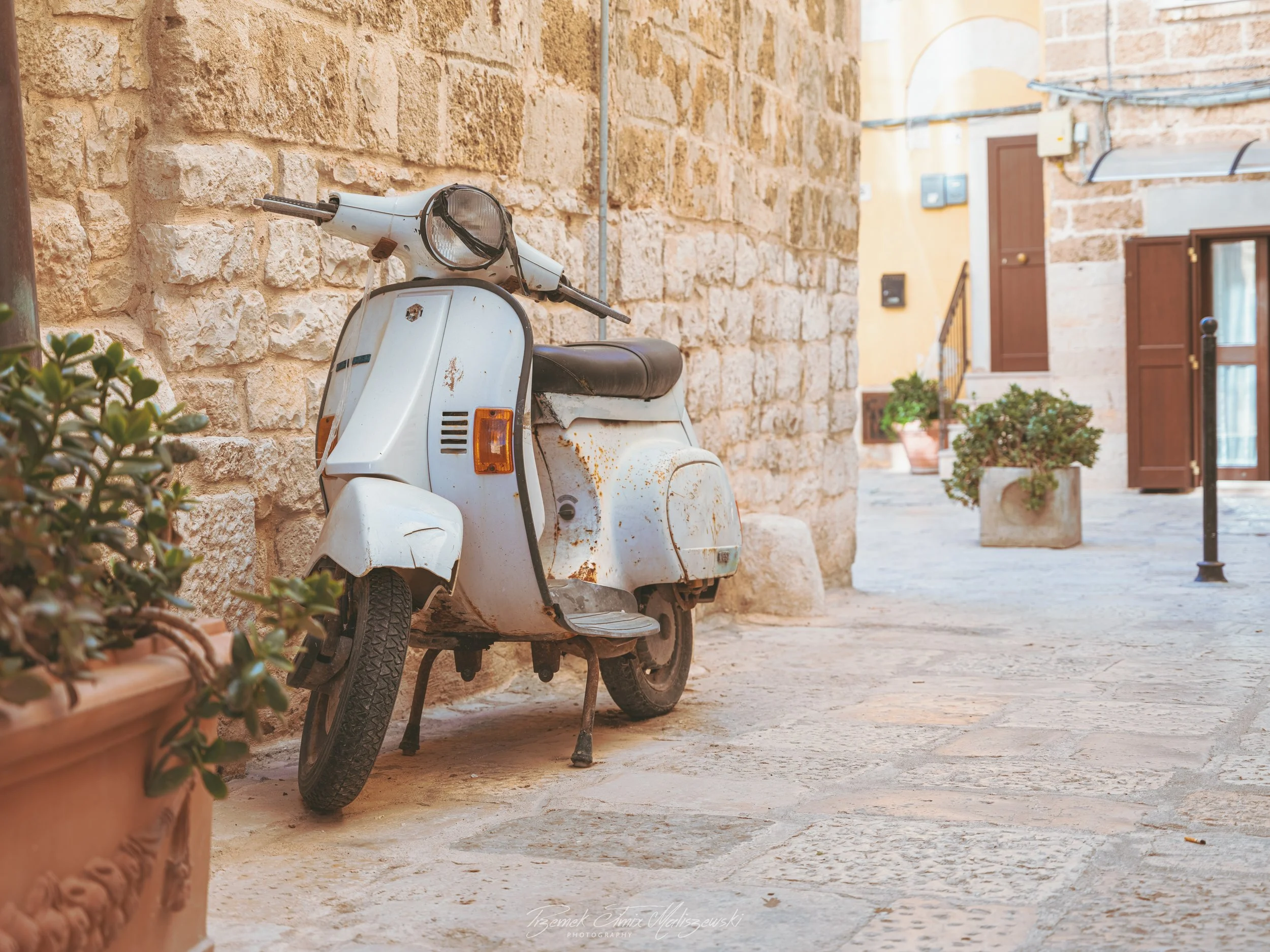
Taking a walk in Bari Vecchia.
Bona had four daughters (Isabella, Sophia, Anna, and Catherine) and two sons (the aforementioned Sigismund and Albert, who died shortly after premature birth caused by a fall from a horse by the then-pregnant queen). Because Bona was, mildly speaking, in conflict with the Habsburgs and did not want to allow them to take power after the death of her husband Sigismund the Old, on February 20, 1530, Sigismund Augustus was crowned vivente rege in Wawel Cathedral as King of Poland. He was 10 years old at the time (a year earlier he had been crowned Grand Duke of Lithuania; the Kingdom of Poland and the Grand Duchy of Lithuania were then connected by a personal union, which meant that both of these independent states shared a common ruler). Both of these early coronations of Sigismund Augustus were carried out to secure the interests of the Jagiellon dynasty, of which Sigismund Augustus was the last male representative. The coronation vivente rege, that is, during the lifetime of the still reigning formal predecessor (in this case, the coronation of the young son during his father's life), was the only such case of introduction to the throne in our Polish history. Until the death of Sigismund the Old, we had two kings in Poland. Of course, the senior king held full power, but as he grew older, the junior took over more and more duties, especially those regarding the Lithuanian part of the Kingdom.
I wrote that we had an Italian woman on our Polish throne, but the truth is, of course, that the contemporary landscape of power in Europe was full of such alliances, most often, of course, concluded not out of love, but to preserve dynastic lines – ergo – to secure political and economic interests and existing influences, or to enlarge and strengthen them. In the 16th century, unusual unions of territories thousands of kilometers apart were the norm (e.g., the Habsburg Empire spanning from Spain, through the Netherlands, to Central Europe and the New World).People tried to pair up in such a way as to ensure the most favorable status quo, though often in the end, even despite initially seemingly favorable affiliations, biology – infertility or the lack of a male heir – put an end to all these more or less refined endeavors. Sigismund Augustus was de facto the only male descendant of Sigismund the Old and Bona, and moreover, his relationship with his mother contributed in a way to her ultimate defeat.
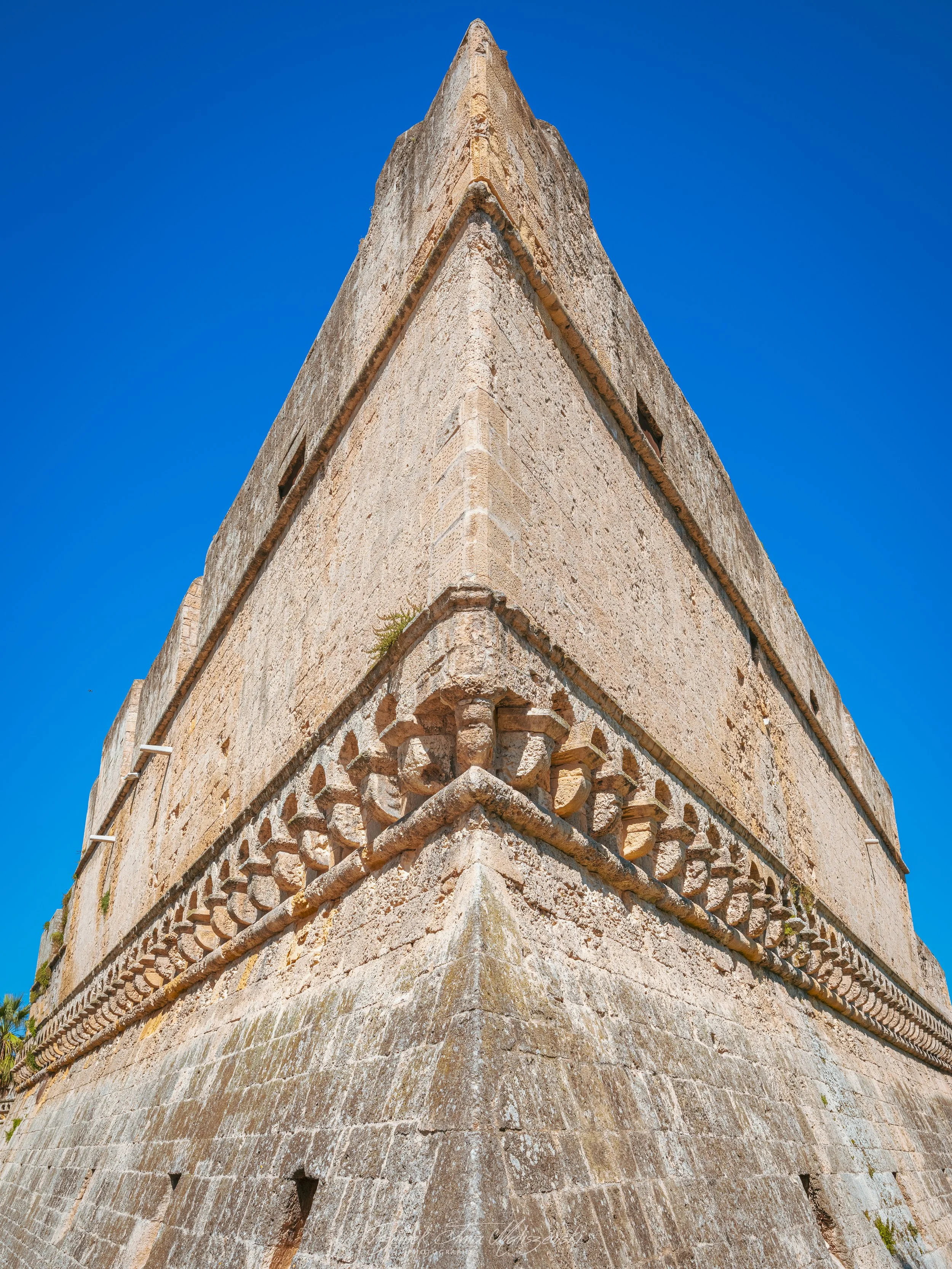
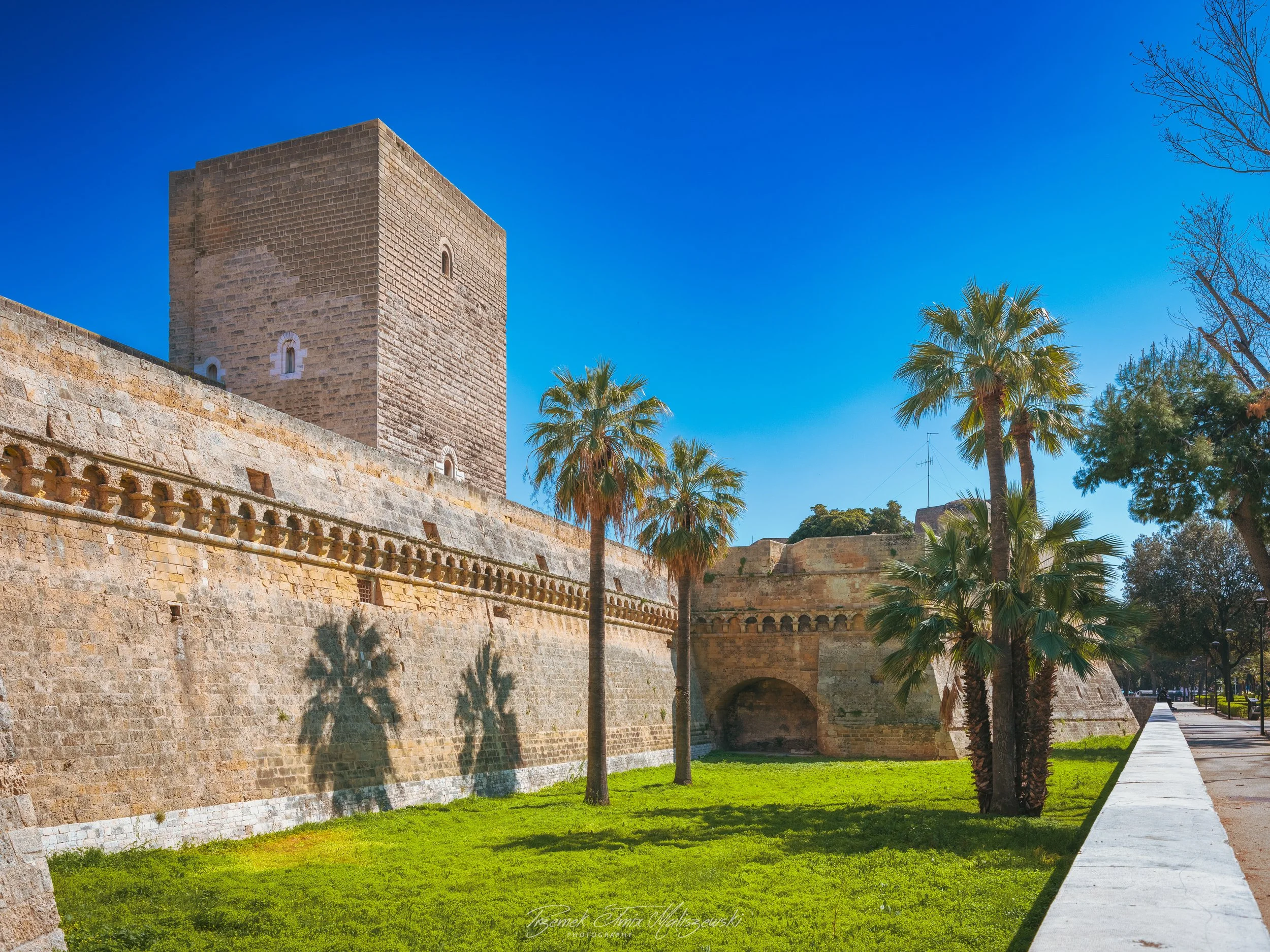
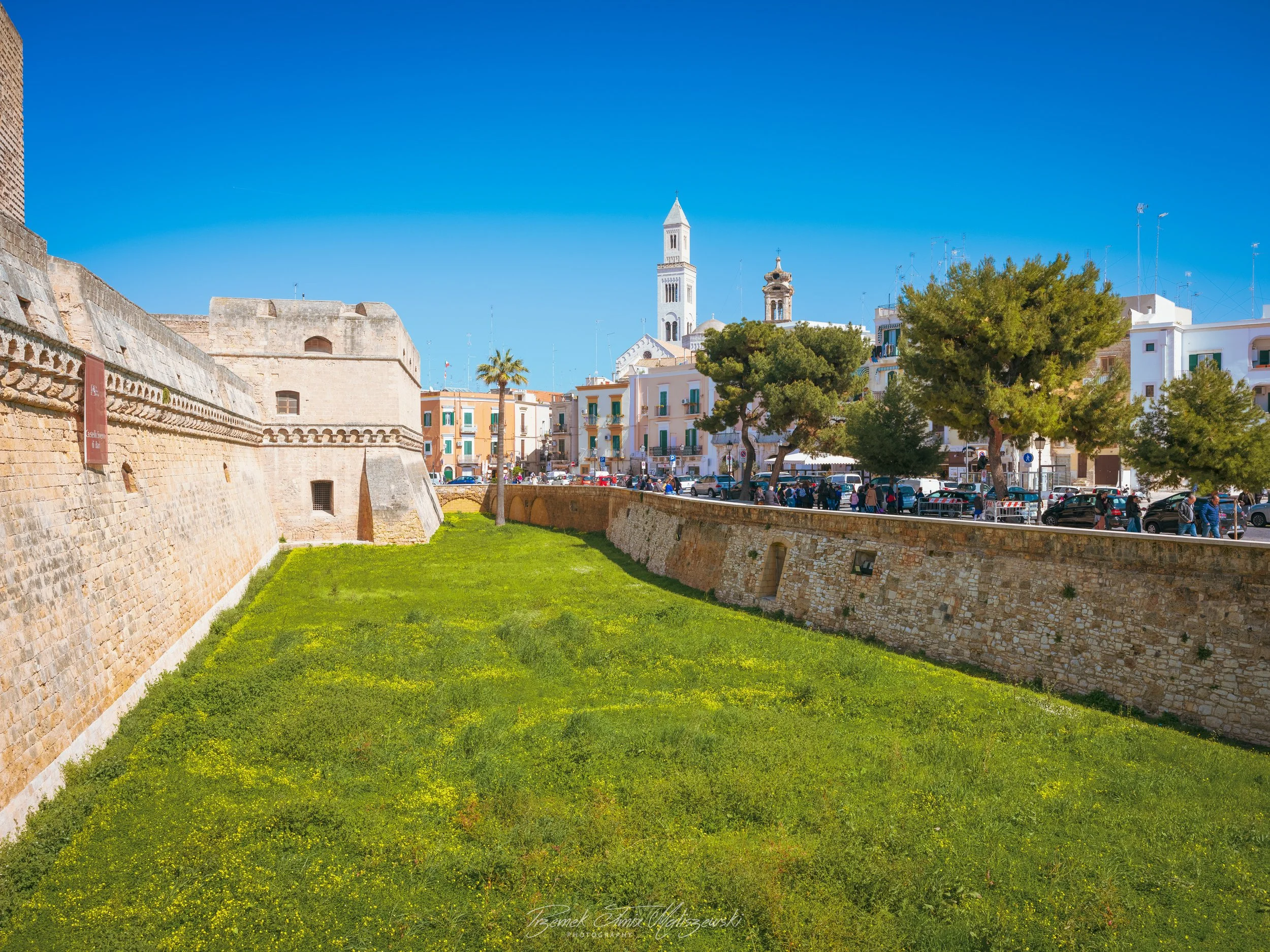
The mighty Castello Svevo di Bari, or the Swabian Castle of Bari, is a Norman fortress erected in the 12th century by King Roger II (Roger II de Hauteville, Norman Count of Sicily from 1105 to 1130). In 1156, the castle was destroyed by the citizens of Bari who rebelled against royal authority. It was rebuilt and significantly expanded in the 13th century by Frederick II, a ruler from the German Hohenstaufen dynasty, who were also Dukes of Swabia. The Swabs (the Hohenstaufen dynasty) came to Bari and all of southern Italy primarily through dynastic marriage and military conquest. A pivotal moment was the marriage of the son of Emperor Frederick I Barbarossa, Henry VI (of the Hohenstaufen/Swabian house), to Constance of Sicily. Constance was the heiress to the throne of the Kingdom of Sicily, which at the time encompassed all of southern Italy, including Apulia and the city of Bari. When the King of Sicily died without legitimate male heirs, Henry VI laid claim to the throne on behalf of his wife. However, he had to conquer the kingdom by force, fighting off local rivals. In 1194, he took Palermo and was crowned King of Sicily, officially introducing the Swabian dynasty to southern Italy. The son of Henry and Constance, Frederick II of Swabia, inherited this kingdom. Although he was a native Swabian and Holy Roman Emperor, he considered southern Italy (Apulia and Sicily) his true home. It was he who rebuilt the castle in Bari and turned the region into a cultural and military powerhouse. (in part via Wikipedia)
Before his death, Sigismund Augustus bequeathed Poland's Italian possessions to his three sisters, the Jagiellonians: Anna, Catherine, and Sophia – with the reservation, however, that they are to formally pass to the Republic after their death. As you probably guess, nothing came of it, although, to be fair, every magnate declared that he was able to enlarge the territory of the Kingdom, and declared it all the more fervently the closer, in his own and his "cabinet's" perception, he was to the prospect of seizing the throne of the Republic. Candidates for this honor were several, for example, Ernest Habsburg and two years later Maximilian II Habsburg. Both promised to bring the matter of the Bar duchy to a successful conclusion for Poland. Also, Sigismund III Vasa, Bona's grandson (son of her daughter Catherine Jagiellon), King of Poland and Sweden, tried to recover the duchies of Bari and Rossano. In vain. His son, Władysław IV Vasa, demanded the same, but the duchies invariably remained ruled by the Habsburgs after Bona's death.
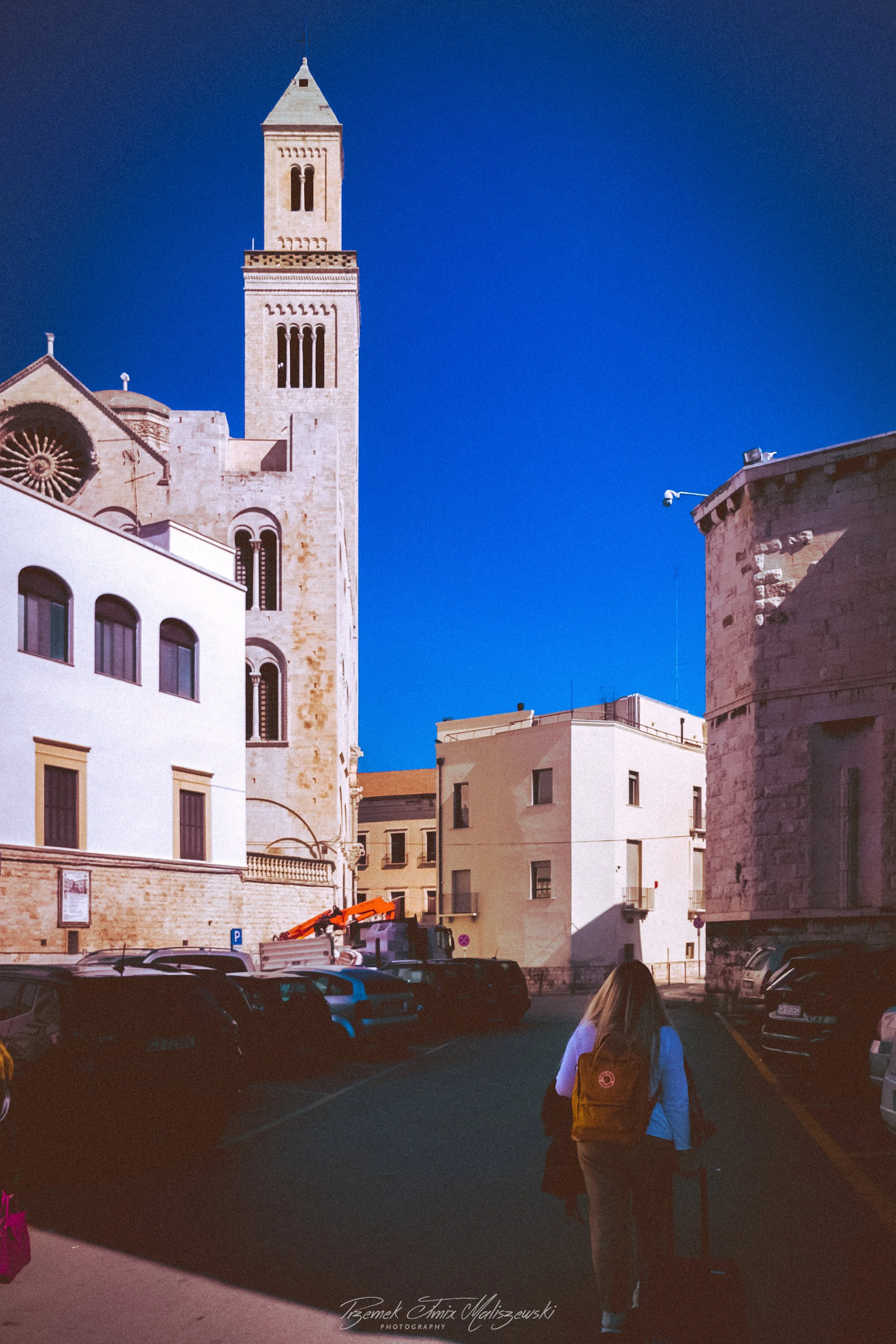
The now-decommissioned Baroque bell tower of the Church of St. Clare (Chiesa di Santa Chiara) on Strada Santa Chiara. The church took its name from the Poor Clare nuns to whom the sanctuary was entrusted in 1492. The sanctuary itself, a fragment of which can be seen in the photo, dates back to the 12th century and was erected by the Teutonic Knights (Cavalieri Teutonici) as the Church of Our Lady of the Alemanni (Madonna degli Alemanni). Originally, it served primarily as a refuge and a place of prayer for a specific group of people: German pilgrims and knights of the Teutonic Order, who were usually heading to Jerusalem.
Here, I will allow myself a linguistic digression, because I like to – oh yes! A wealth of history and knowledge is "stitched" into language and words. Sometimes, a single word can inspire us to expand our awareness of related topics. So here it is: the Alemanni (or Alamanni) were a powerful confederation of Germanic tribes that formed at the turn of the 2nd and 3rd centuries. Originally inhabiting the Elbe river basin, they moved to the southwest. They occupied the so-called Agri Decumates (the area between the Rhine, Danube, and Main rivers). Today, these are the regions of southwestern Germany (Baden-Württemberg), Alsace (France), and Switzerland. Their dialect gave rise to the Alemannic language, which still functions today as a group of High German dialects (Hochdeutsche Sprache – used in Switzerland, the Austrian Vorarlberg, German Swabia, and French Alsace).
And here is something that many of you have probably already noticed: how our neighbor across the Oder river is referred to in certain languages. We, Poles, Slavs, say Niemcy. The situation is very similar in Czech, Slovak, Ukrainian, Hungarian (although Hungarians are not Slavic), Russian (the word Niemets), Serbian, Bosnian, Slovenian, and Belarusian. But what is it like in other European languages? Let’s take a look: Spanish: Alemania, French: Allemagne, Portuguese: Alemanha, Catalan: Alemanya, Galician: Alemaña, Occitan: Alemanha, Arabic: ألمانیا (Almāniyā), Turkish: Almanya, Persian (Farsi): آلمان (Ālmān), Kurdish: Almanya, Azerbaijani: Almaniya, Welsh: Yr Almaen, Breton: Alamagn, Tagalog (Philippines): Alemanya (a loanword from Spanish), Quechua (South America): Alimanya, Khmer (Cambodia): អាល្លឺម៉ង់ (Allemang – a loanword from French), as well as Old and Middle English: in old times in England, Germany was called Almany and Germans were called Almains. These terms fell out of use by the 19th century in favor of the Latin-derived form Germany.
And what does “Alamann” actually mean? In the Middle Ages, the word Alemanni (the Alemanni/Alamanni) referred to a specific branch of Germanic tribes, and later, generally to the German-speaking population. In the 12th century, the modern state of "Germany" did not exist; the Holy Roman Empire of the German Nation existed instead. Etymologically, the name Alemanni means "all men". This name perfectly reflected the nature of the group and consists of two Proto-Germanic elements:
all- – meaning "all" or "everything".
mann- – meaning "man" or "human".
Why precisely "all men"? As the 6th-century Roman historian Agathias already reported (citing earlier sources), the name referred to the fact that the Alemanni were not a single, indigenous tribe. They constituted a loose confederation of various Germanic tribal branches (including the Suebi, Semnones, and others) that united along the Upper Rhine to jointly resist the Roman Empire. The term "all men" therefore simply meant "people from various places," "a mixture of people," or "united people" (in part via Wikipedia).
From a historical point of view and above all from the perspective of our times, all this seems very convoluted. Not only estates, but entire duchies and kingdoms passed from hand to hand. Personal unions were formed, overt unions, unions on the model of the Lublin one, nations were united, armies, offices, and treasuries were separated, management was conducted at a distance (like Bona managed Bari), children were enthroned and married off, while plotting and fighting each other ruthlessly whenever someone's interests of this or that faction, family, or dynasty benefited from it. States that today are independent entities once had a single ruler, like Poland and Lithuania, or Sweden and Poland. Numerous wars and skirmishes were waged, long-term disputes over smaller and larger territories were conducted, uniting, separating, annexing, and detaching.
Italy at that time was a collection of duchies, small principalities, independent cities, and castles on hills. Austrians, Spaniards, popes, and also a certain Polish queen who was an Italian woman ruled there. It is difficult to find one's way through all this, and delving into the history of this period alone, one repeatedly gets the impression of wandering in a labyrinth – a labyrinth of figures, interdependencies, intrigues, romances, illegitimate children (pardon: unlegitimized ones), pretenders, candidates from the matrimonial "exchanges" of European courts, affiliations, arrangements, and above all interests, possessions, fortunes, and inheritances.
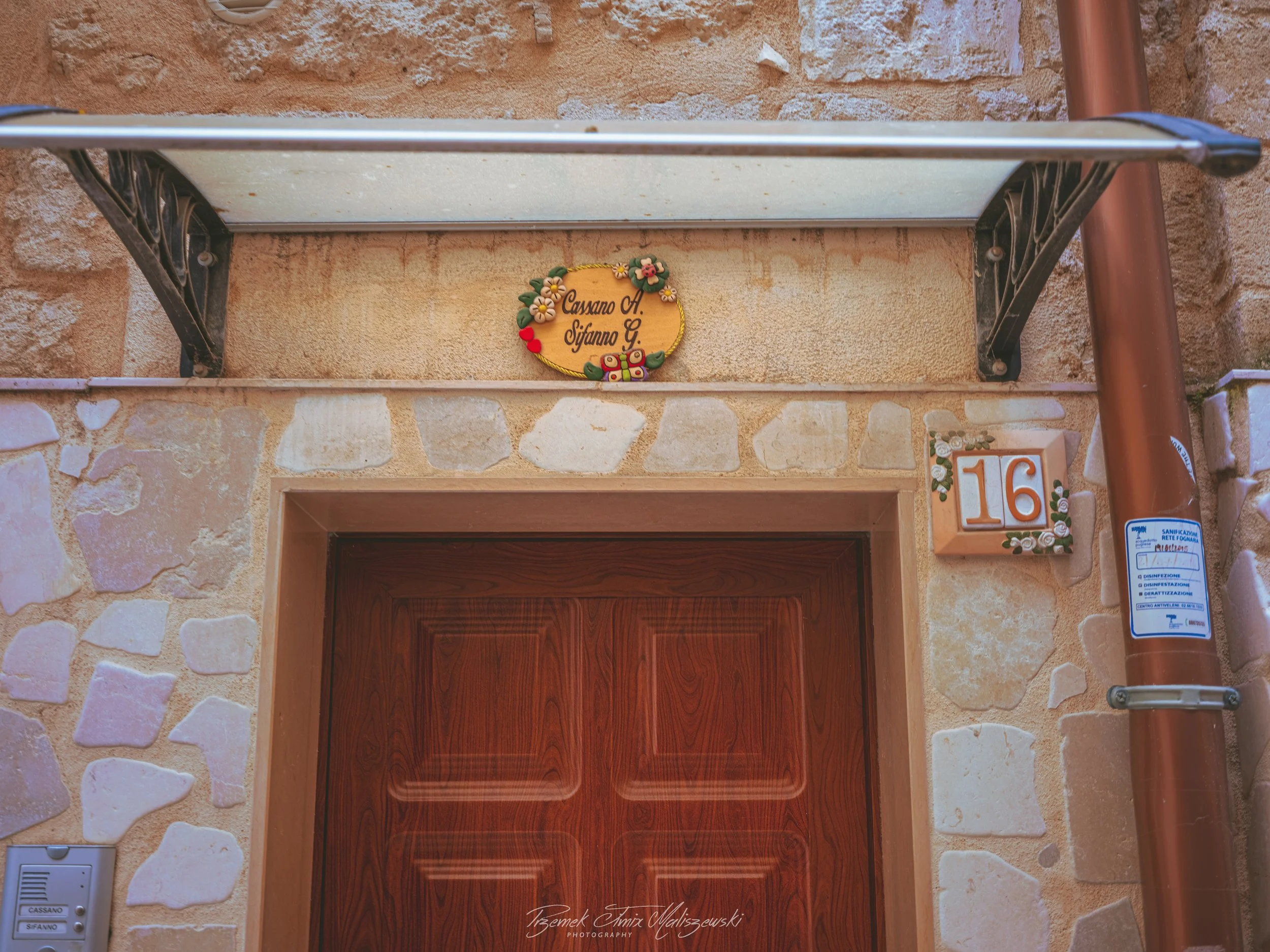
The history of Italian Bari connects or intertwines with places whose participation in this brief and yet immensely superficial story about it I would not have expected myself. Of course, this is a somewhat secondary participation, sometimes even marginal, but it is there. Just near my parents' hometown, Łomża, are the remains of an early medieval settlement from the beginning of the 9th century, when it was merely an open settlement. Today it forms a slope called Queen Bona's Hill. Consequently, Łomża has a place traditionally for decades named after this former Italian Duchess of Bari and Rossano.
Łomża itself was one of the residences for the Italian woman in the north-eastern territories of Mazovia. One of her official residences was located in the castle in Łomża. That castle, or rather the court of the Mazovian dukes, built in the years 1403–1421, was situated between today's Senatorska and Dworna streets. According to legends, Bona ordered vegetable gardens to be established in Łomża (probably with the famous "włoszczyzna" – of course!). During Bona's reign, the so-called small royal castle was expanded. Today, as I mentioned, no trace of it remains, except for the remnants of underground structures (archaeological work conducted in 1967 uncovered fragments of the building's brick foundations, so its exact location remains determined and undisputed).
In 1575, which was 18 years after Bona's death, an inventory of the court was carried out, thanks to which today we know it consisted of a brick building facing the Narev river, where King Sigismund the Old (and presumably the future Sigismund Augustus) and Queen Bona frequently stopped, a chancery, an additional house, a bakery, a bathhouse, a kitchen, and an orchard. The fortifications of the facility were wooden. After the death of Sigismund Augustus in 1572, his sister Anna Jagiellon frequented the castle, where she hosted envoys, including reportedly those who sought her hand in marriage.
Umberto e Francesco an their morning delivery of fruits and vegetables (frutta e verdura). Did they also bring the “włoszczyzna” (Italian veggies”)?
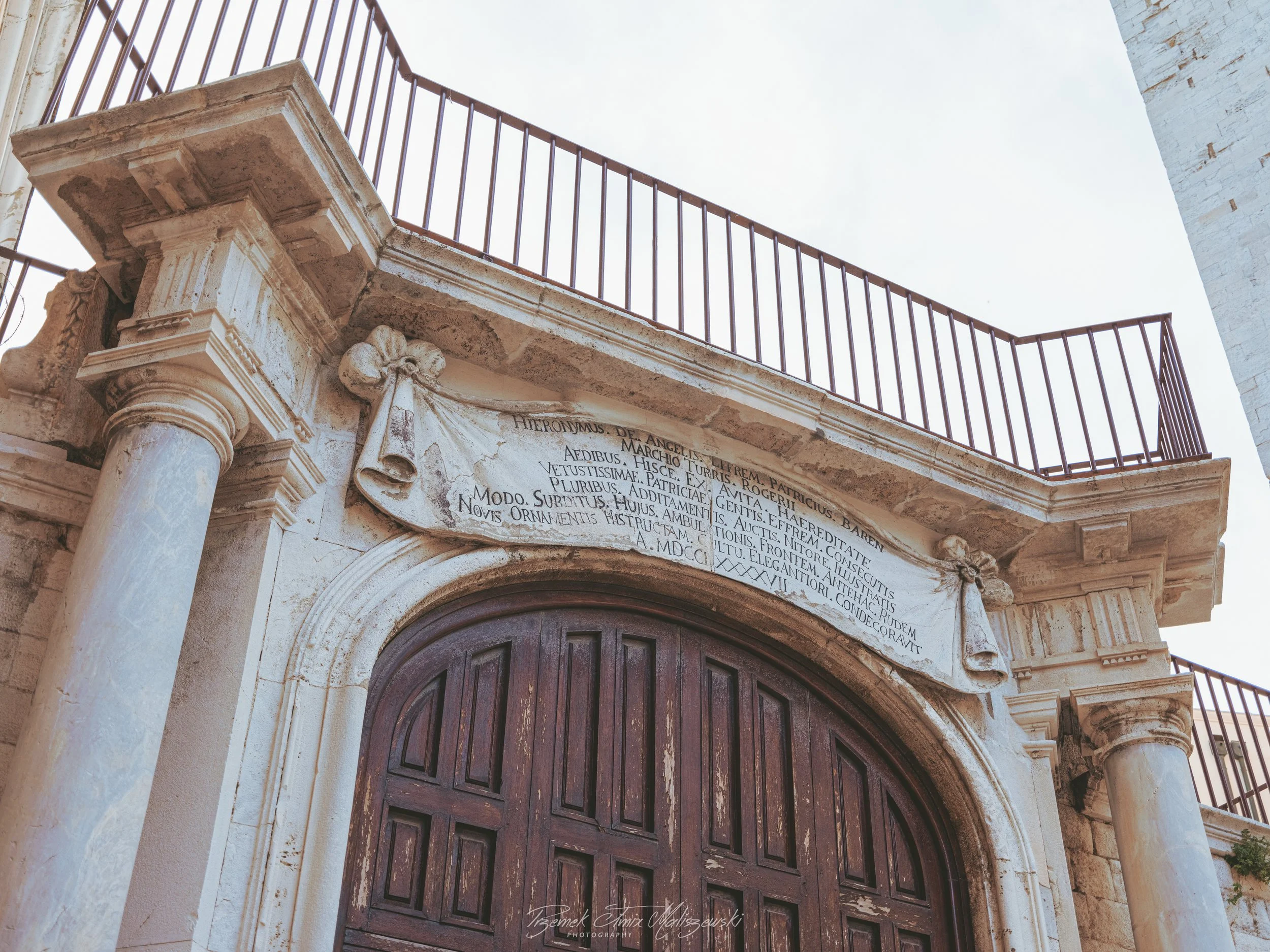
The second location significant from the perspective of my own genealogy is a small town of Tykocin. When in 1572, in Knyszyn in Podlasie, Bona's son, Sigismund Augustus, died, funeral ceremonies took place, among other places, in Tykocin (as well as in Warsaw and of course in Kraków). But here a very significant thing happens: Sigismund Augustus died childless, ending the male line of the Jagiellon dynasty, and the state faced the specter of civil war and anarchy, as there were no procedures regulating who should rule during the period called interregnum (lit. between-kingship). The interregnum, lasted until May of 1573, when as a result of an election, a certain Edward Alexander de Valois, born in 1551 in Fontainebleau, known as Henri de Valois, and to Poles as Henry III of France, was chosen as the monarch of Poland. He was a French king from the Valois dynasty, Duke of Angoulême, Orléans, and Anjou. And once again we have "trade" on the matrimonial exchange: since he was the fourth son of Henry II of France and Catherine de' Medici, he had little chance of seizing the French throne. "Too bad", Henri probably thought, but fortune had a "backup option" in store for him. Right there in not-so-distant Poland, a "vacancy" had opened up. And so the Polish nobility chose Edward Alexander for the throne, who took the name Henri III de Valois.
I mentioned the "matrimonial exchange" – candidates who lost the "race" for the Polish throne included the son of the then Holy Roman Emperor Ernest Habsburg, Tsar Ivan the Terrible of Moscow, and King John III Vasa of Sweden. Those were the times.
Today, many of us talk about a mega scandal whenever news spreads through the media about the sale of this or that company to some foreign entity, whereas in the 16th century Poland was ruled by a Frenchman (almost by an Ivan), we were losing Southern European duchies, or we were a single state with Lithuania or Sweden. But ad rem: during the ongoing interregnum after the death of Sigismund Augustus, his embalmed body stayed at the Tykocin castle for over a year. The king died on July 7, 1572, while the funeral ceremonies started only on September 10, 1573. And it was in the chapel of the Tykocin castle that the main service was celebrated. The castle itself was then a powerful royal fortress and at the same time a royal treasury. The funeral procession formed after the service, which set out from Tykocin through Warsaw to Kraków, was the longest funeral procession in the history of our country.
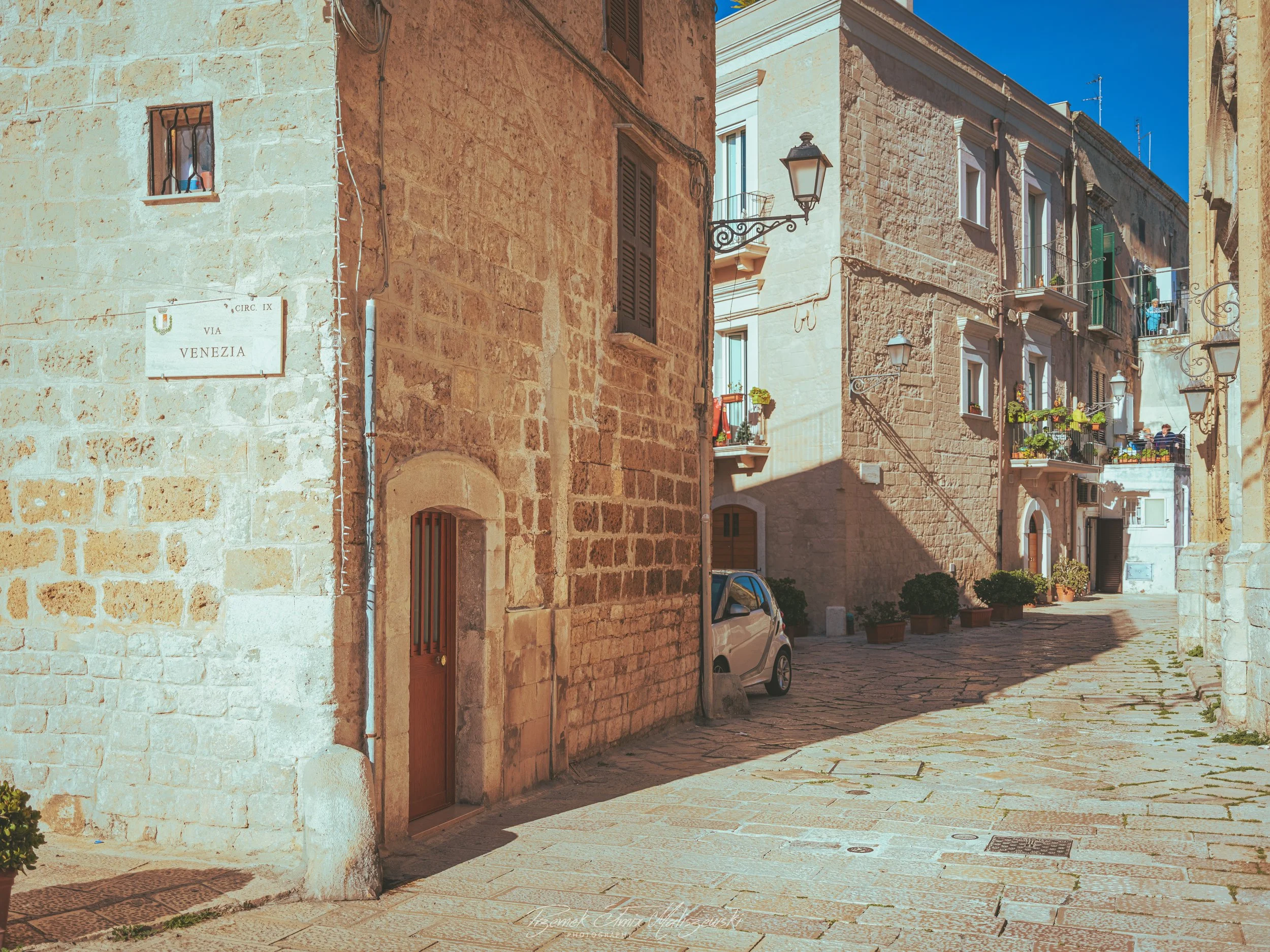
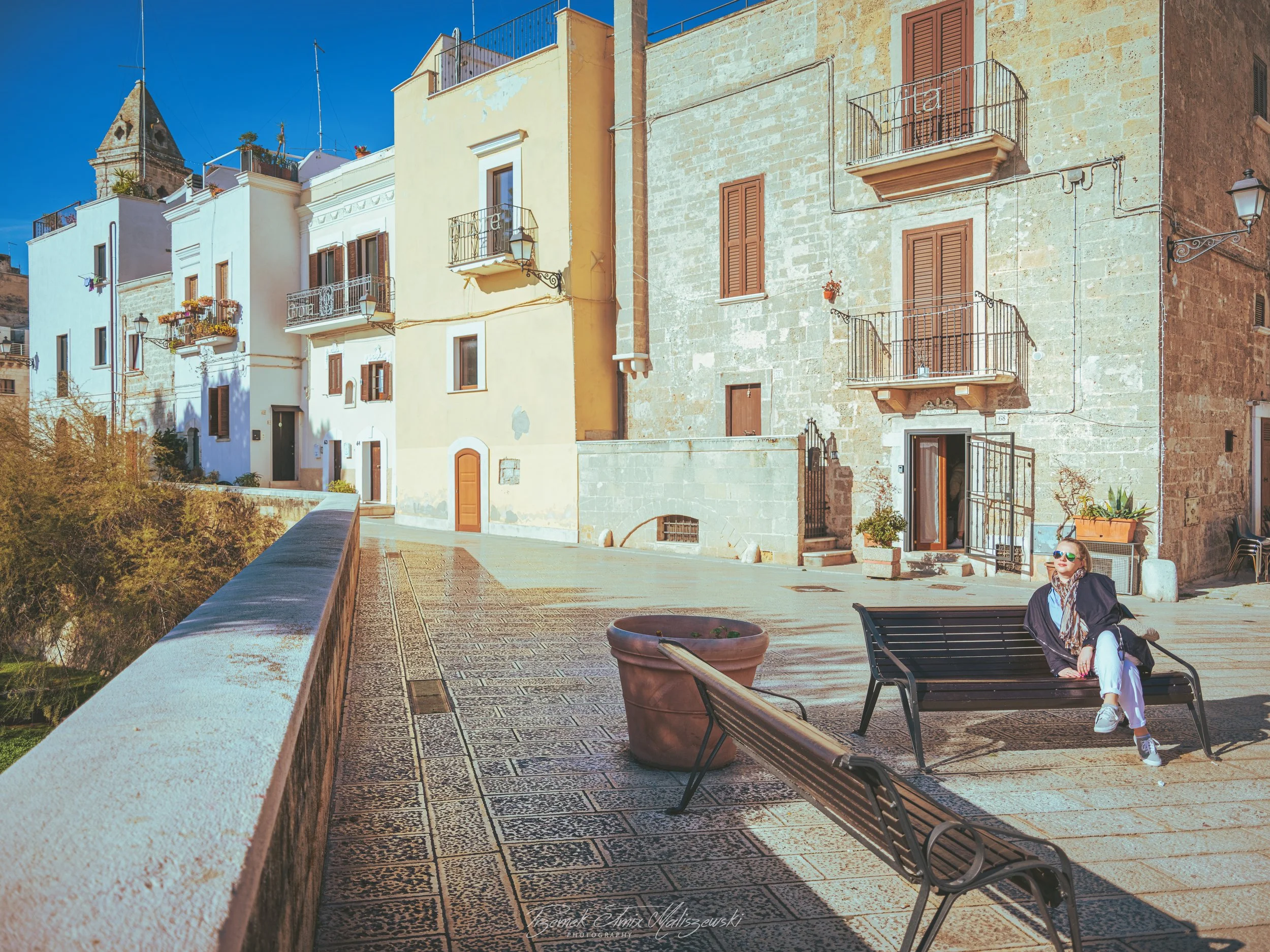
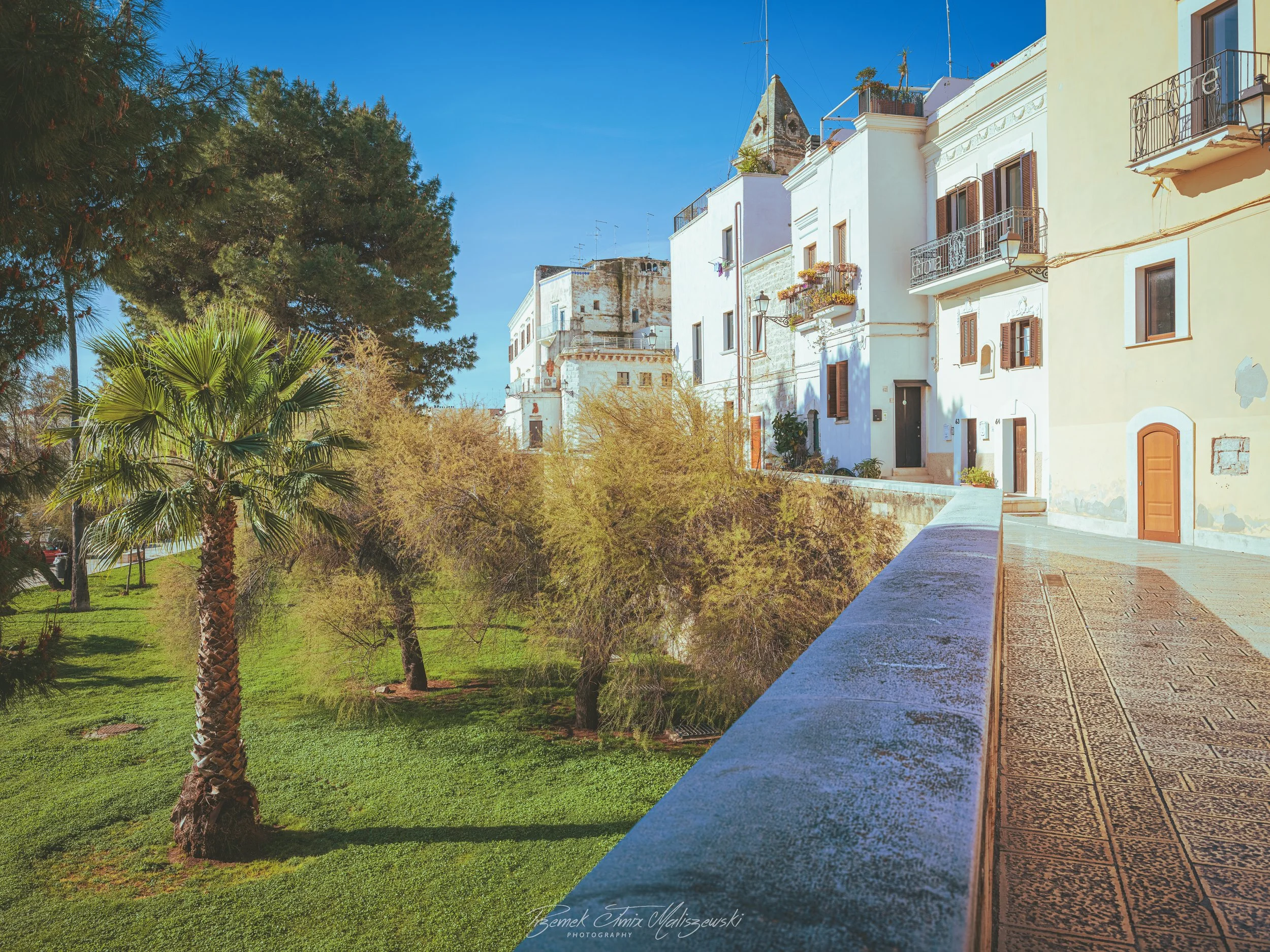
In 1860 Bari, after years of being a duchy passed from hand to hand, became part of the Kingdom of Italy. A little-known episode from the history of the city of Bari is an event from World War II called the "Little Pearl Harbor." On December 7, 1941, the Imperial Japanese Navy and Air Force launched an attack on the US Pacific Fleet anchored or moored in the port of Pearl Harbor in Hawaii. Then also in December, this time on December 2, 1943, the Luftwaffe carried out a raid on the port in Bari, full of Allied units. The raid lasted less than twenty minutes. As a result, nearly two thousand people died, and 28 ships were sunk.
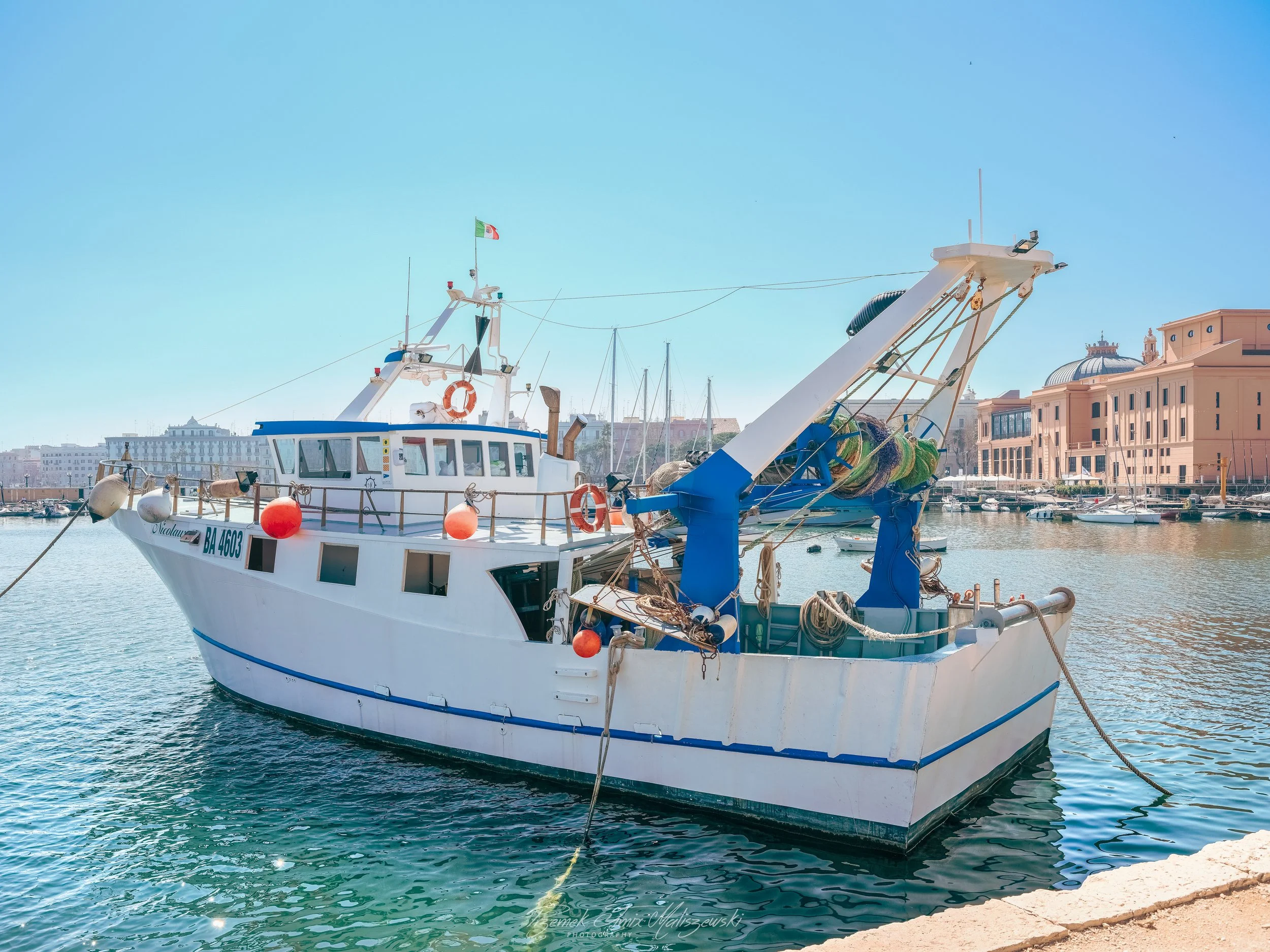
The marina in Bari.
Bari is today both a city and a commune, the capital of the province of Bari and the Italian region of Puglia. It is the largest city in southern Italy after Naples and the largest Italian city located on the Adriatic Sea. It has a large military, commercial, and passenger port. From Bari, one can sail to Montenegro, Greece, Albania, and Croatia. Bari is an important commercial, industrial, and cultural center of southern Italy. It has a very well-developed shipbuilding and food industry (pasta and wine are the main branches of the food industry). Bari is also home to large chemical, machinery, and fish-processing plants. There is a university and a maritime school here.
The view south from Via Venezia.
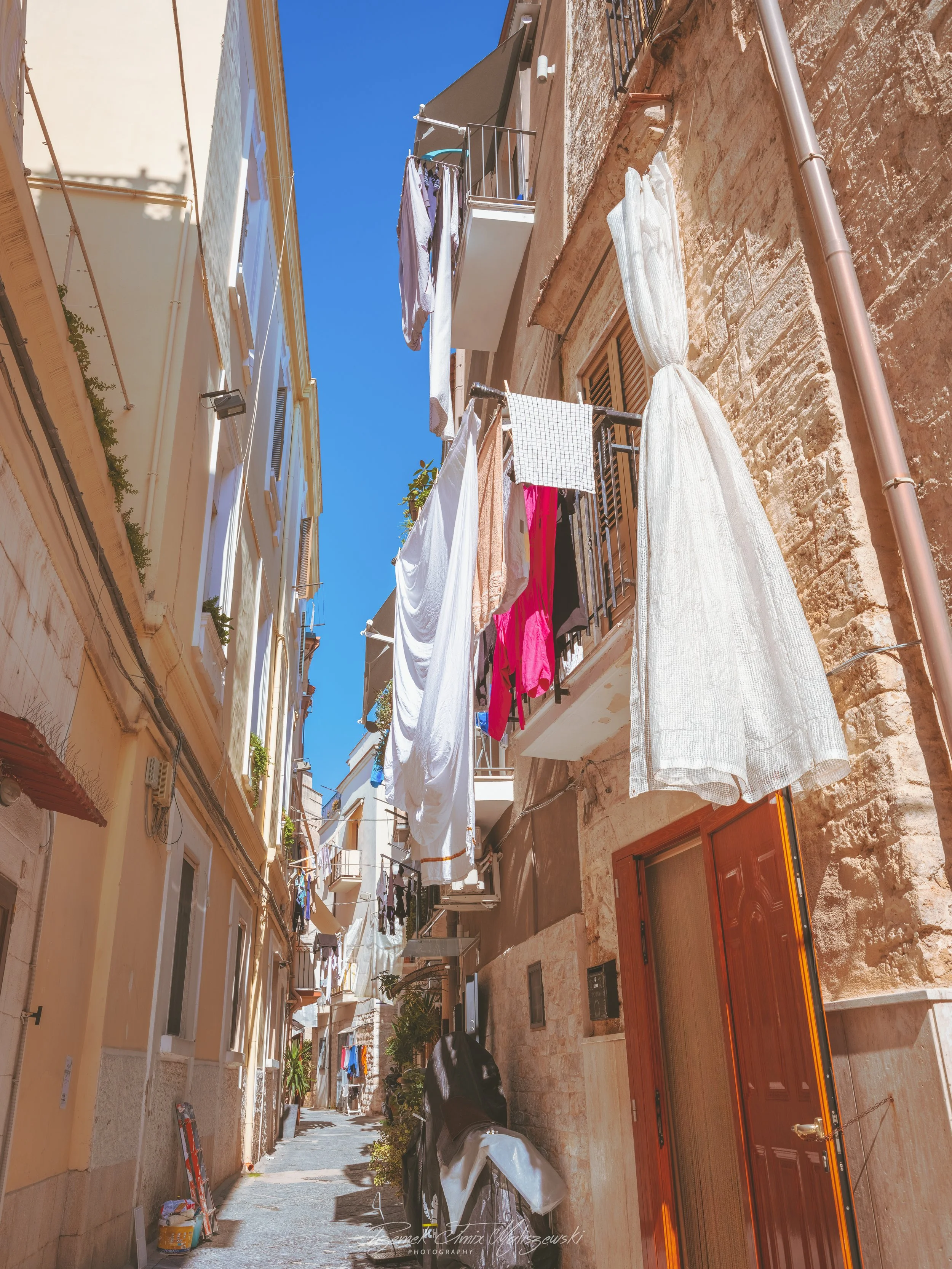
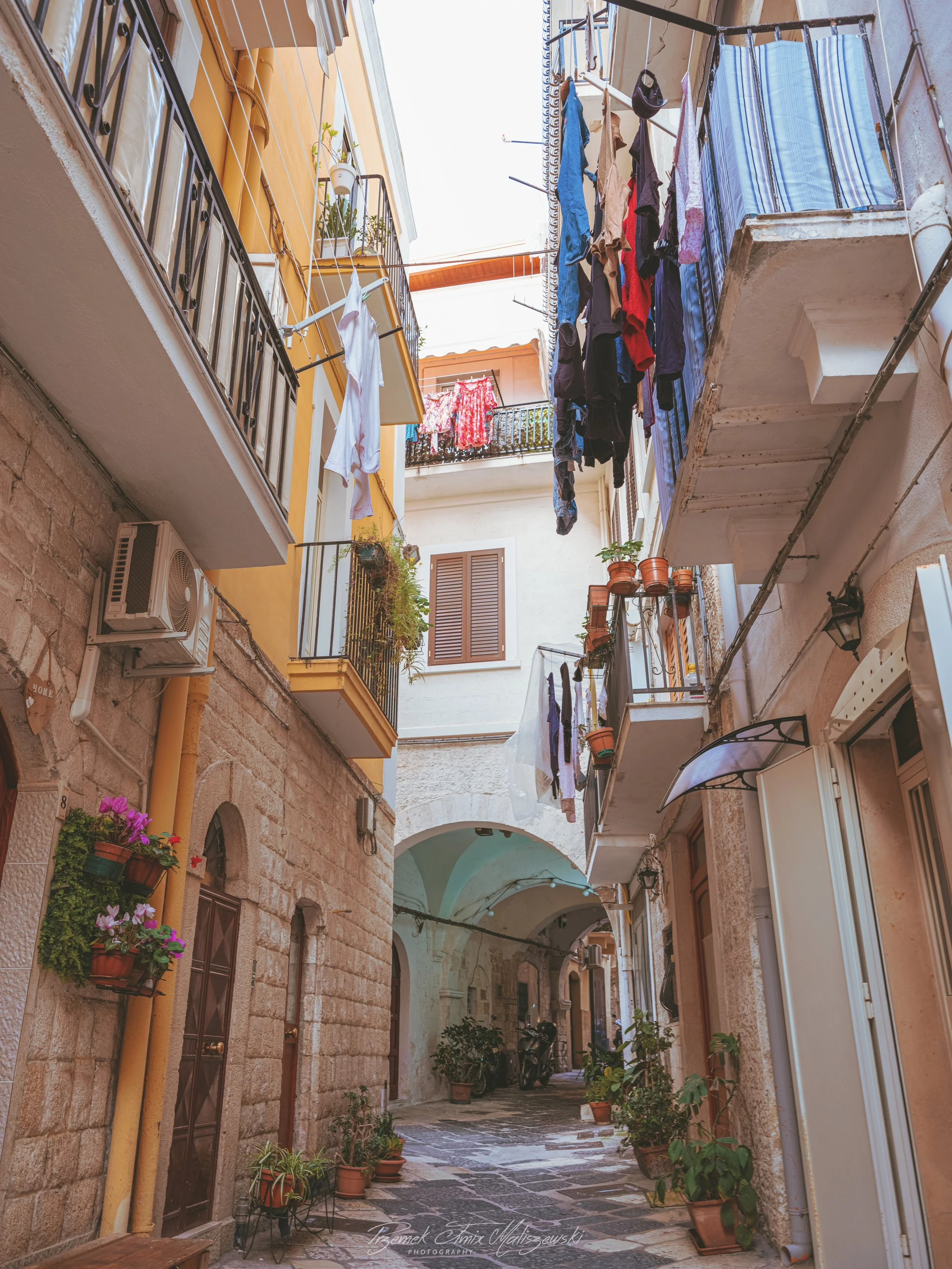
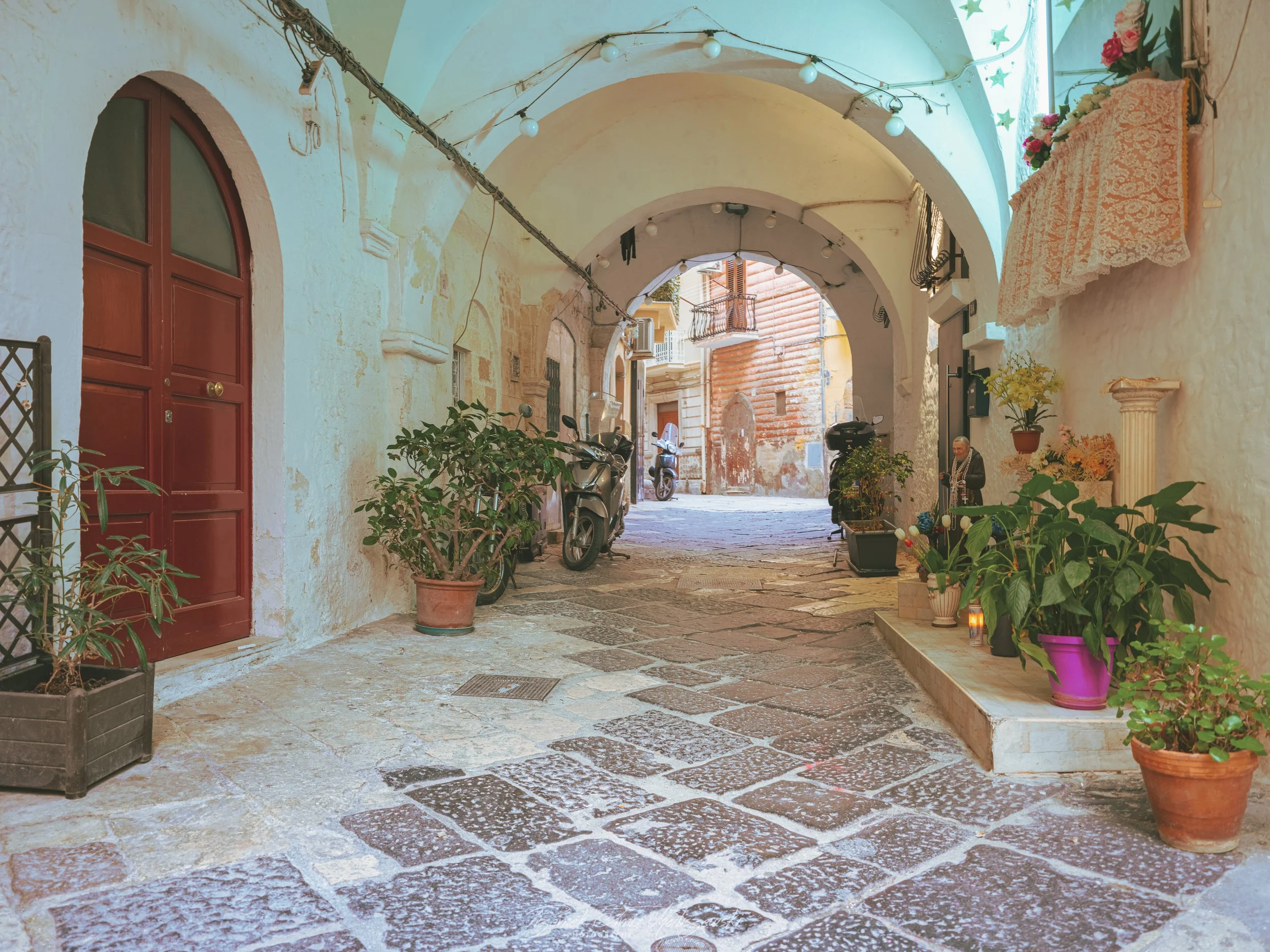
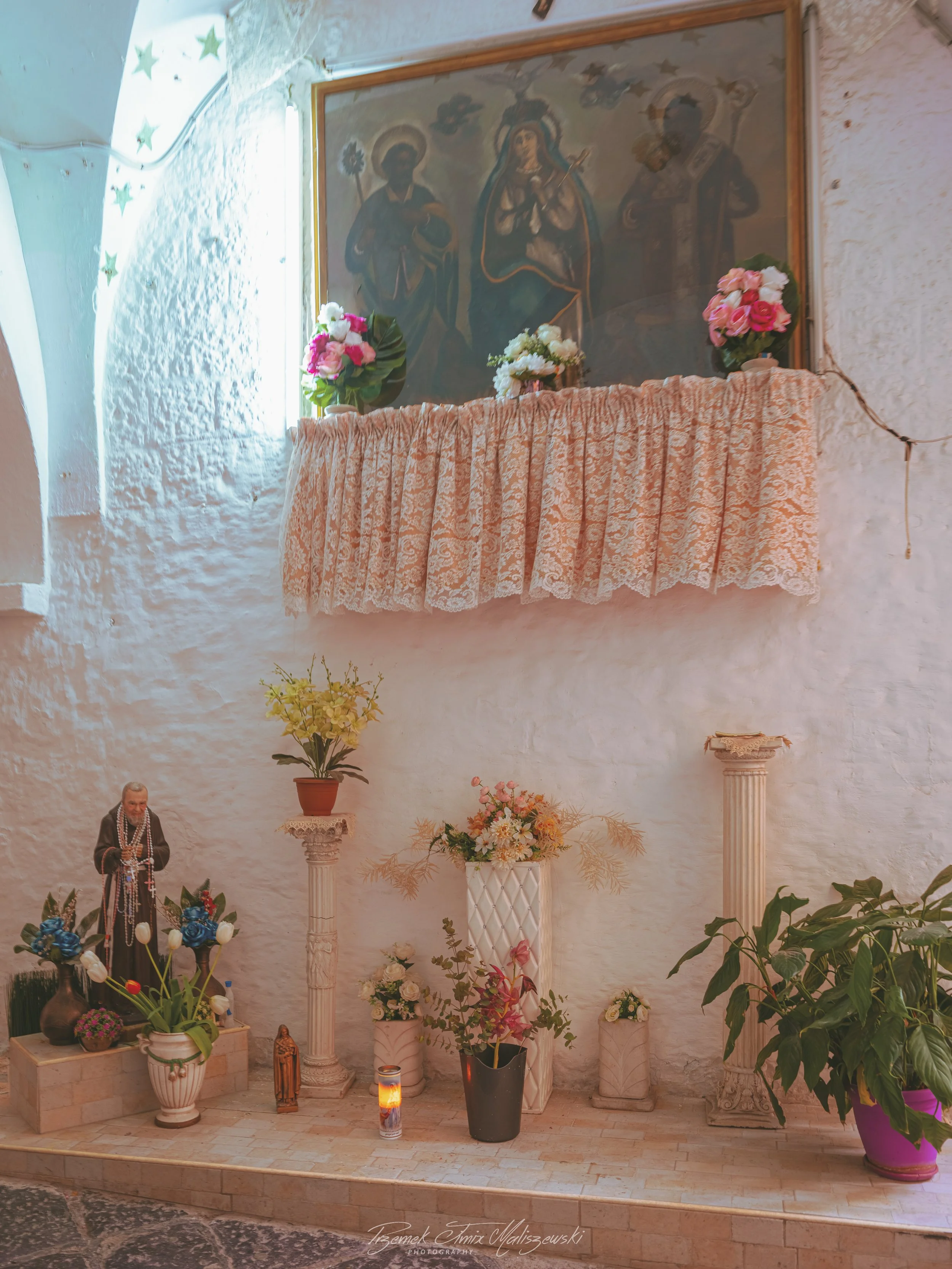
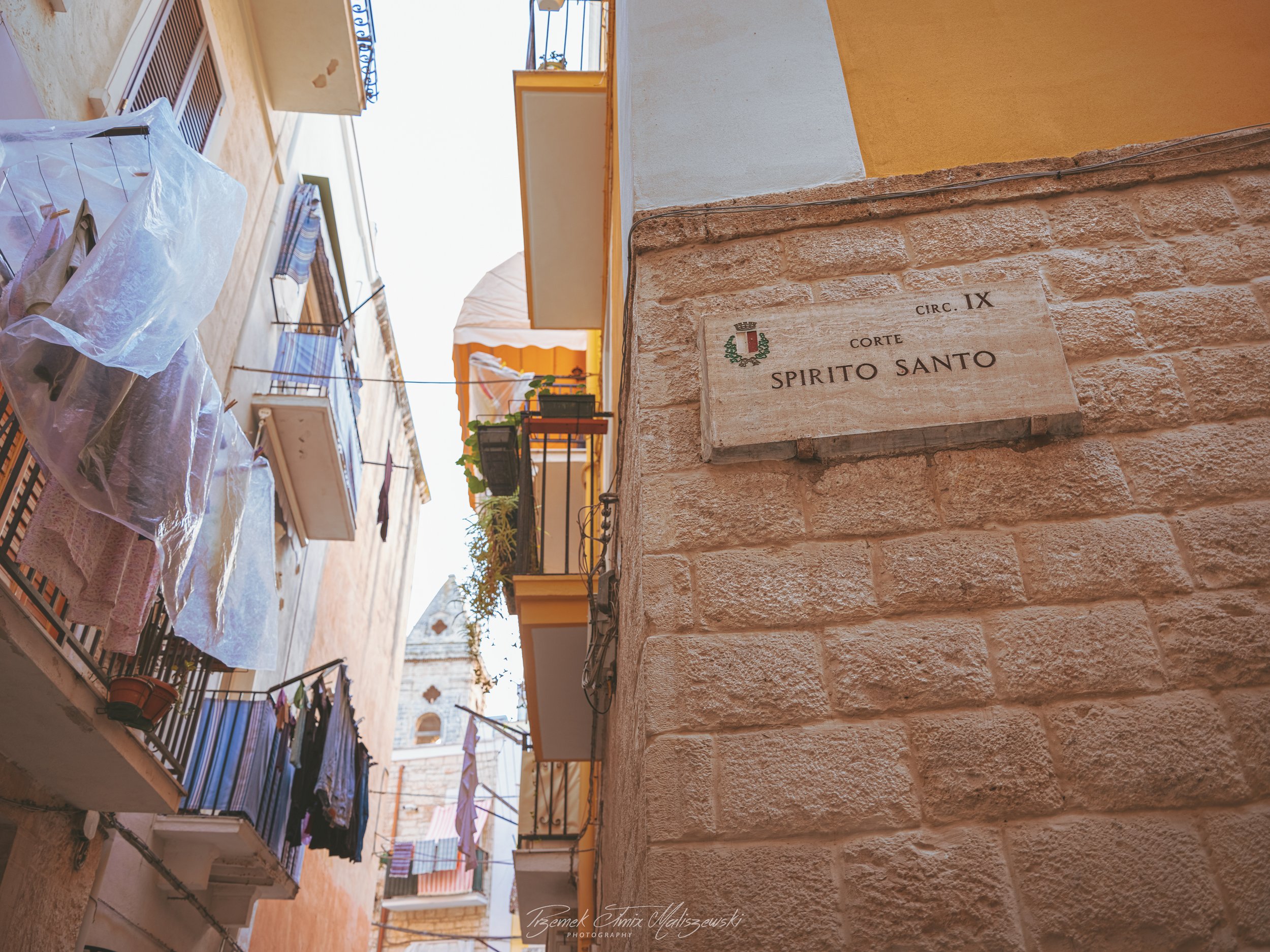
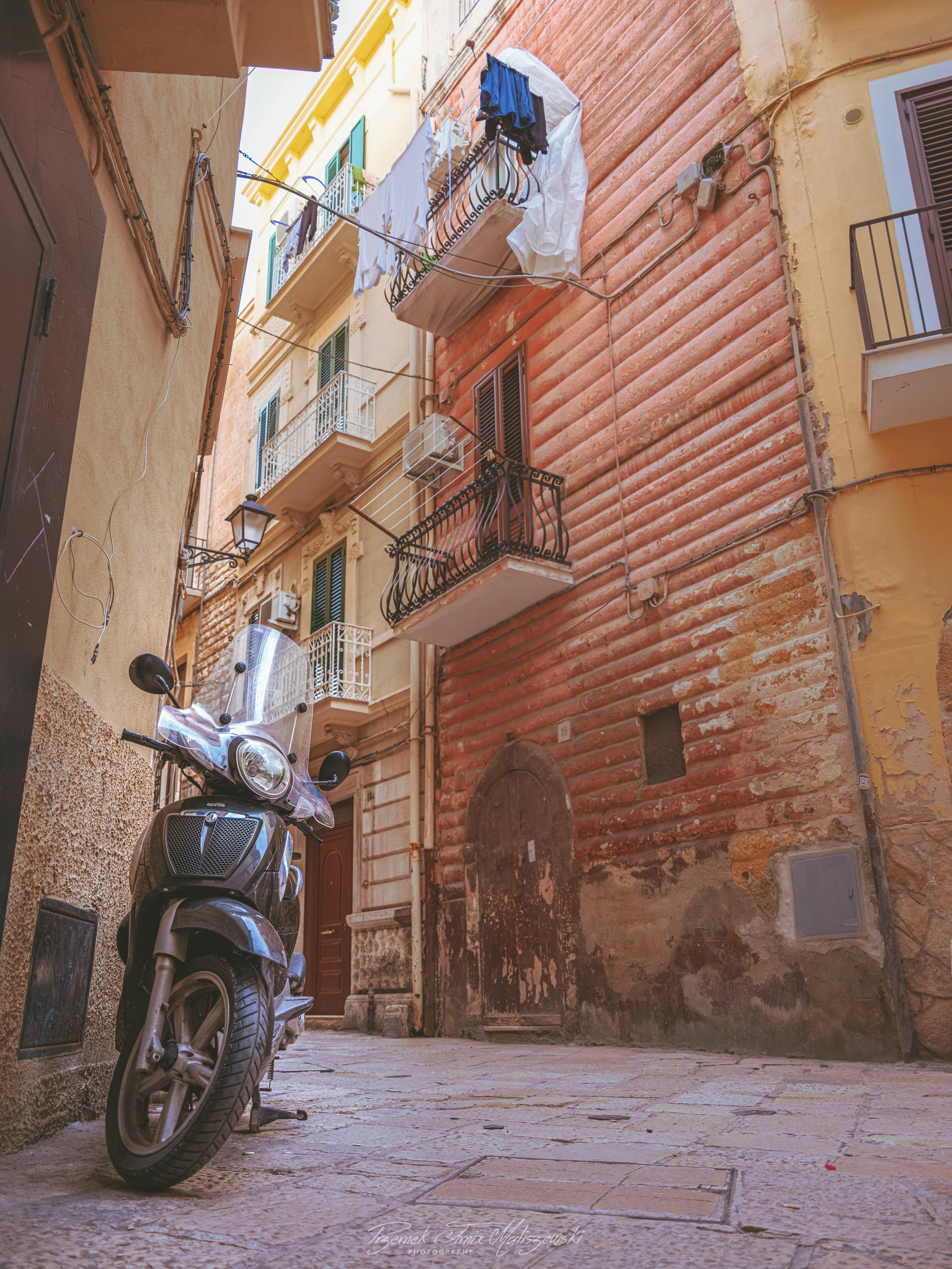
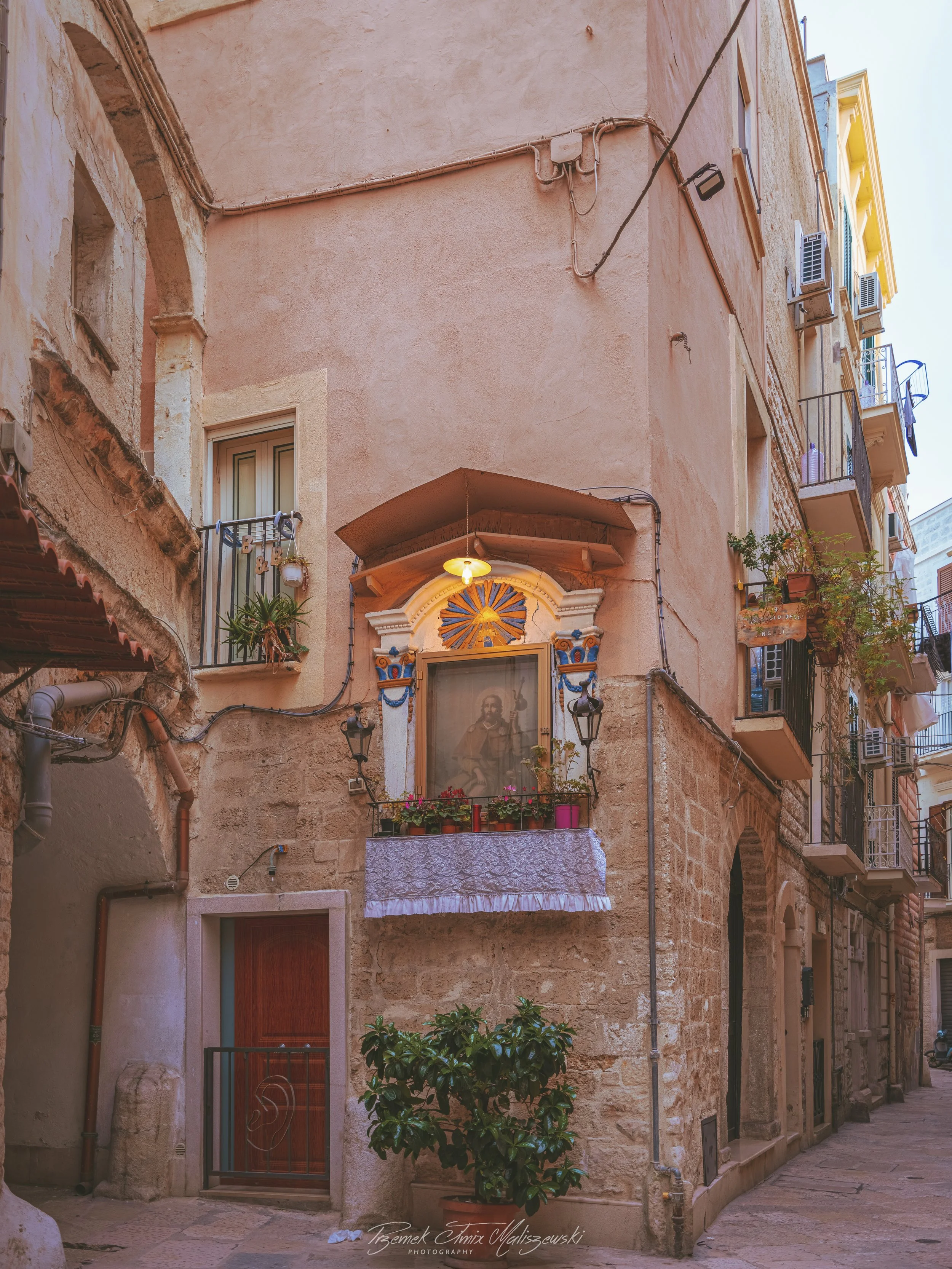
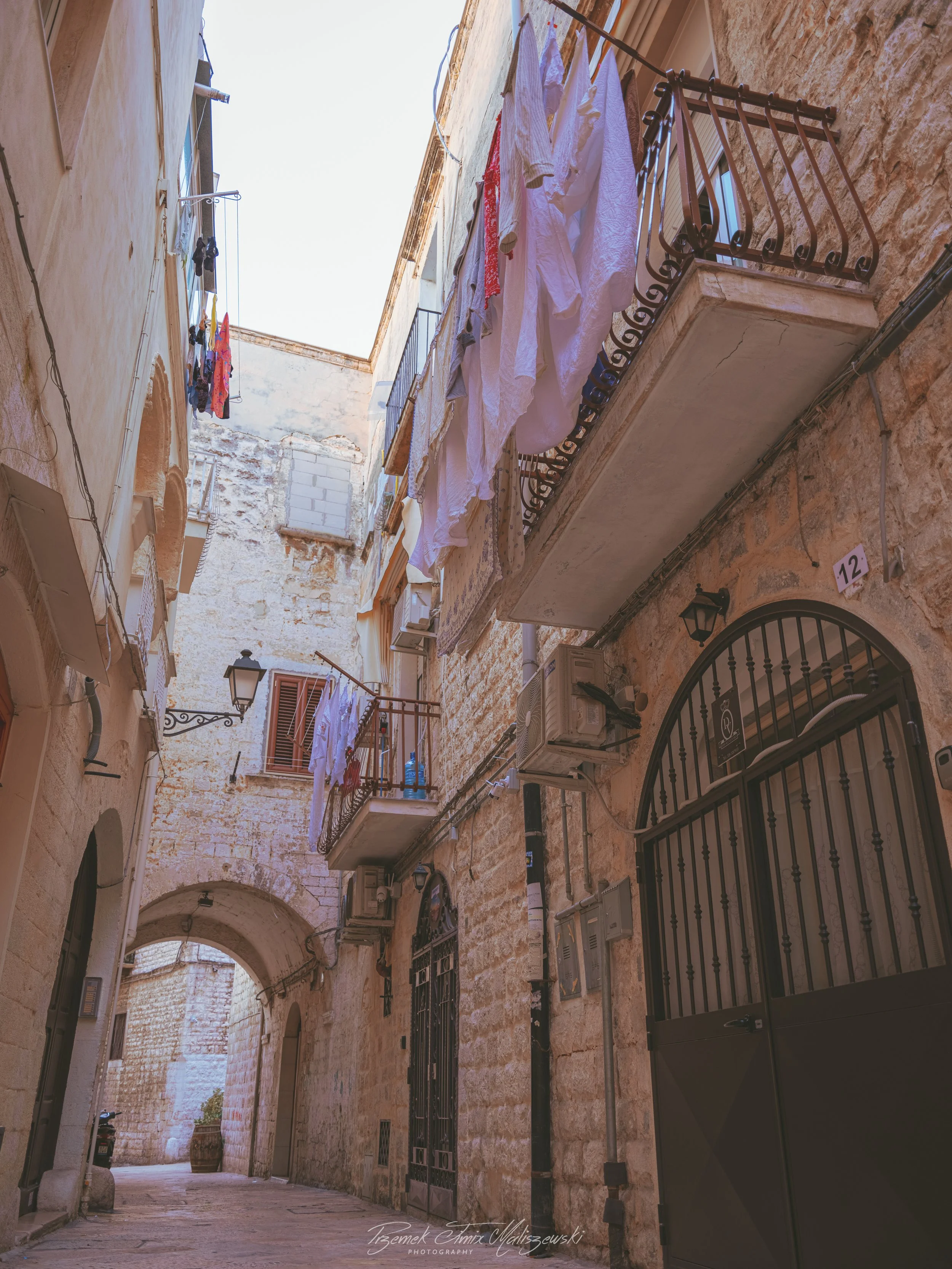
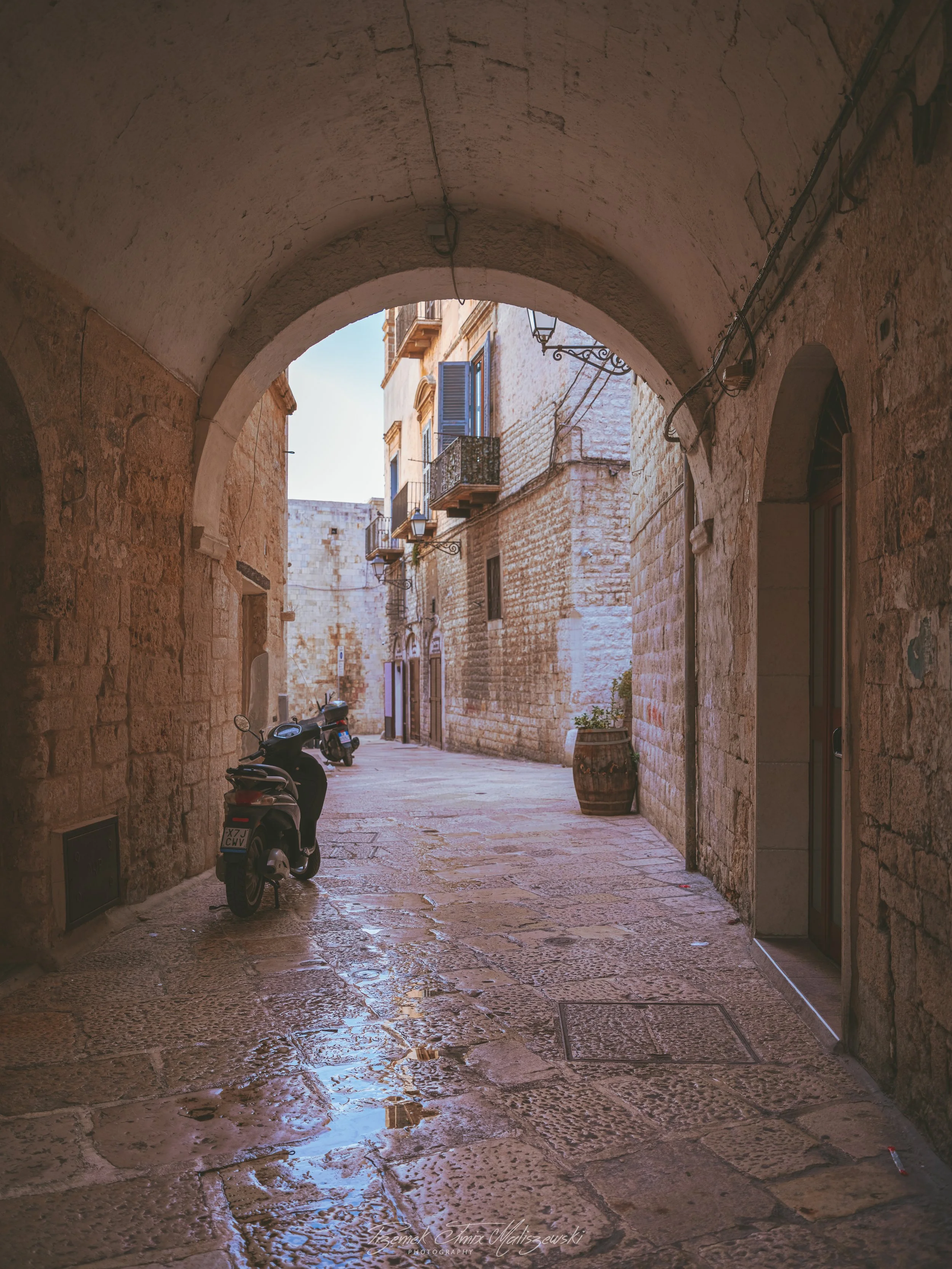
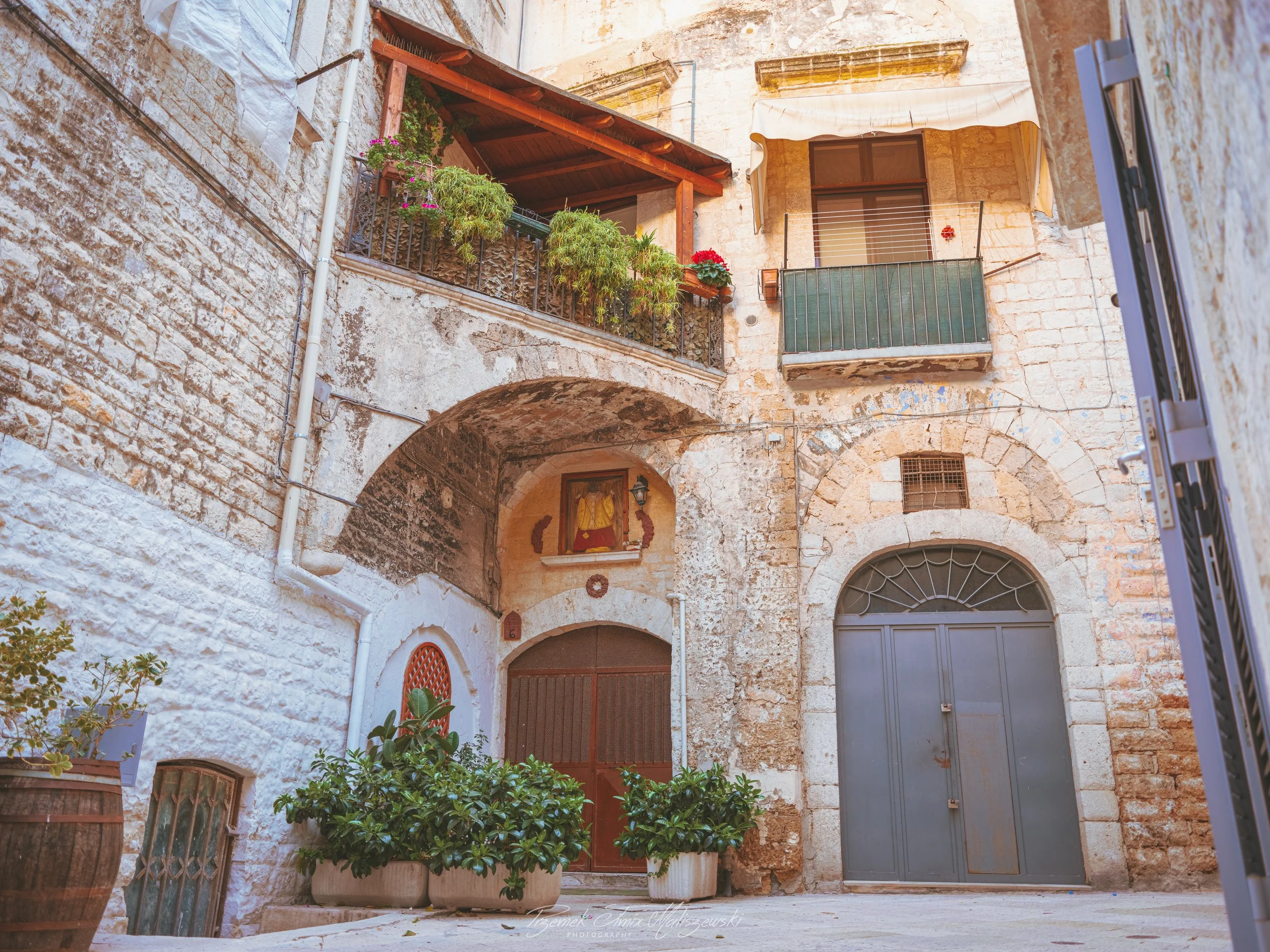
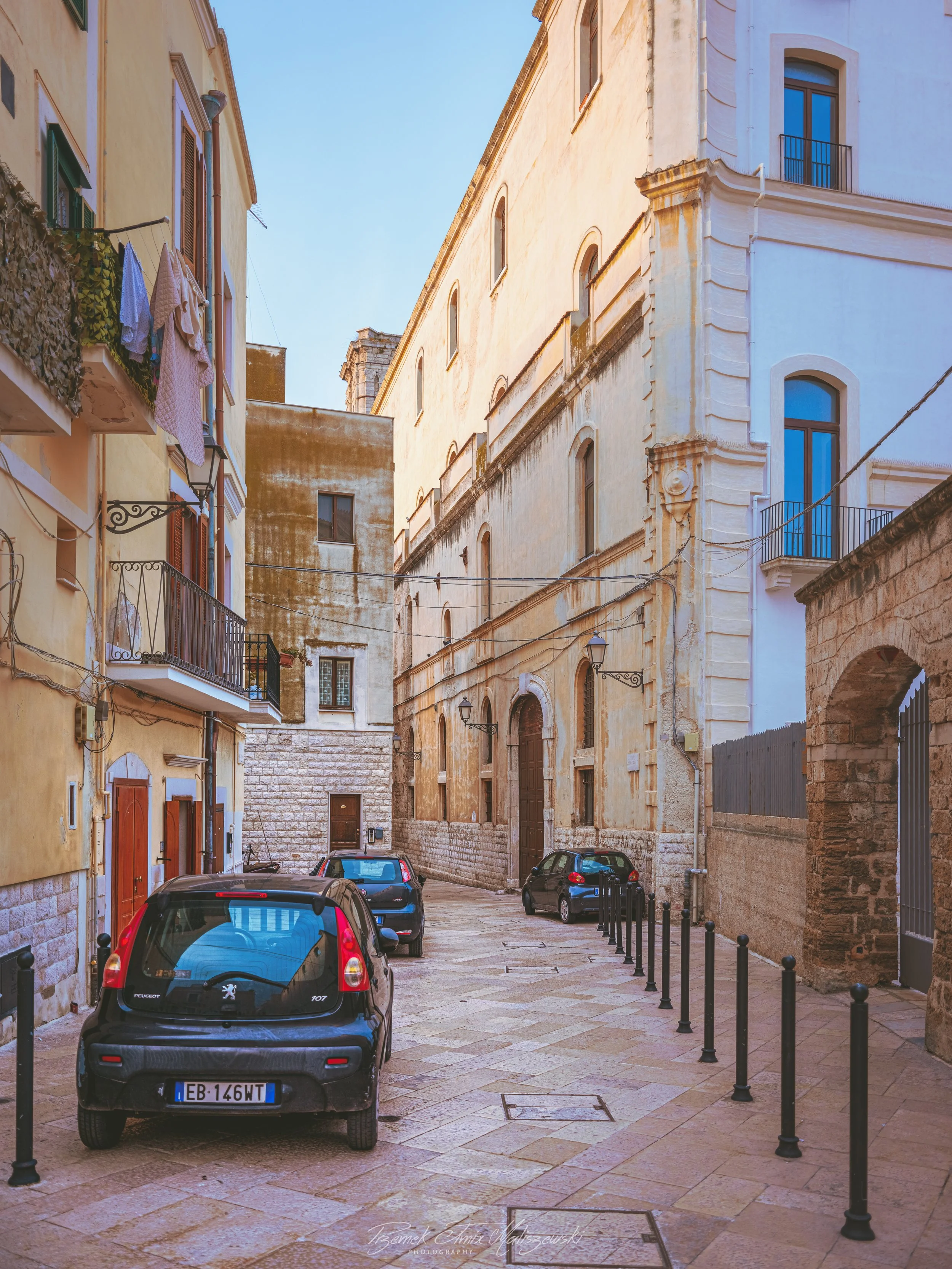
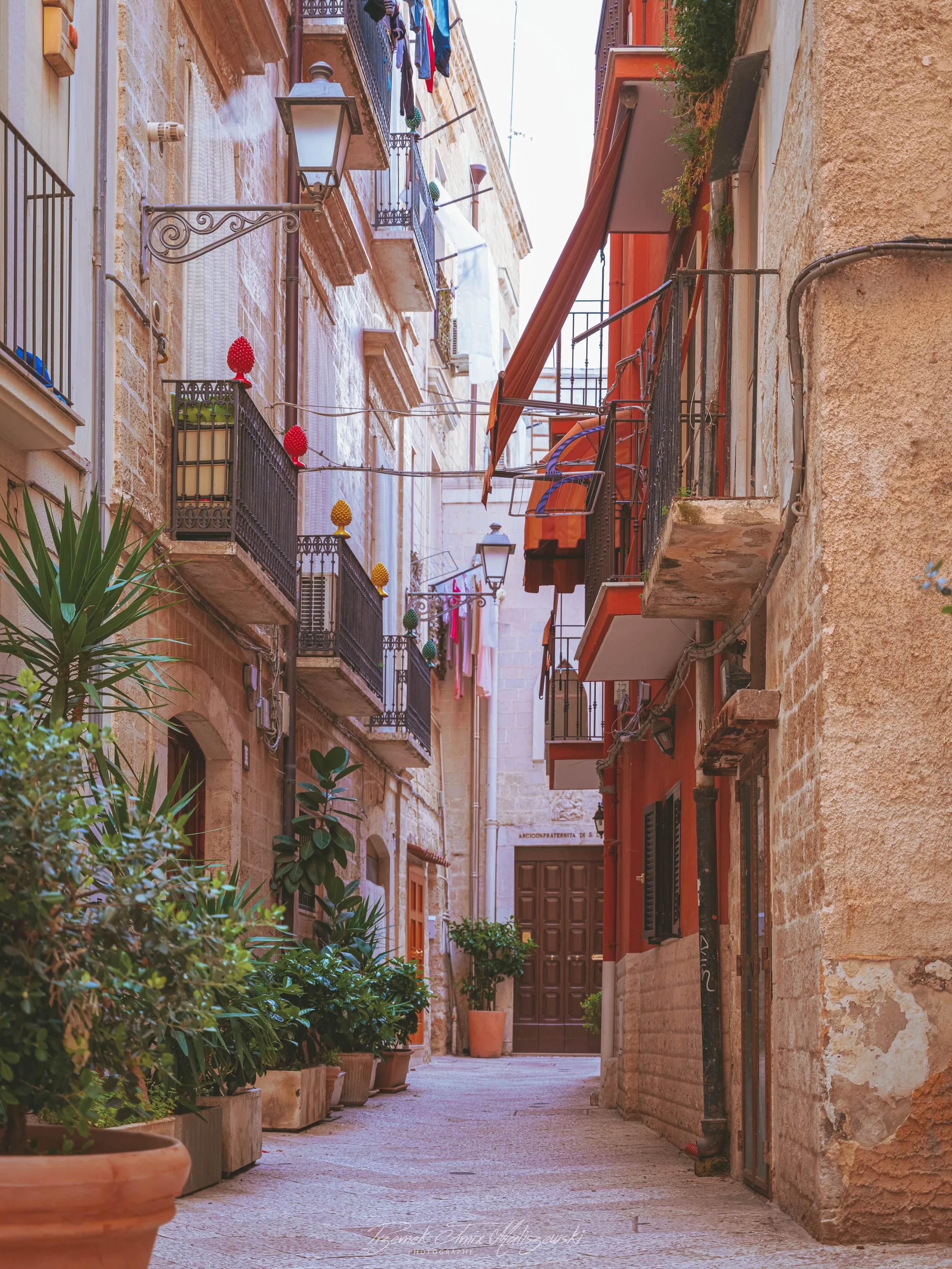
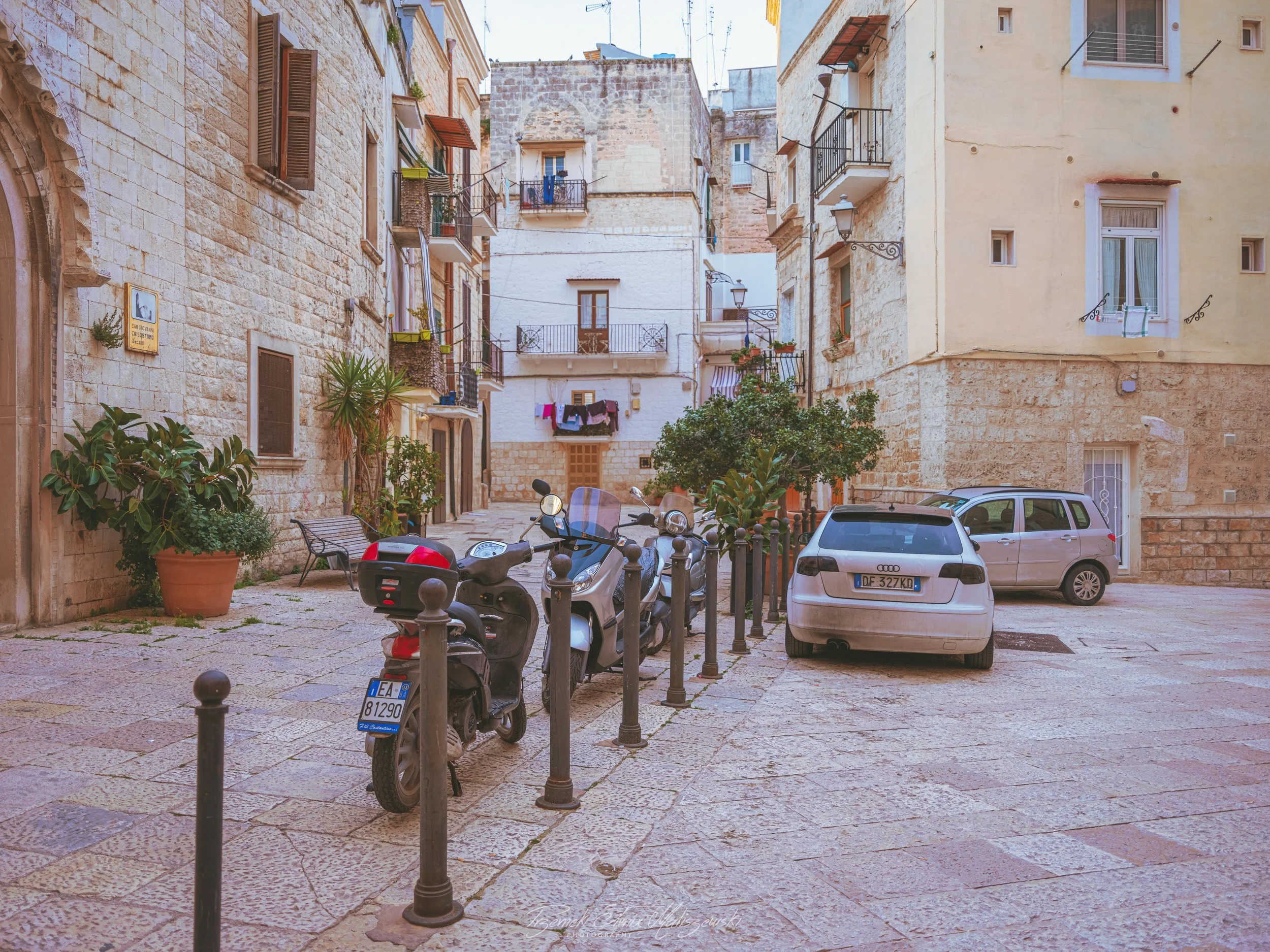
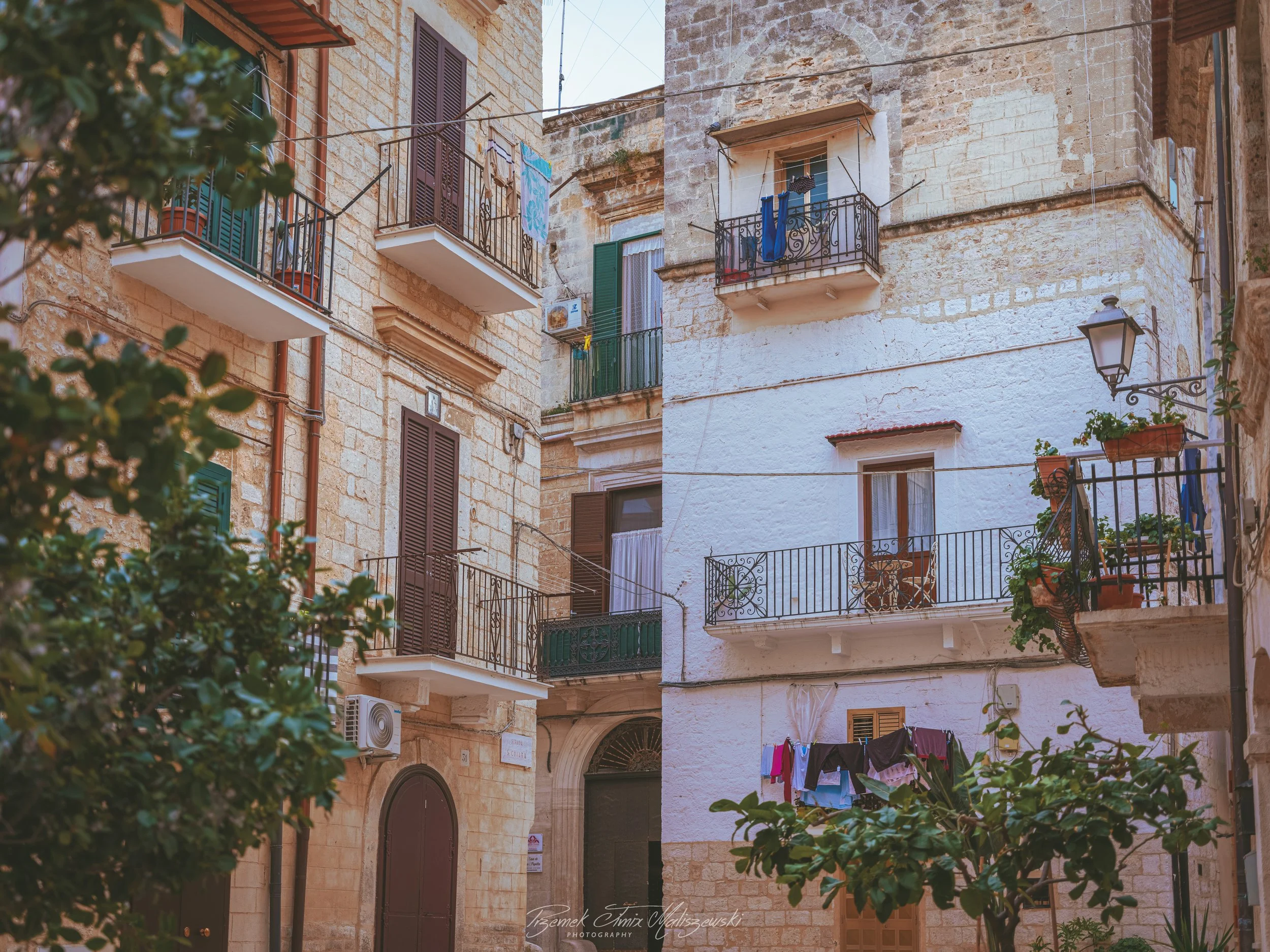
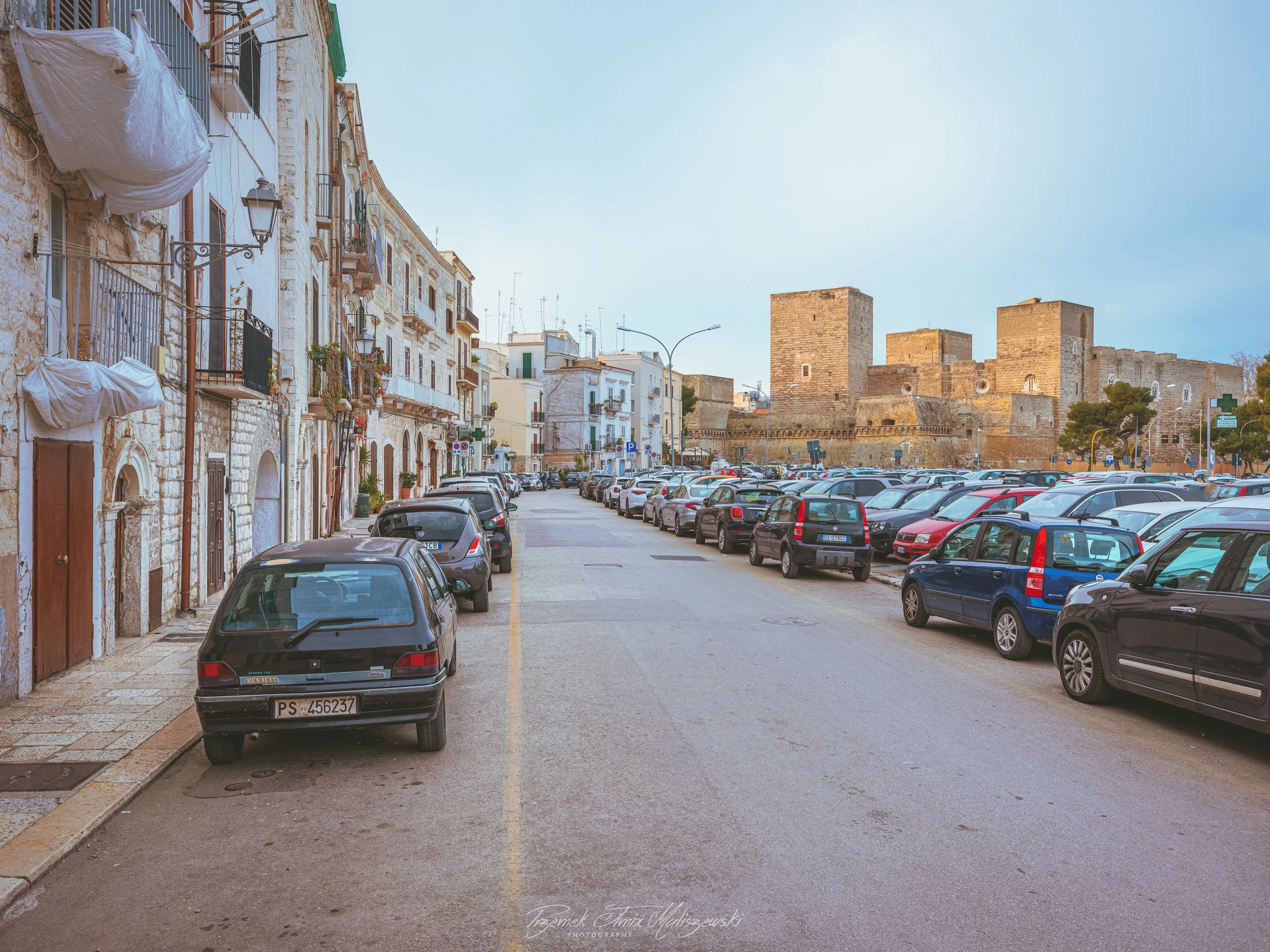
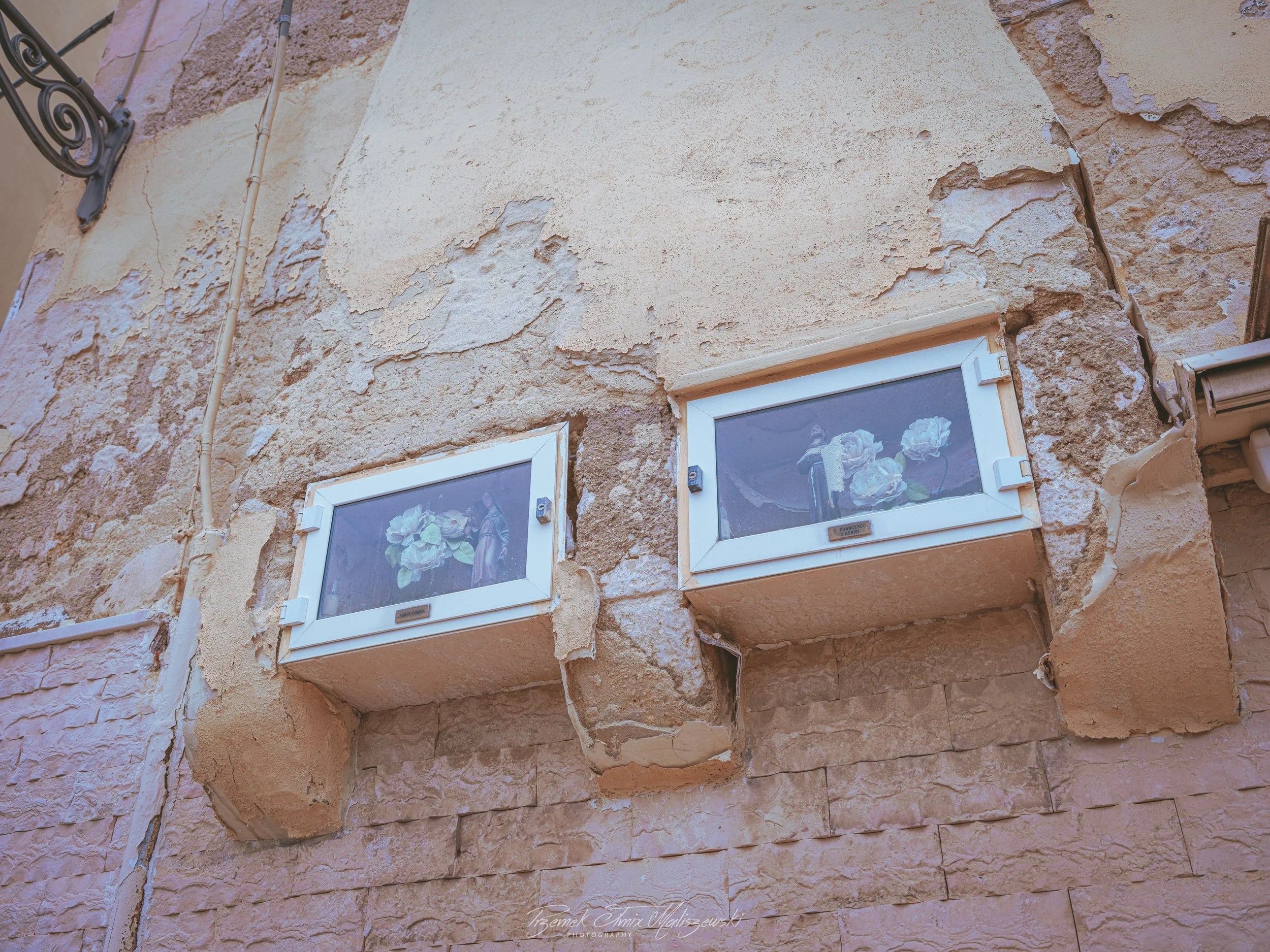
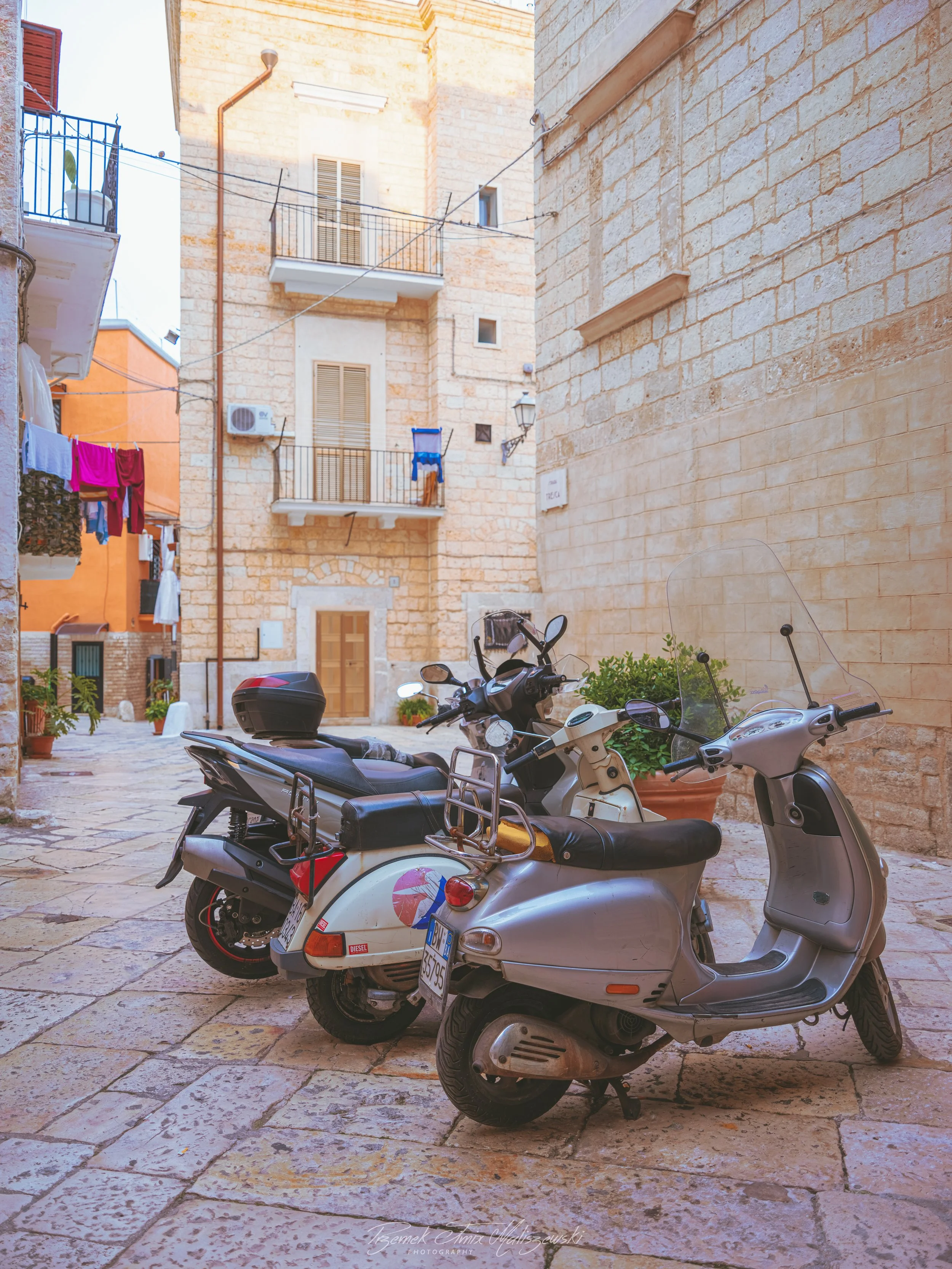
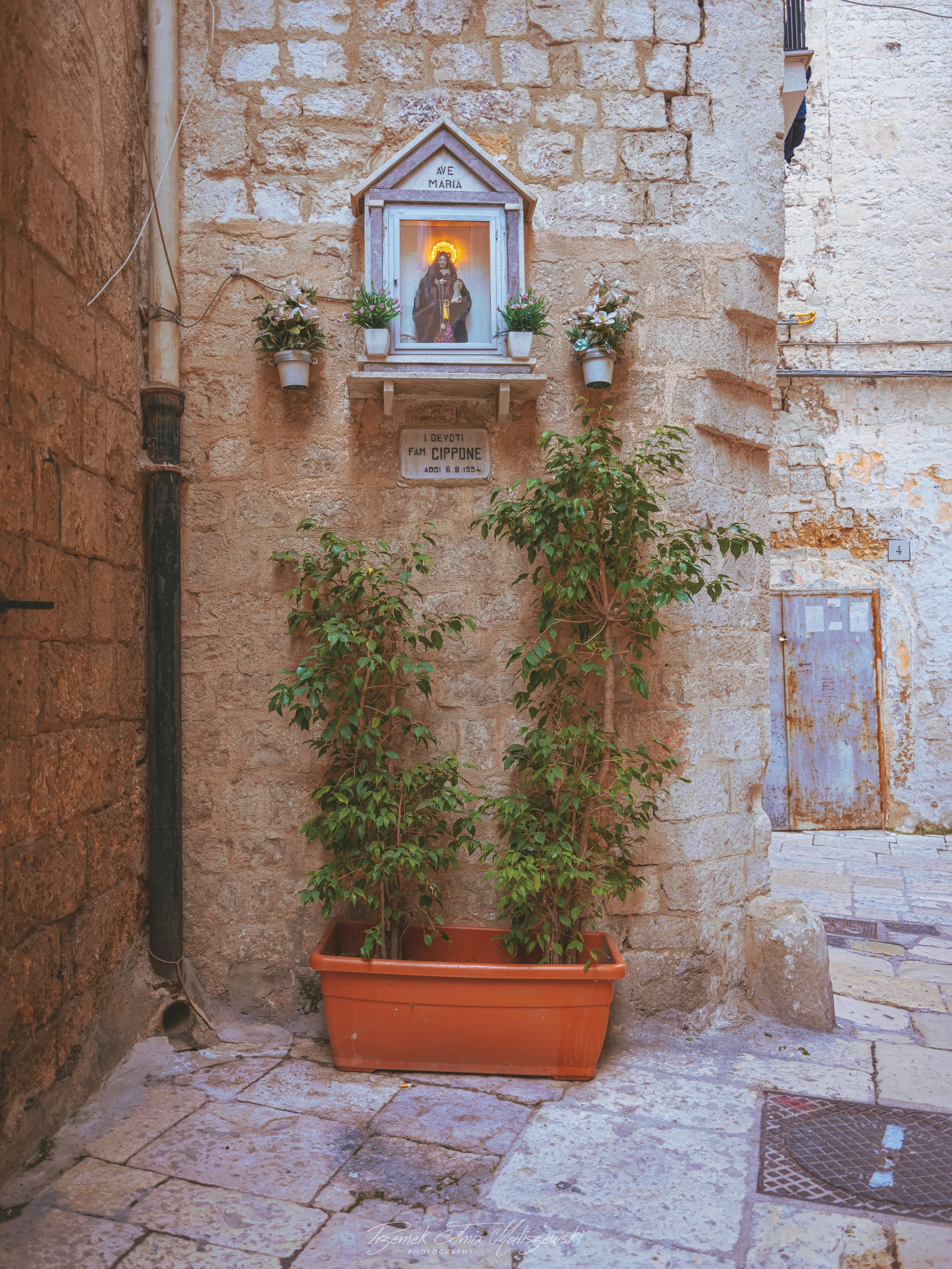
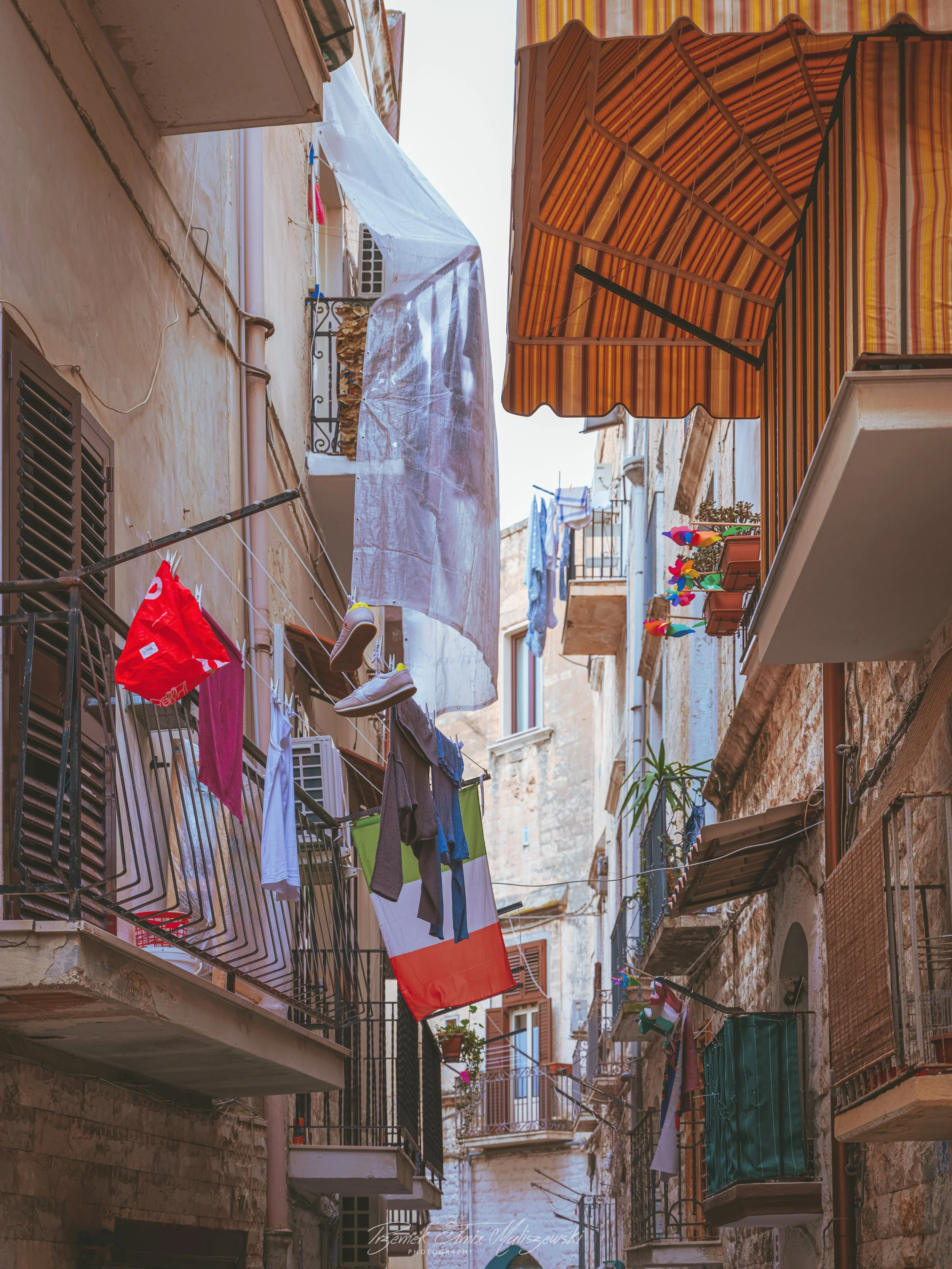
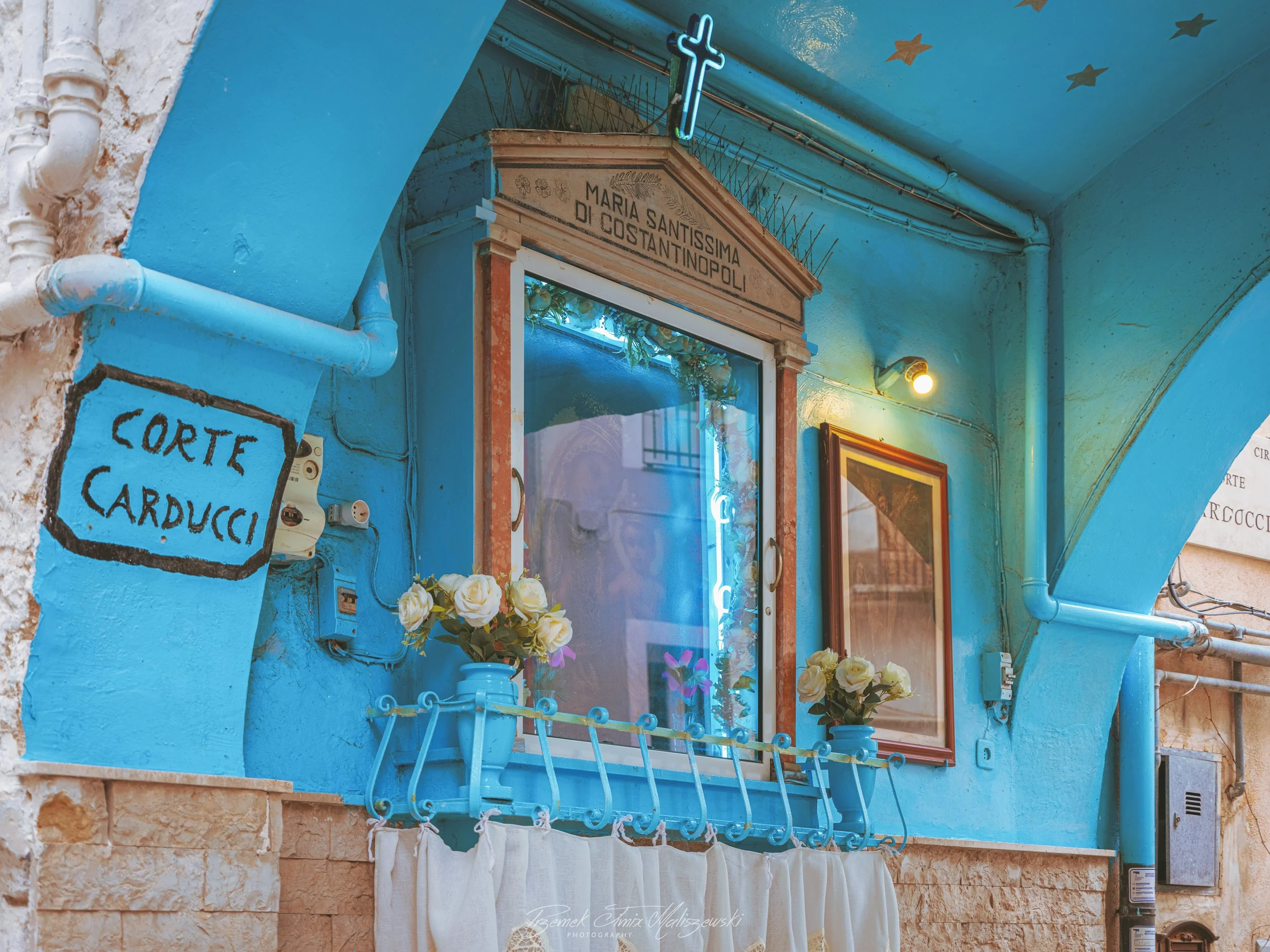
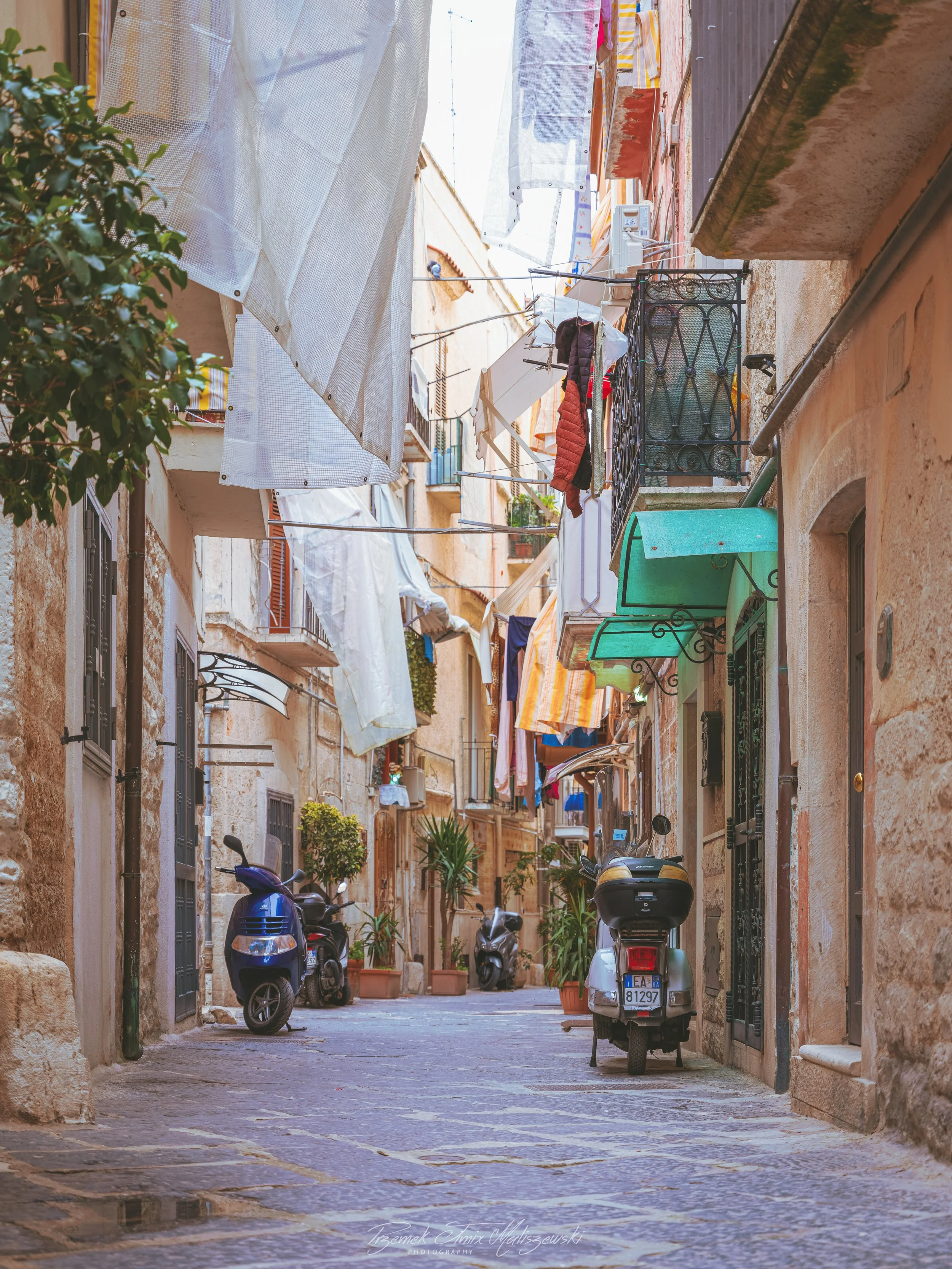
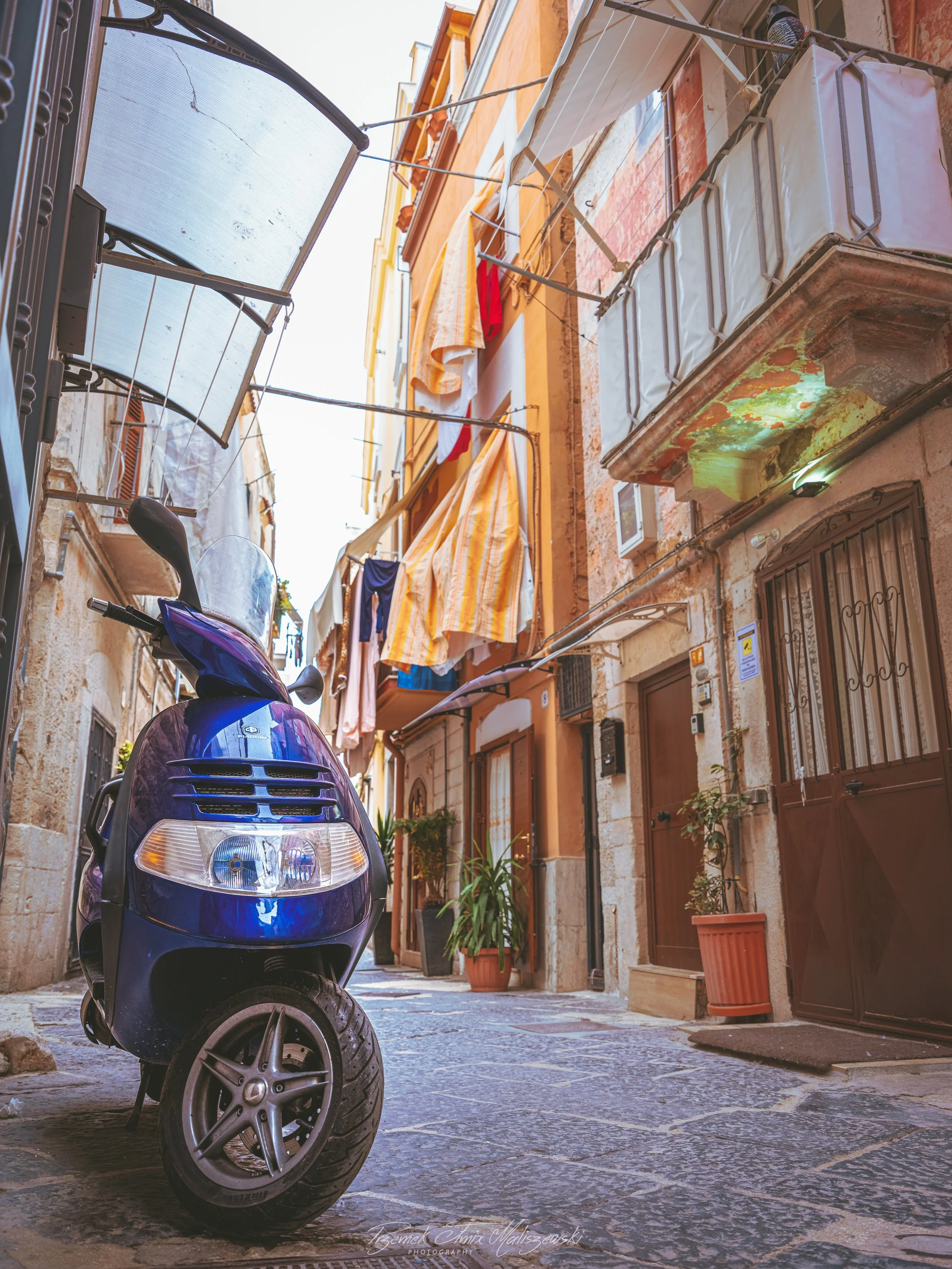
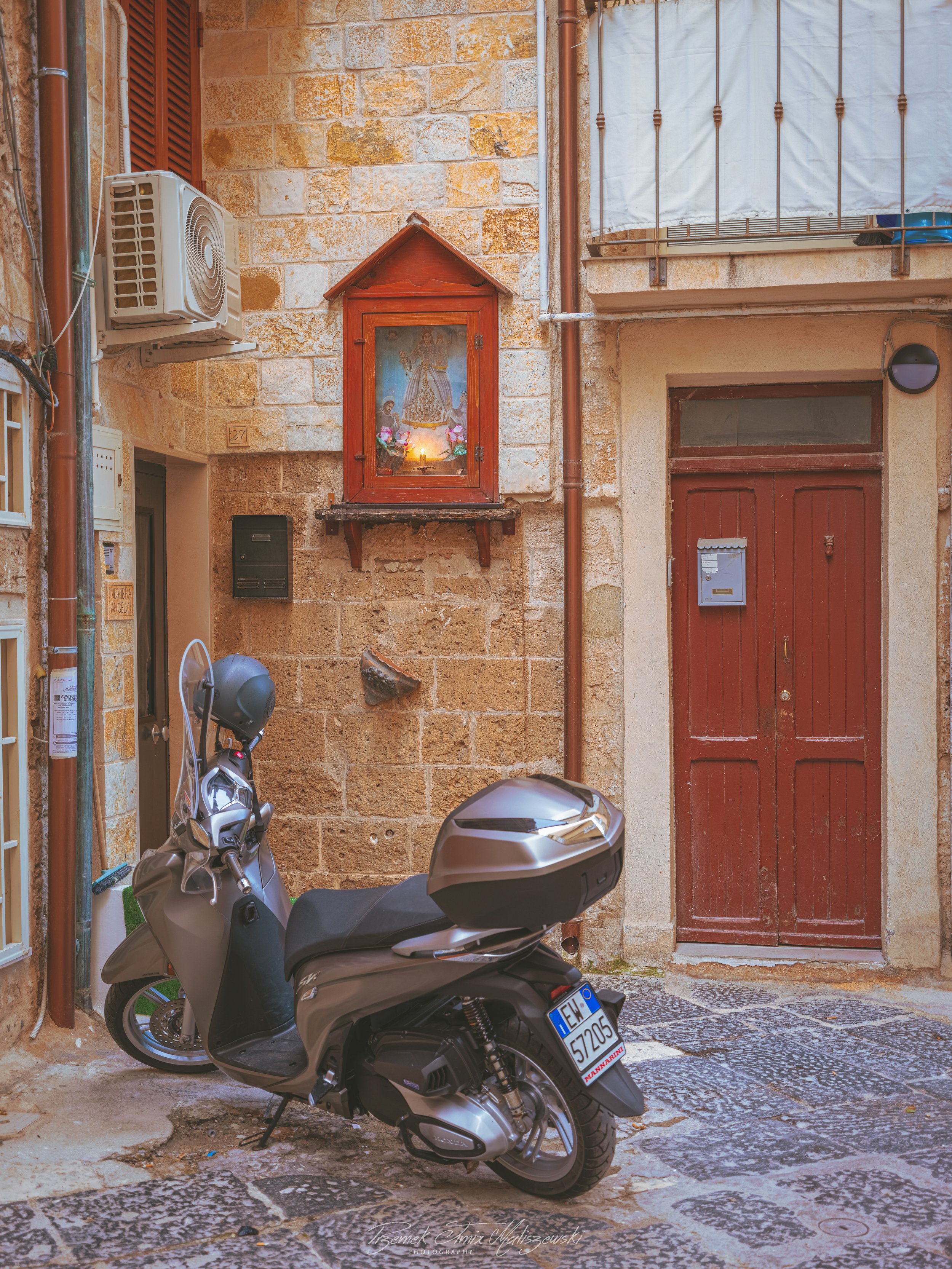
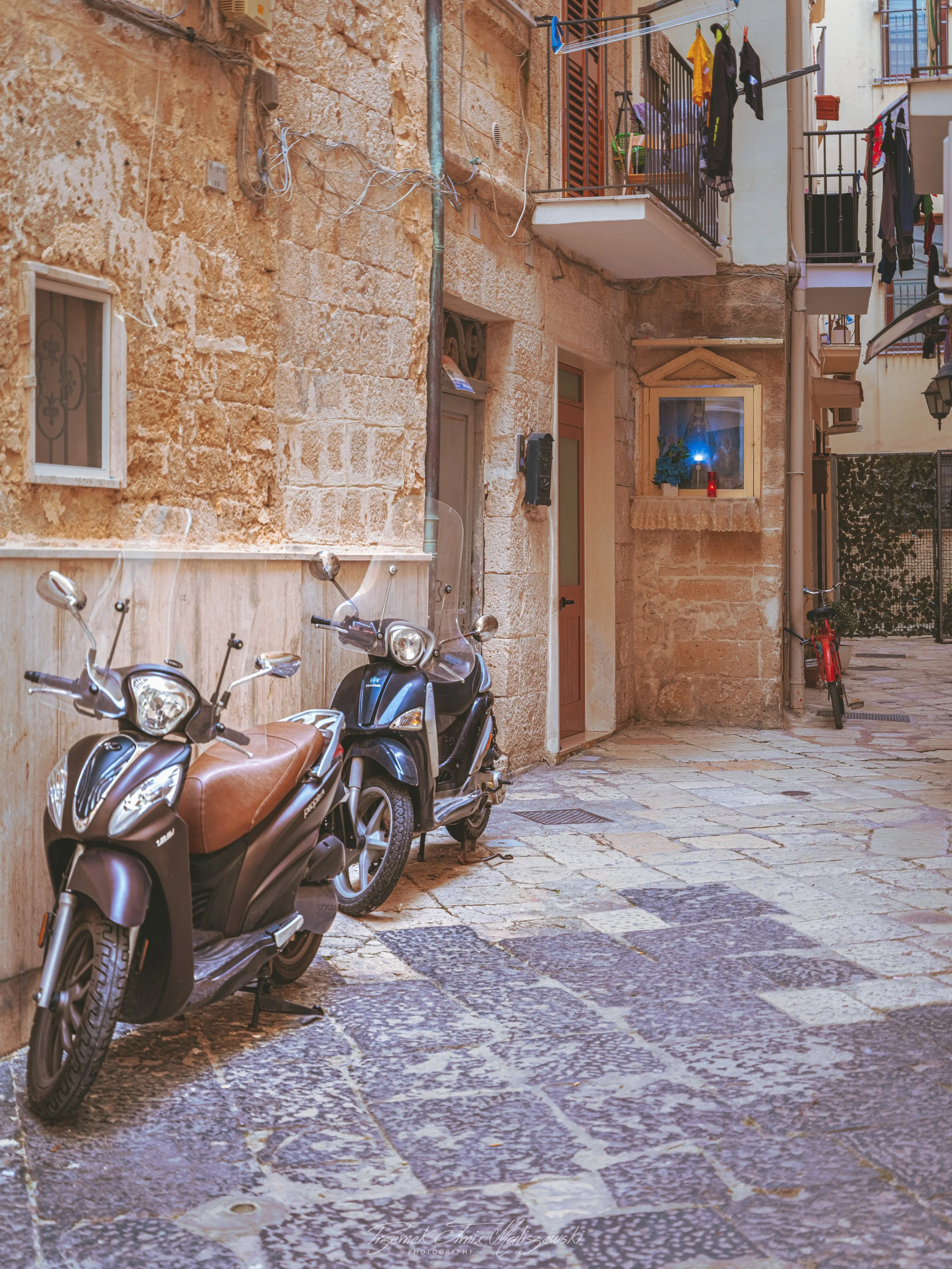
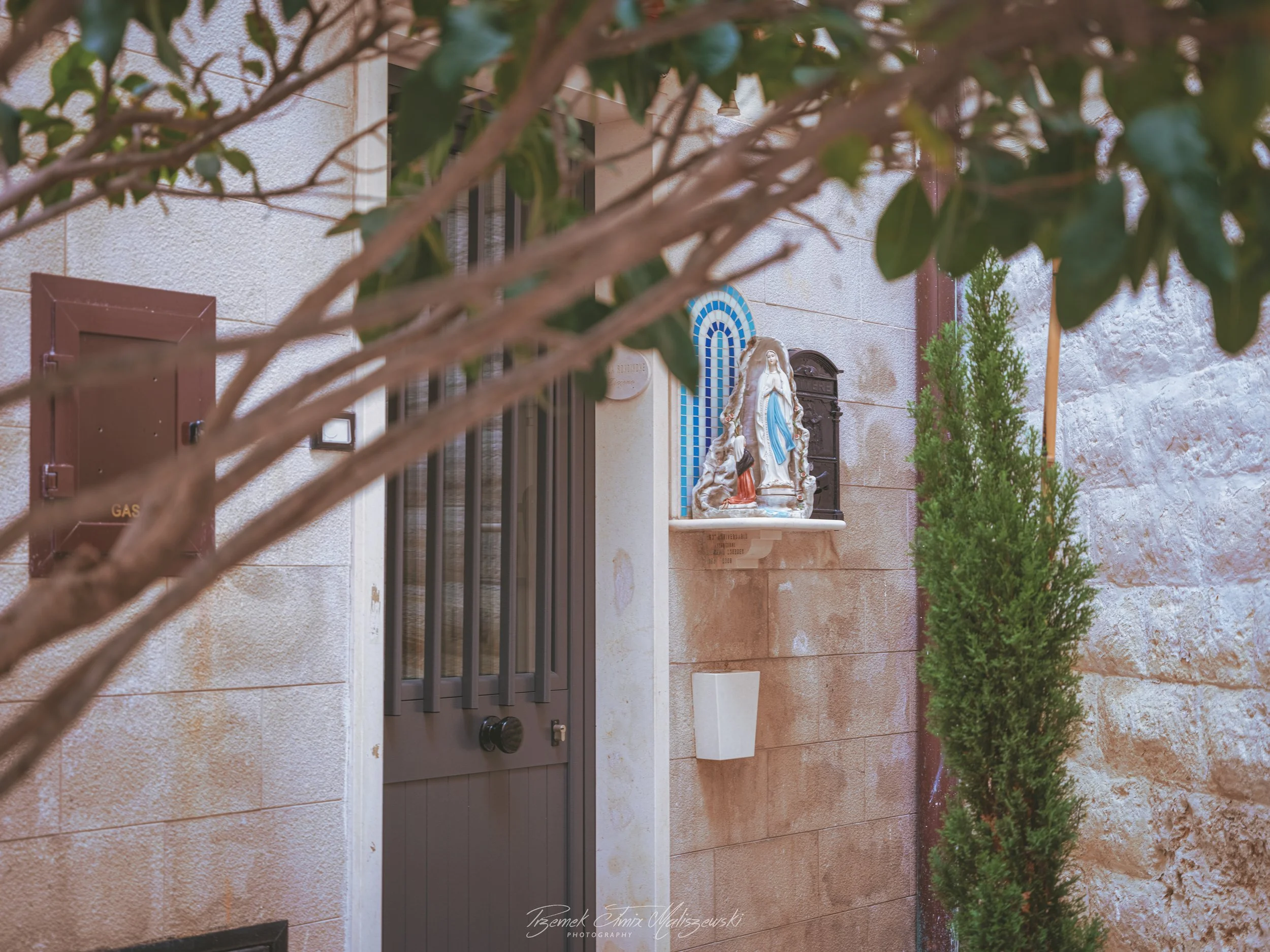
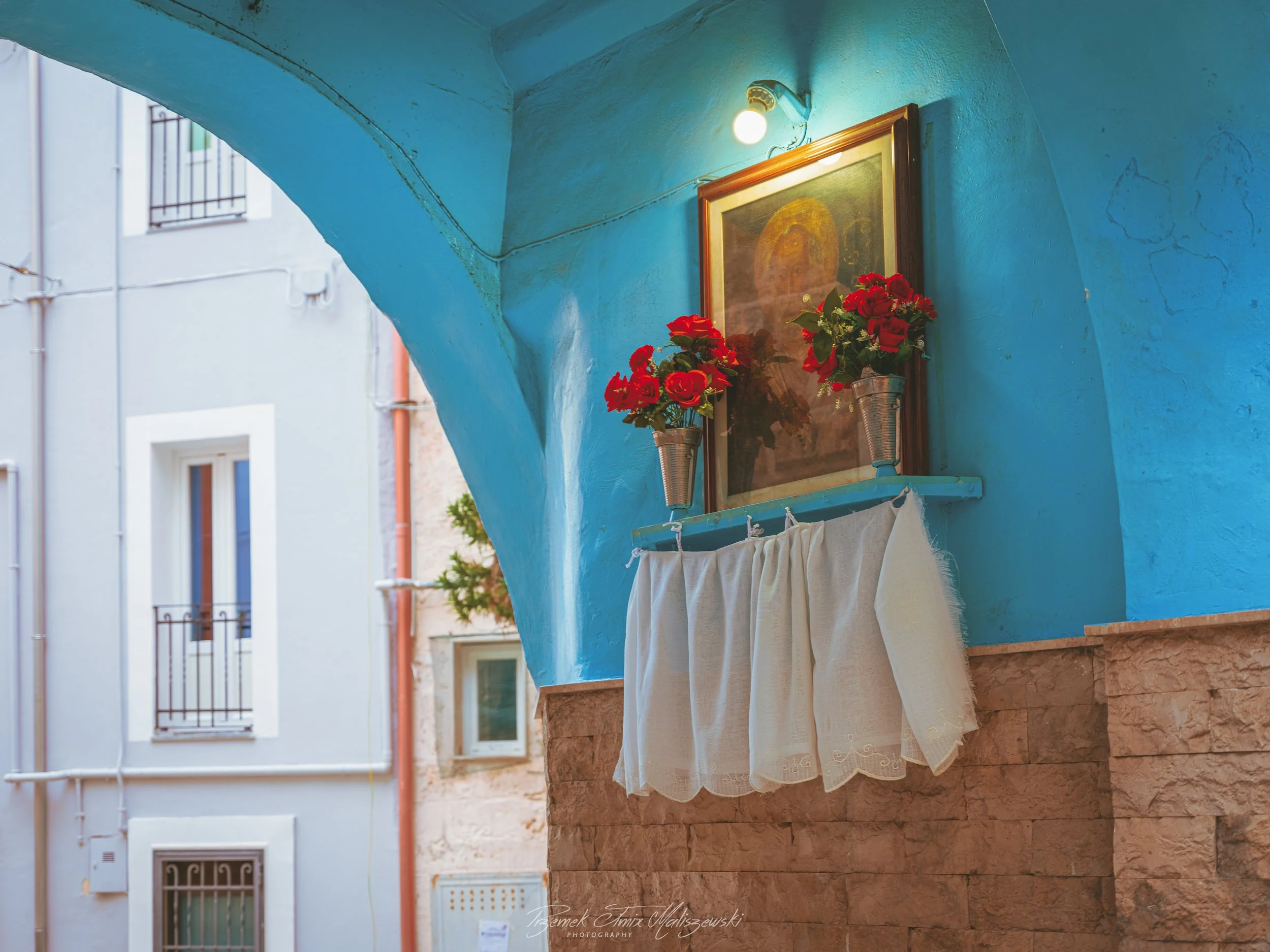
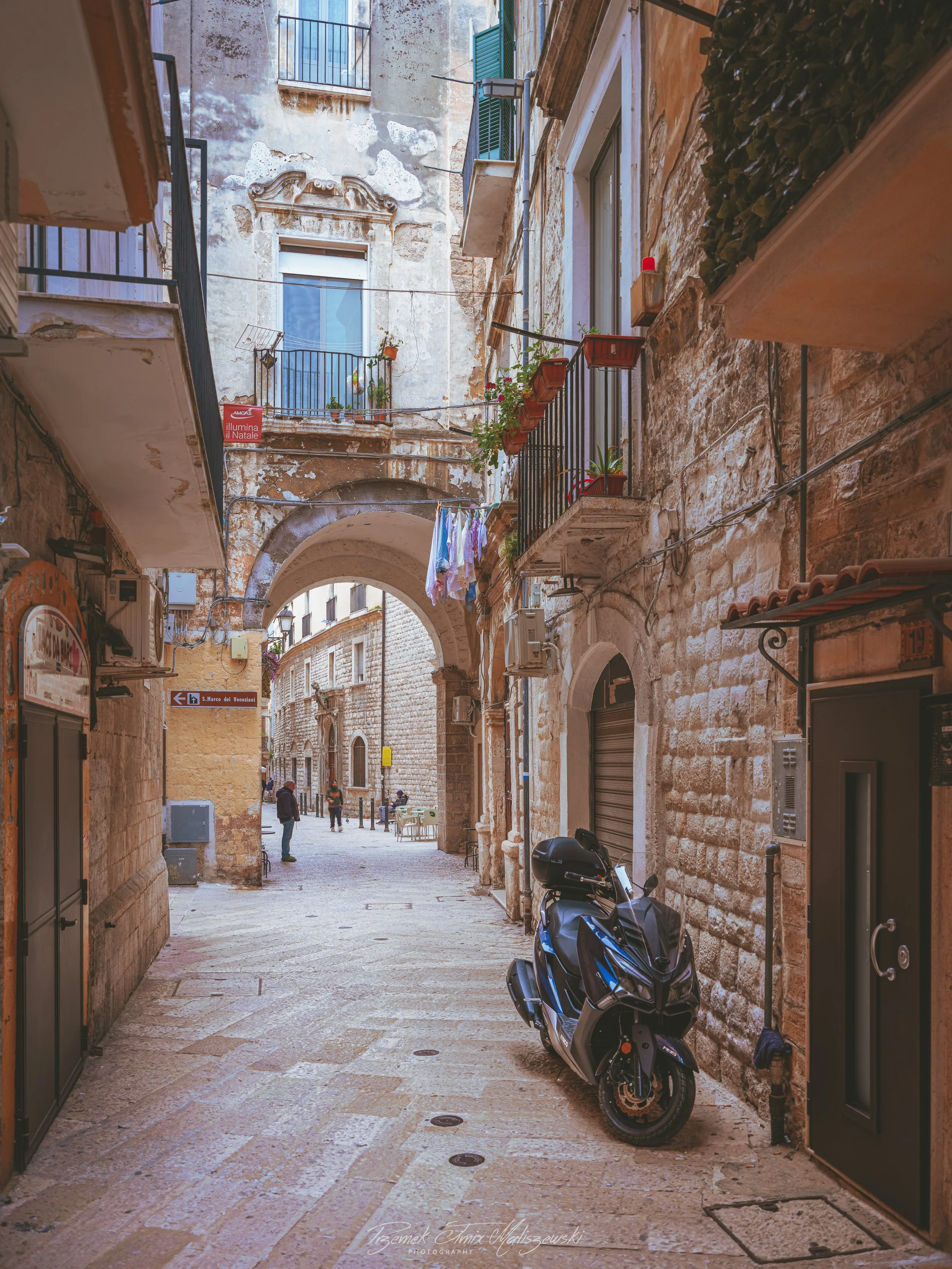
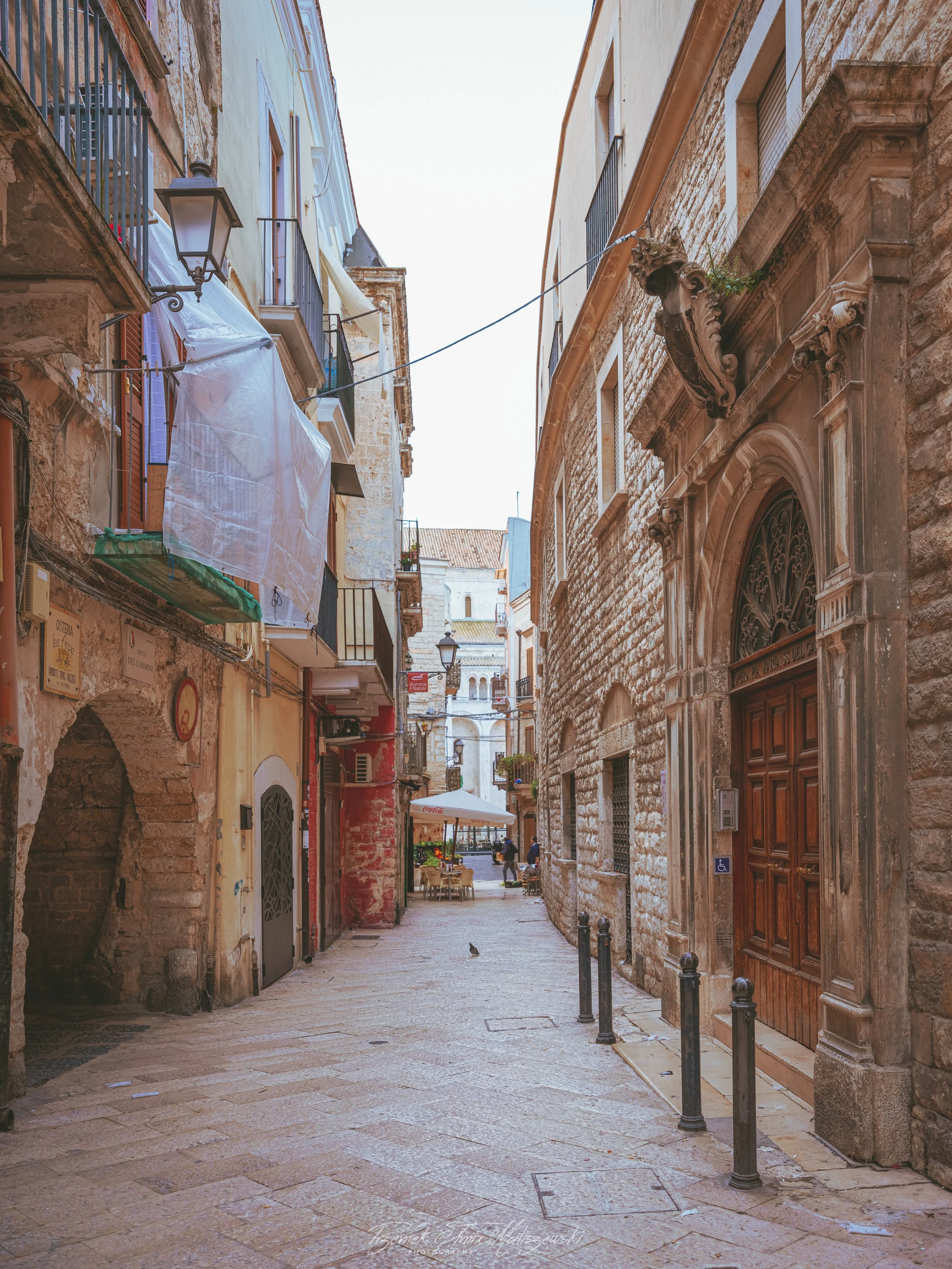
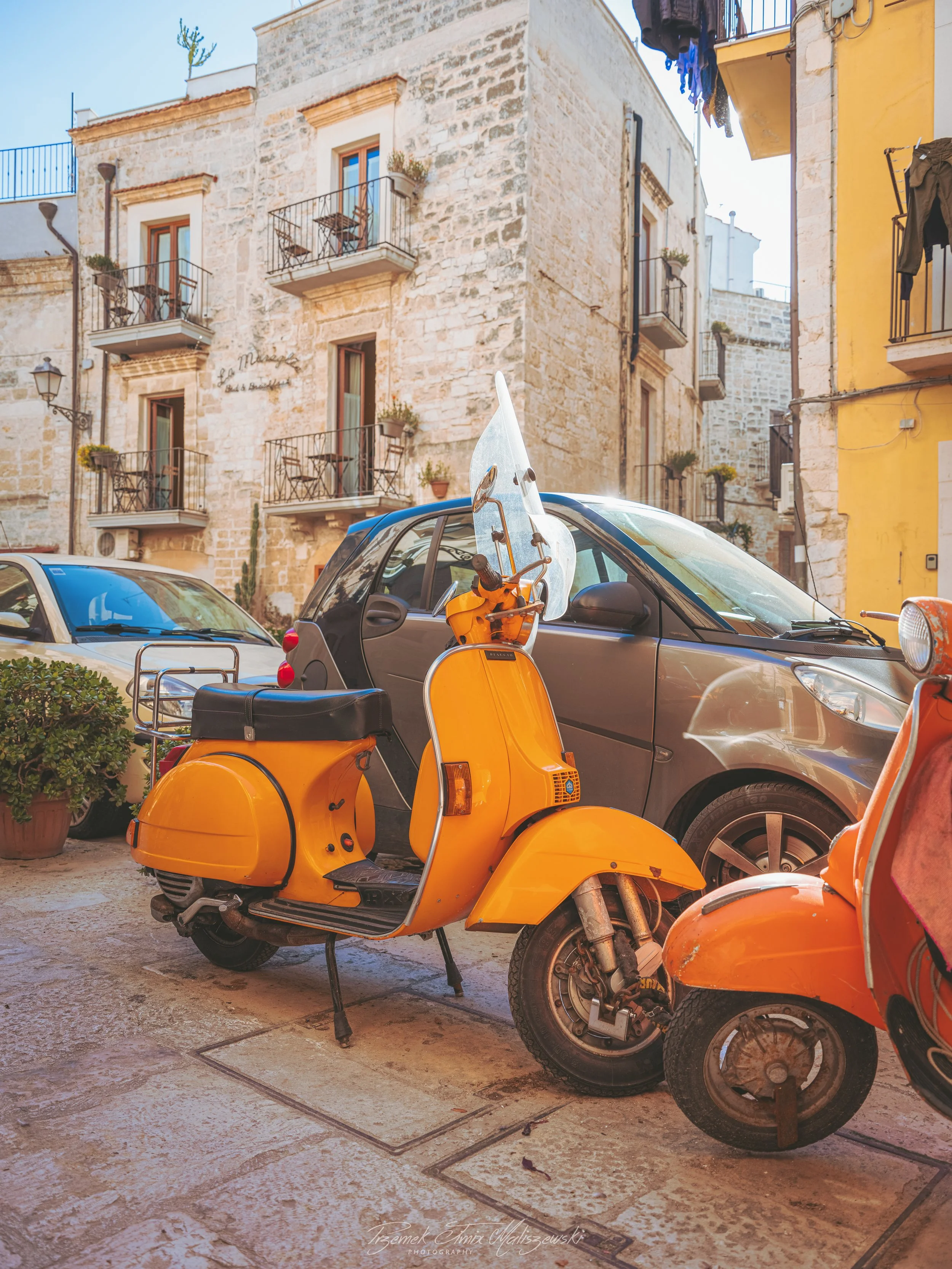
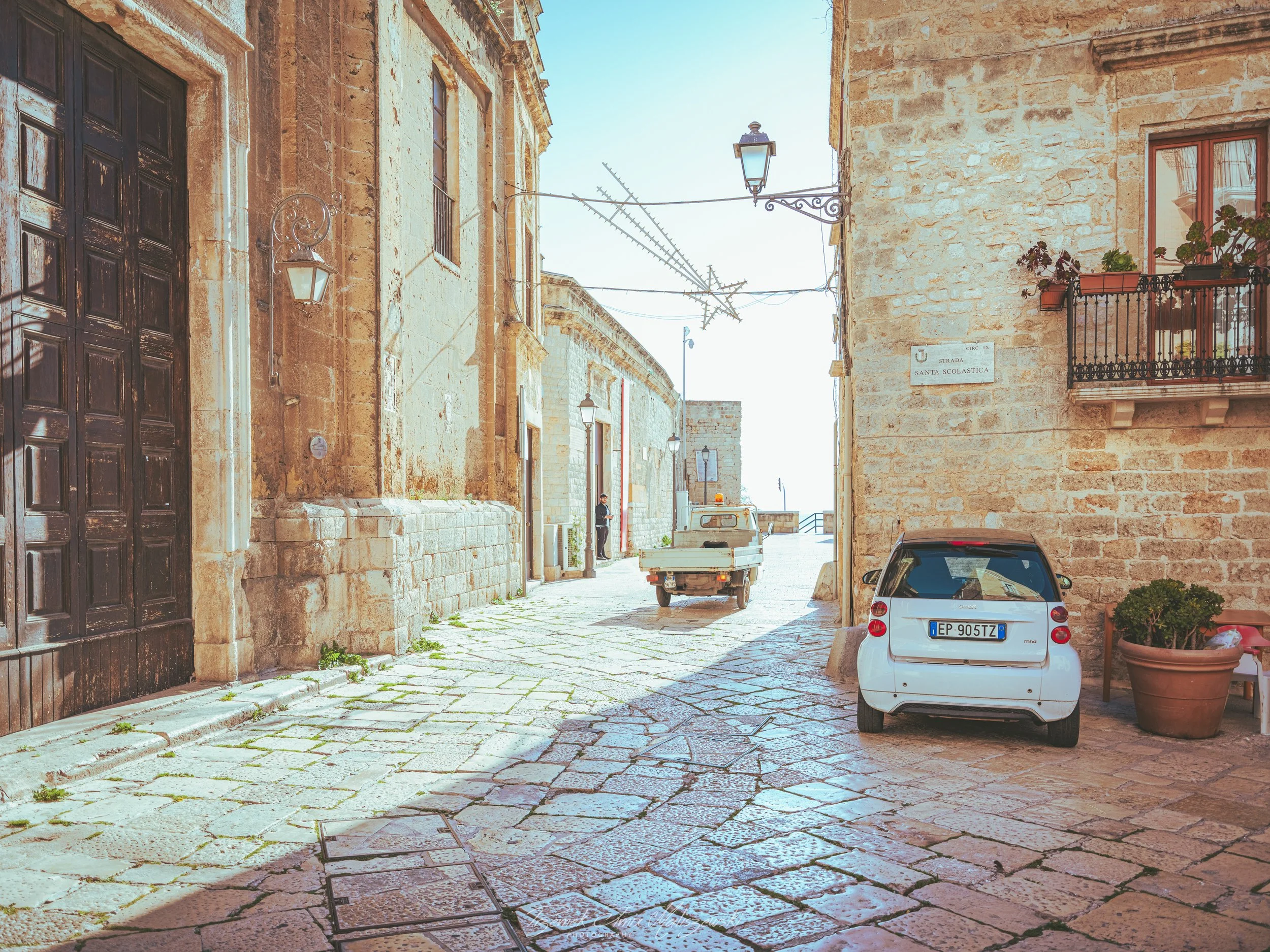
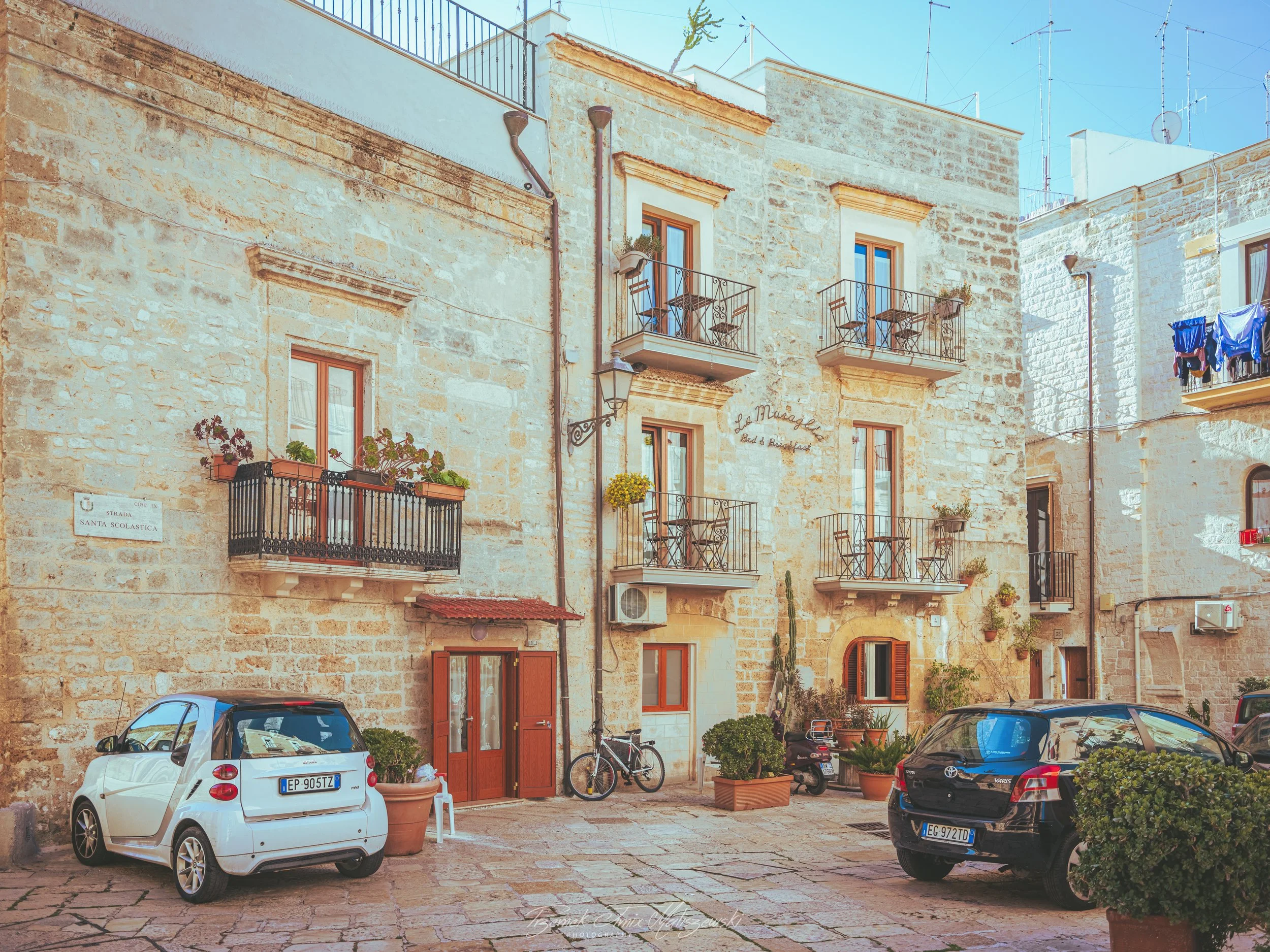
Being in Bari, we did not feel the presence of such high industrial activity, however. Quite the contrary, Bari seemed to us a very peaceful city, large, elegant, but still peaceful for southern Italy. Especially its old part, where we stayed and spent the most of our time, namely Bari Vecchia. And it was this old part of Bari that charmed us the most. Labyrinths of narrow streets, small piazzete, shrines and altars with Padre Pio and the Mother of God at every turn, and on top of that, of course, laundry lines strung overhead, the sounds of life taking place in homes, clinking dishes, the sounds of conversations, sometimes arguments and singing, church bells ringing from time to time, and the murmur of a living city.
The morning vibes of Bari Vecchia.
As always, which I try to emphasize each time, it is worth exploring the city early in the morning, long before the invasion of tourists and just before the cafes open. It is especially worth doing so when photographing. Southern cities are most beautiful in the morning. The morning light is the best. And in Italy it is different, much like it is different on the coasts of Spain and Portugal. It reflects off pastel blues and yellows of walls, off warm sandstone and brick, off sprawling palm leaves, and mixed like this, it penetrates the narrow canyons of winding streets.
A morning walk is the most wonderful time to experience a place and get to know it from that slightly different side, perhaps not as bustling and dynamic, but rather more sincere, perhaps slightly sleepy, even dozing, yawning, quieter, more subtle. In my case, this always works. Of course, it's usually hard for me to get out of bed too; after all, it's a vacation, and when it's a vacation, the mind immediately equals the word "vacation" with the plan of "sleeping until it's over." I am not a vacation terrorist and I don't forbid anyone from sleeping in. Anyway, let me put it this way: you guys sleep as much as you want and until whenever you want, and in the meantime I'm sneaking off to feel the vibe of the new: for a quiet, unhurried walk, for coffee with the locals, to sit down somewhere in an alley and sink into a momentary dolce far niente and meditate over a croissant. And you guys sleep tight, little hamsters.
Colazione in Piazza San Pietro.
We arrived in Bari early and wasted a bit of time before locating the apartment booked in the old town. This is already some time when during our wanderings Google Maps is unable to successfully lead us to the indicated address. That is – yes, the building matches, but where is the entrance? Sometimes one gets the impression that some apartment owners make it a point of honor to hide the way to get to the place from their clients. This time our landlord, Roberto, had to come and show us the entrance. Google Maps, however, got completely lost. Still, not this building. Well, okay, it's the old town, città vecchia, labyrinths and street twists were enough for the poor thing to give up.
A curious Dalmatian dog peers out from its home, across Via Venezia, toward the Adriatic Sea, on the other side of which lies... Dalmatia.
Apartments in Italy in old parts of cities nevertheless have their charm. Being in Naples, we also stayed in the old part of the city, in Quartieri Spagnoli. And the atmosphere was in a way very similar, hidden in those unusual stairwells, in those often bizarre rounded walls, arches, vaultings, timbered ceilings whose beams were not just a design element, but actually supported the ceiling and the floor of the rooms above us, in uneven, whitewashed walls and – importantly – in sounds: the sounds of a living city.
Bari is the capital of Puglia and in a way the gateway to its interior, especially, of course, when arriving there by sea or air (notabene: the airport in Bari is named after Karol Wojtyła – Aeroporto di Bari - Karol Wojtyła).


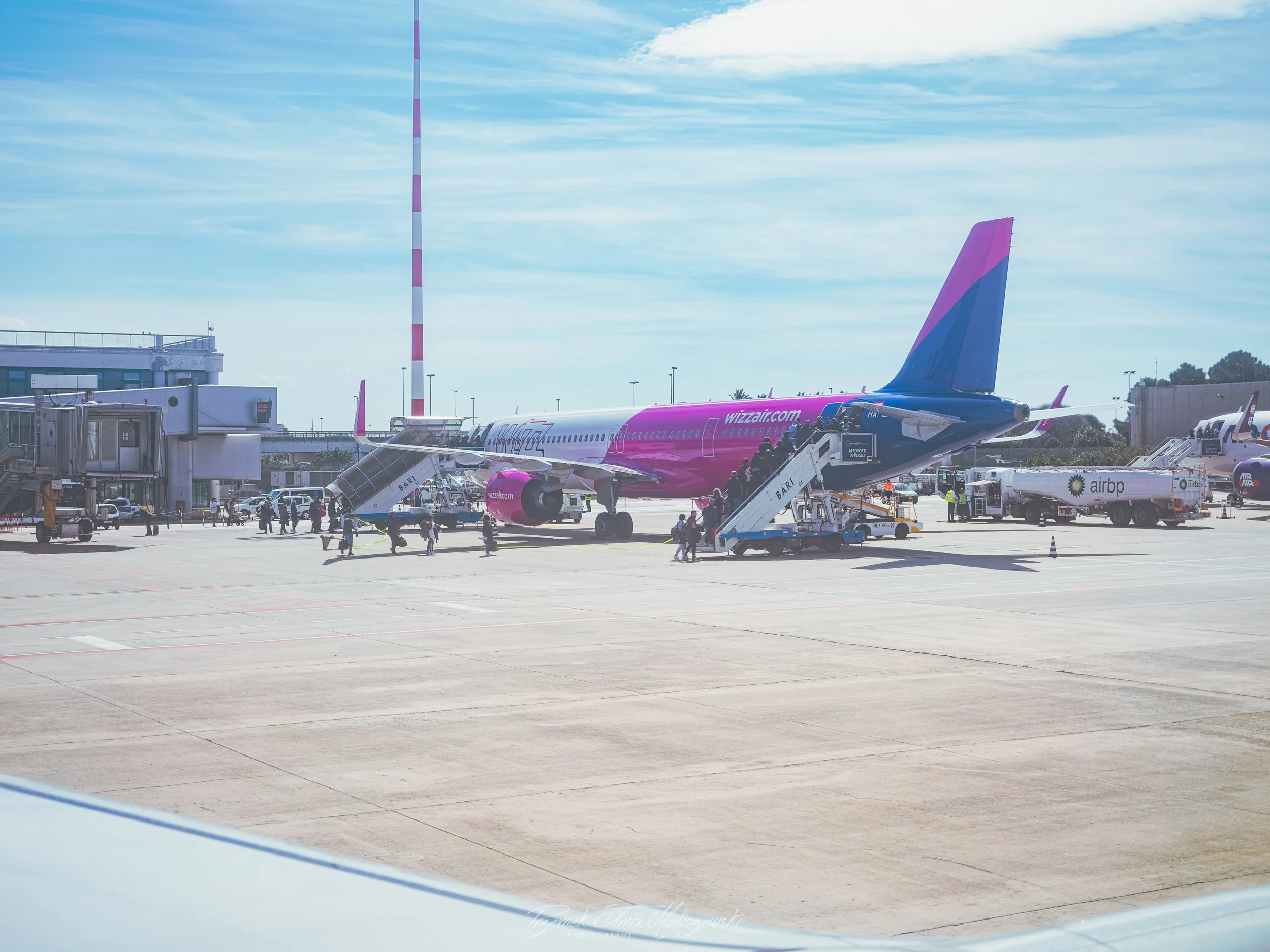
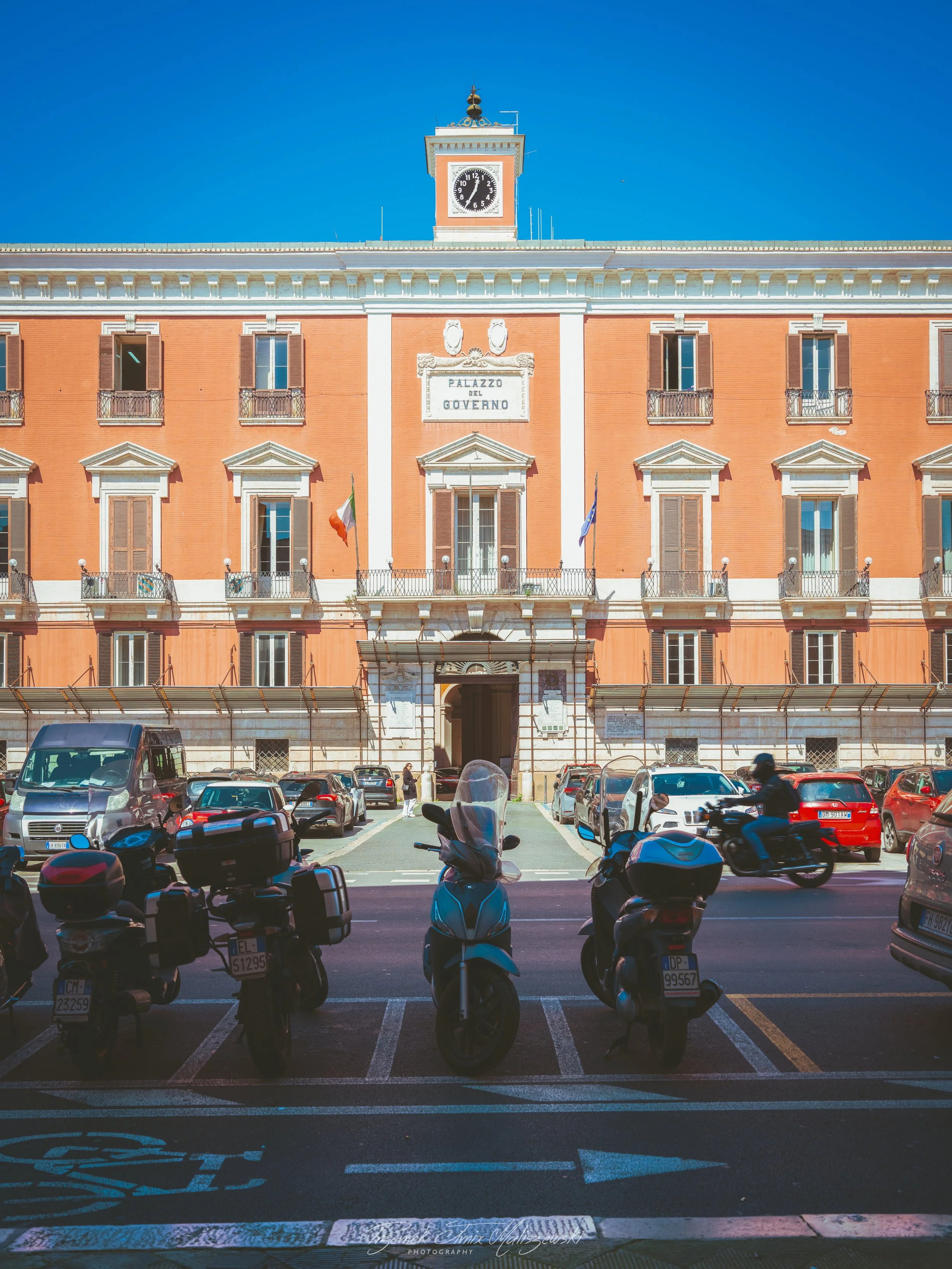
Bari is a city with definitely two faces. The first of them is Bari Vecchia – Old Bari, while the second face is the adjacent and younger Murat (Borgo Murattiano), which took its name from the Marshal of France, Joachim Murat, appointed in 1808 by Napoleon as King of both Sicilies (which historically included the continental part of Italy as well as Sicily itself). Murat, the actual King of Naples (of the contemporary Kingdom of Naples), contributed to the expansion of Bari with this very district of his, which is visually distinguished from its old part primarily by the regular grid of streets intersecting at right angles.
Looking at the map or perhaps today – a satellite photo of Bari, it is hard to escape a visual, urbanistic analogy with New York's Manhattan. Manhattan, much like Bari, developed from the ocean, and its oldest part, Lower Manhattan (once forming the settlement of New Amsterdam), differs significantly from Midtown or Upper Manhattan in its urban layout: it is, much like Bari Vecchia, an irregular and tangled street pattern, so well known from most Old World cities, stretching basically to Houston Street or even to 14th Street, which – as you look at the map – cuts this world-famous island across, giving rise to a geometric grid of streets and avenues whose order is ruined by the diagonally running Broadway (supposedly tracing the footprint of bare feet and leather sneakers of an ancient Indian trail).
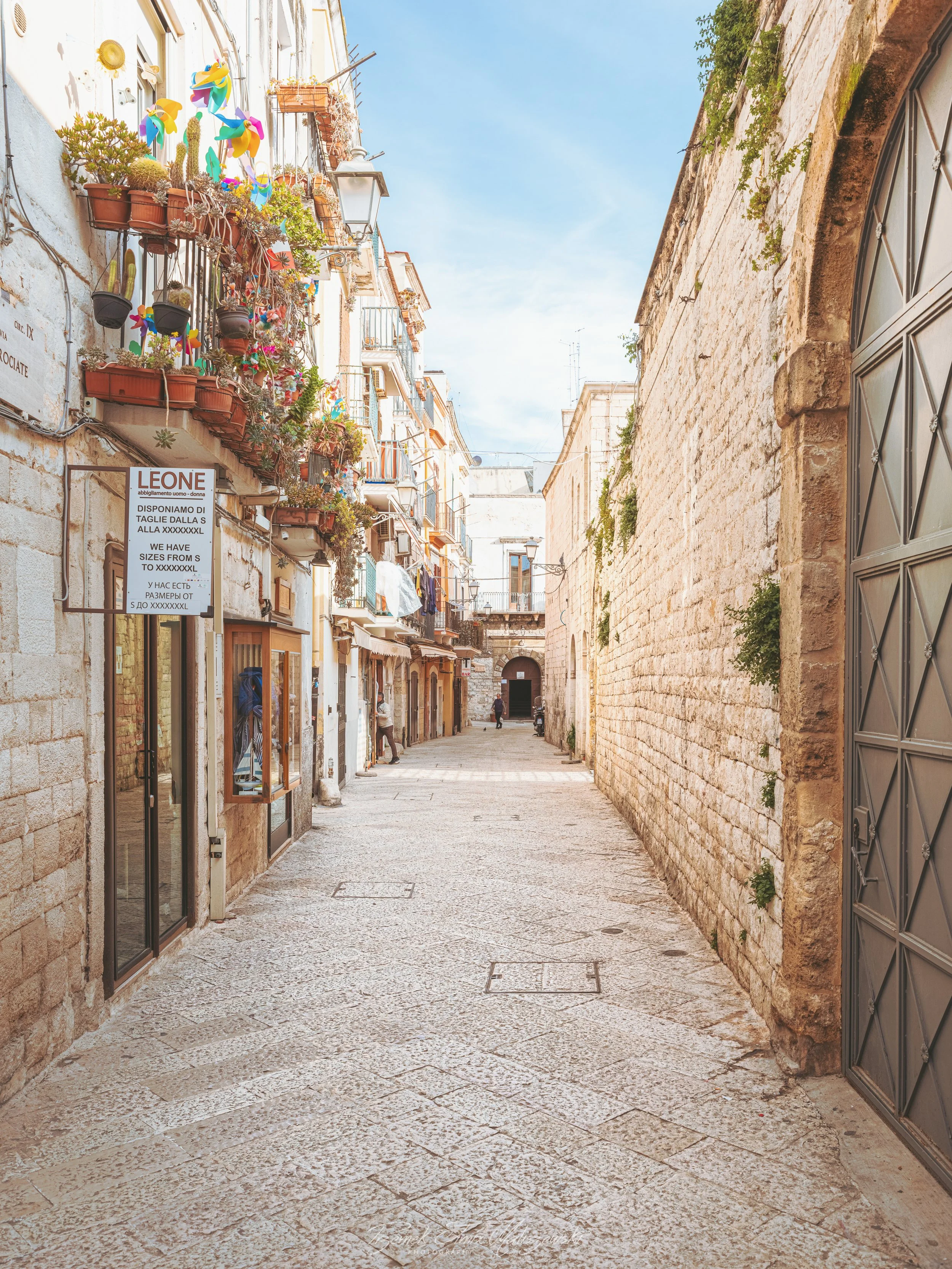
Strada delle Crociate.

And now look at the satellite photo of Bari: the scale is naturally different, but the development path and concept are remarkably similar. The old town is an urban chaos, and south of Corso Vittorio Emanuele II we already have a regular urban grid and – much like Broadway running diagonally in Manhattan – so does Via Francesco Crispi run diagonally here.
Bari seen from a satellite. The older, urbanistically rather chaotic part of the city is clearly visible alongside the newer one – characterized by geometric order and neatness.
New York's Lower Manhattan on the left, with an urban chaos similar to Bari's, alongside the geometric grid of streets and avenues of Midtown.
What more to write to you about Bari? It is a fantastic place for a few-day trip. It is a gateway and base camp precisely for exploring the entire region. Famous towns, such as Polignano a Mare or Alberobello, lie basically nearby, and you can easily reach each of them by city bus or train. To Alberobello we went by bus, came back by train, sort of dropping by Polignano along the way (Volare!).
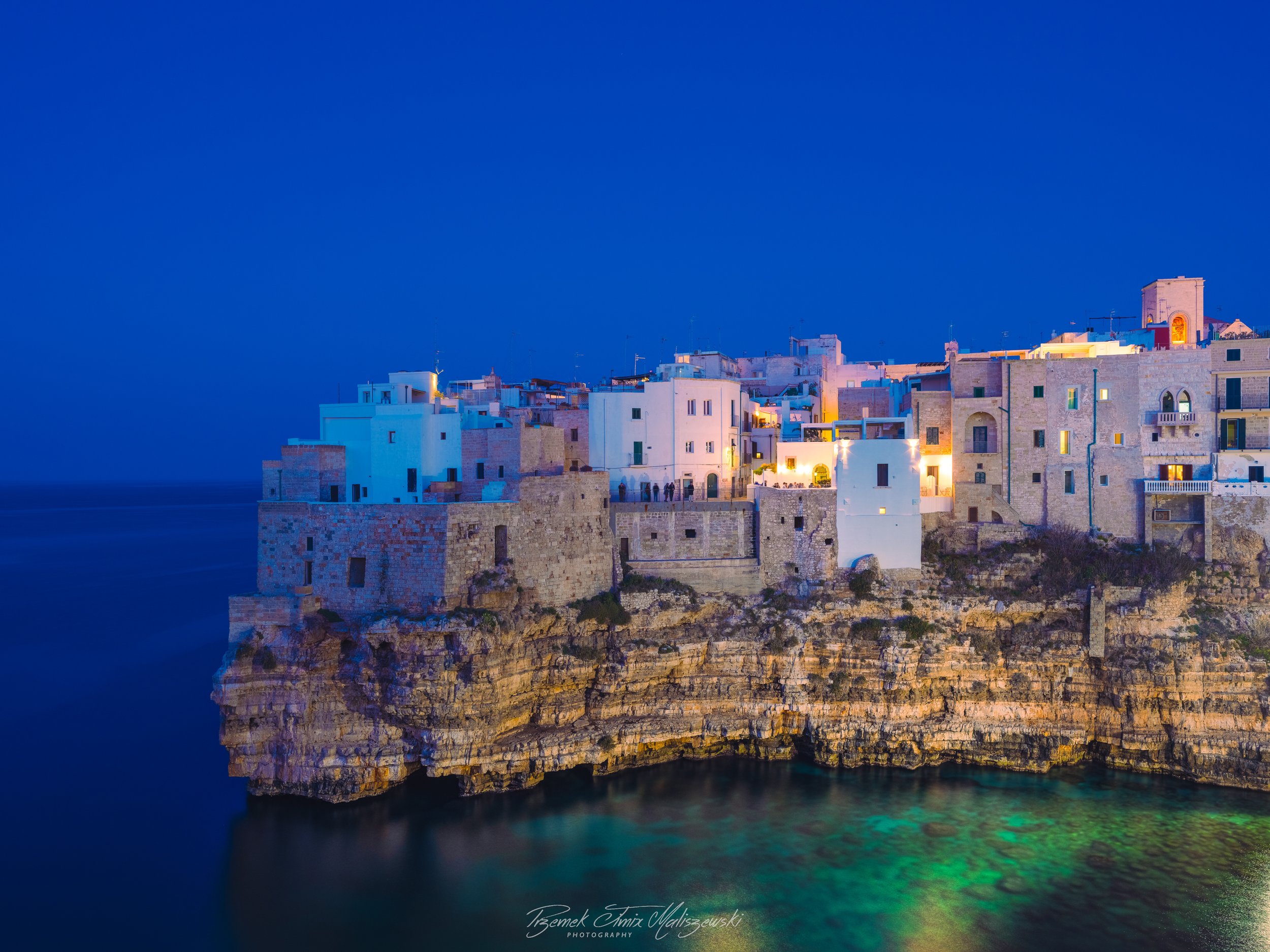
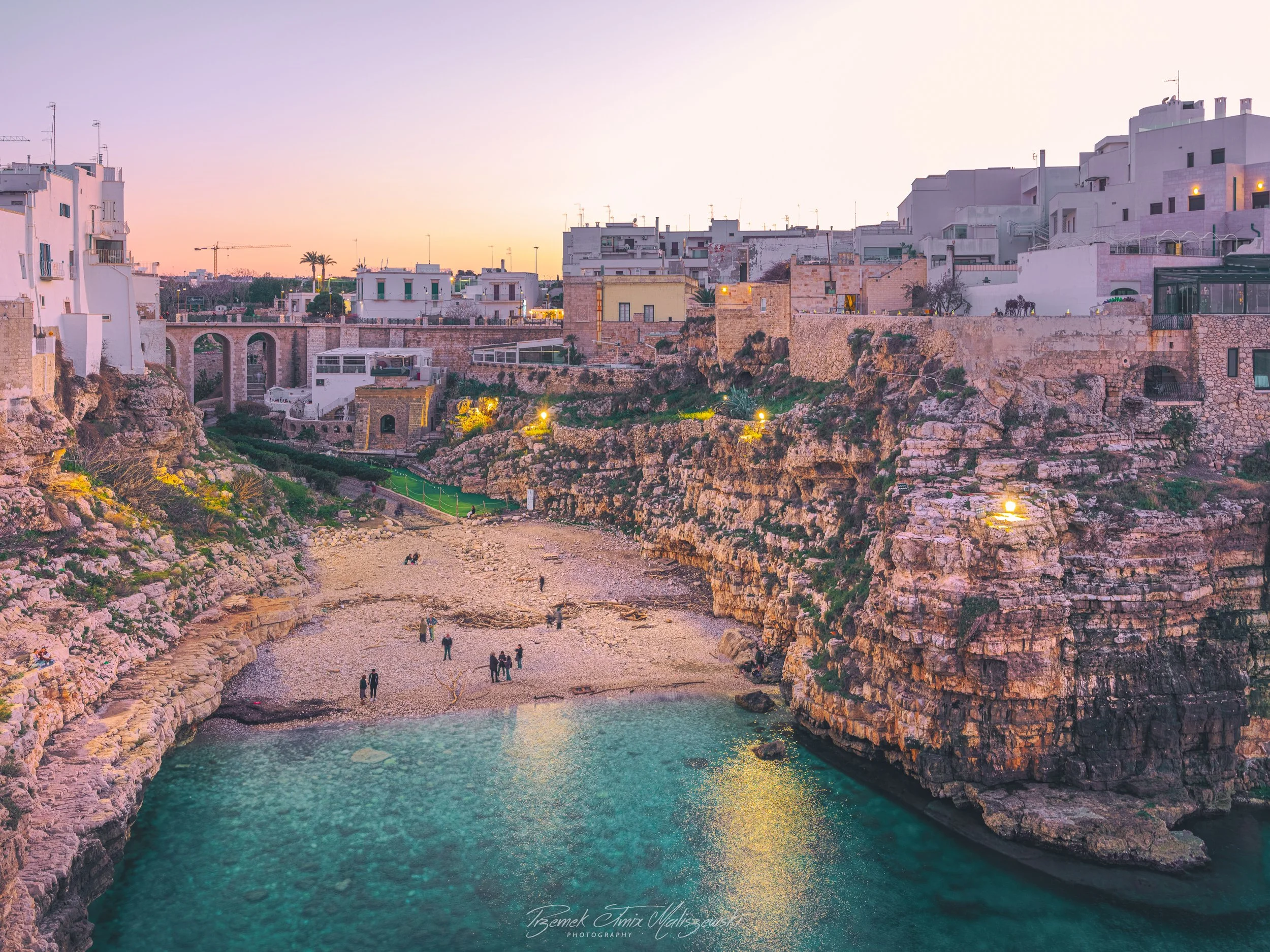
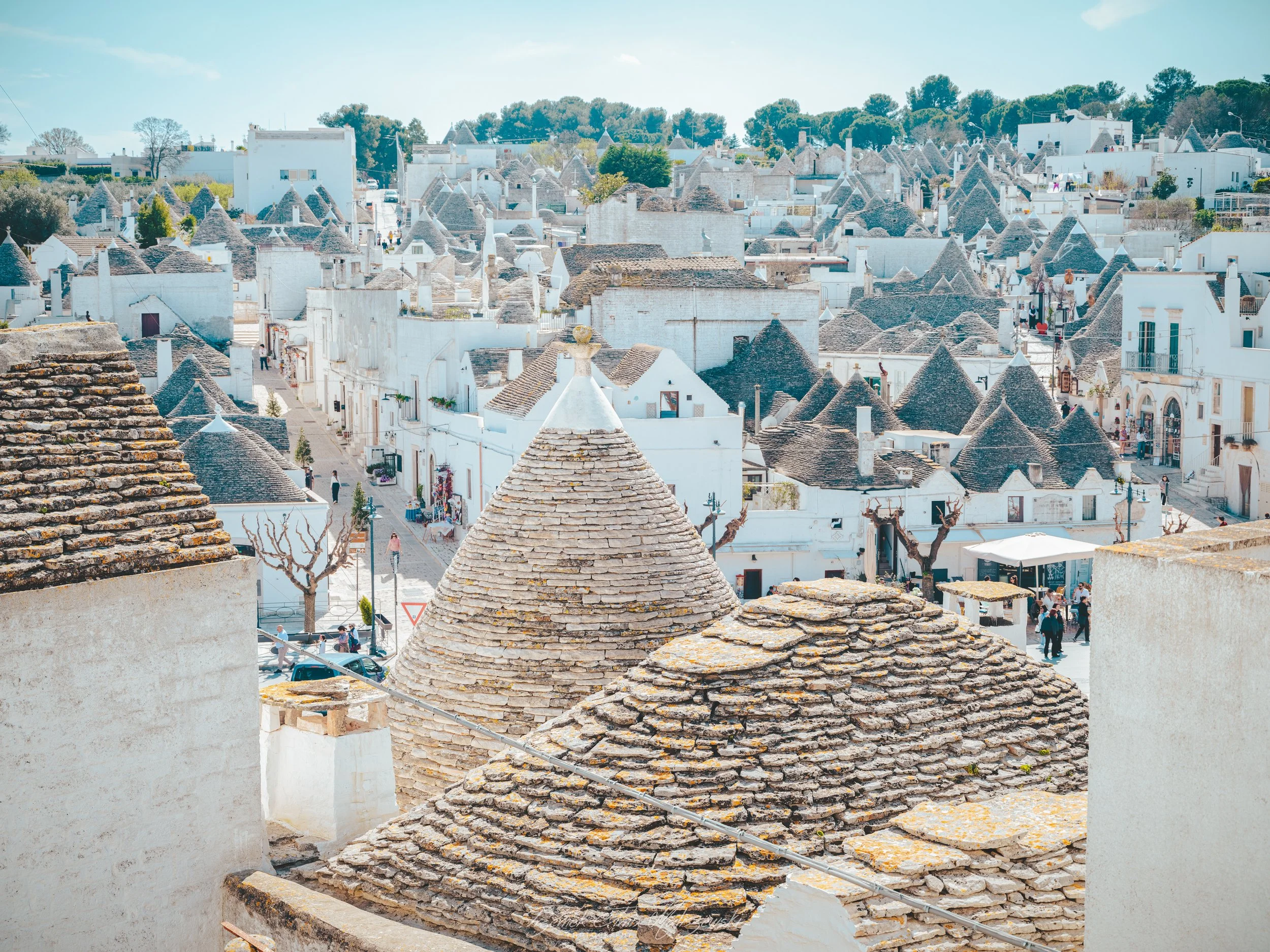
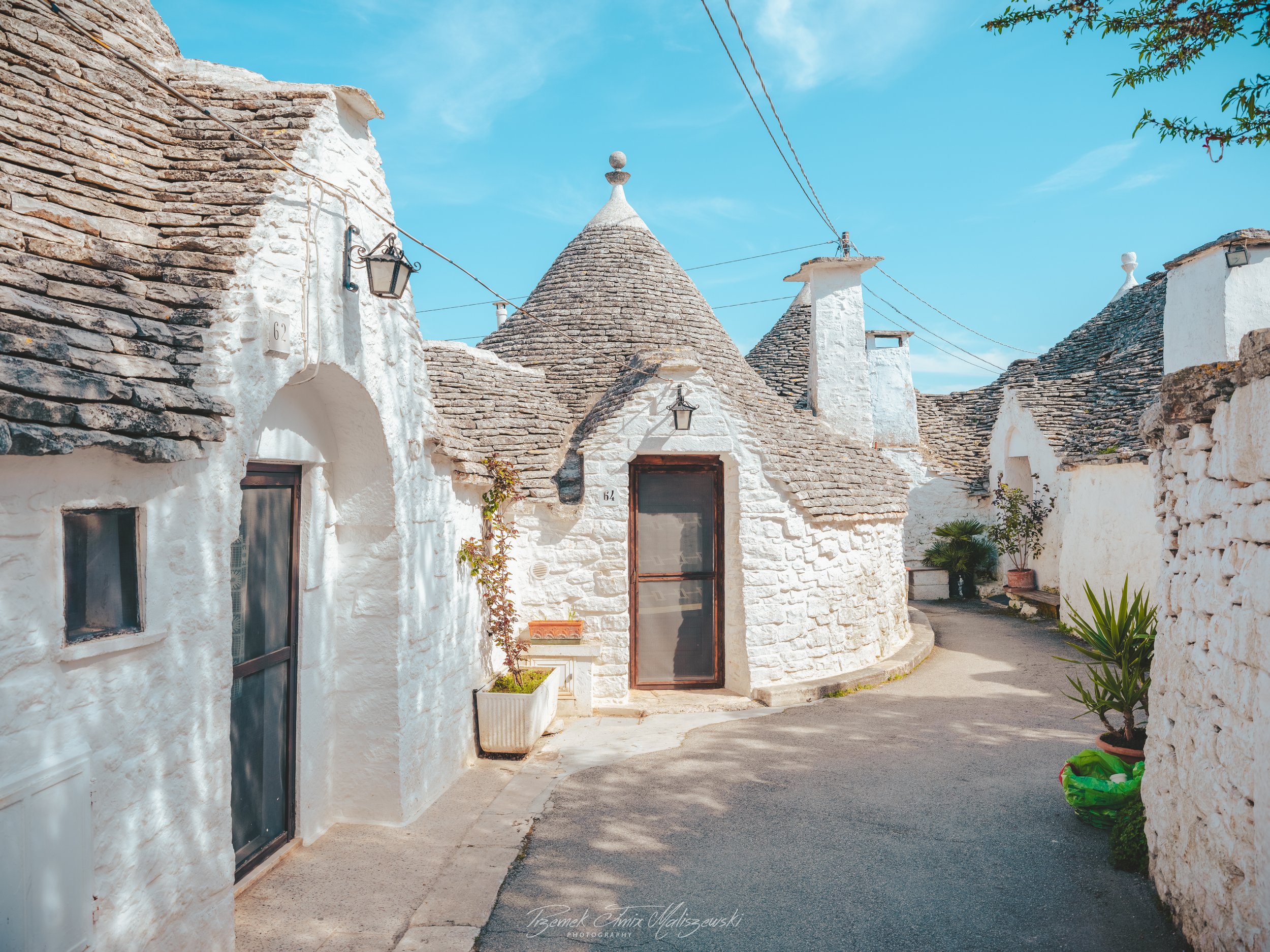
Voooooooo-laaaa -reeee, oooo-oo!! The monument to Domenico Modugno in Polignano a Mare. Below in the photos are the famous cliffs of Polignano a Mare and the trulli in Alberobello.
Culinarily, Bari is wonderful. I mentioned in the post about Rome that essentially Rome is the culinary navel of Italy. And so it is. I won't change my mind. But Rome owes this navel status on the culinary map of Italy to a certain kind of dispersion and thematic variations "on a theme." After all, it's the capital of a modern and large European state. Bari, on the other hand, like other cities and regions, is more specialized or targeted. It is local. It is more from here than from everywhere.
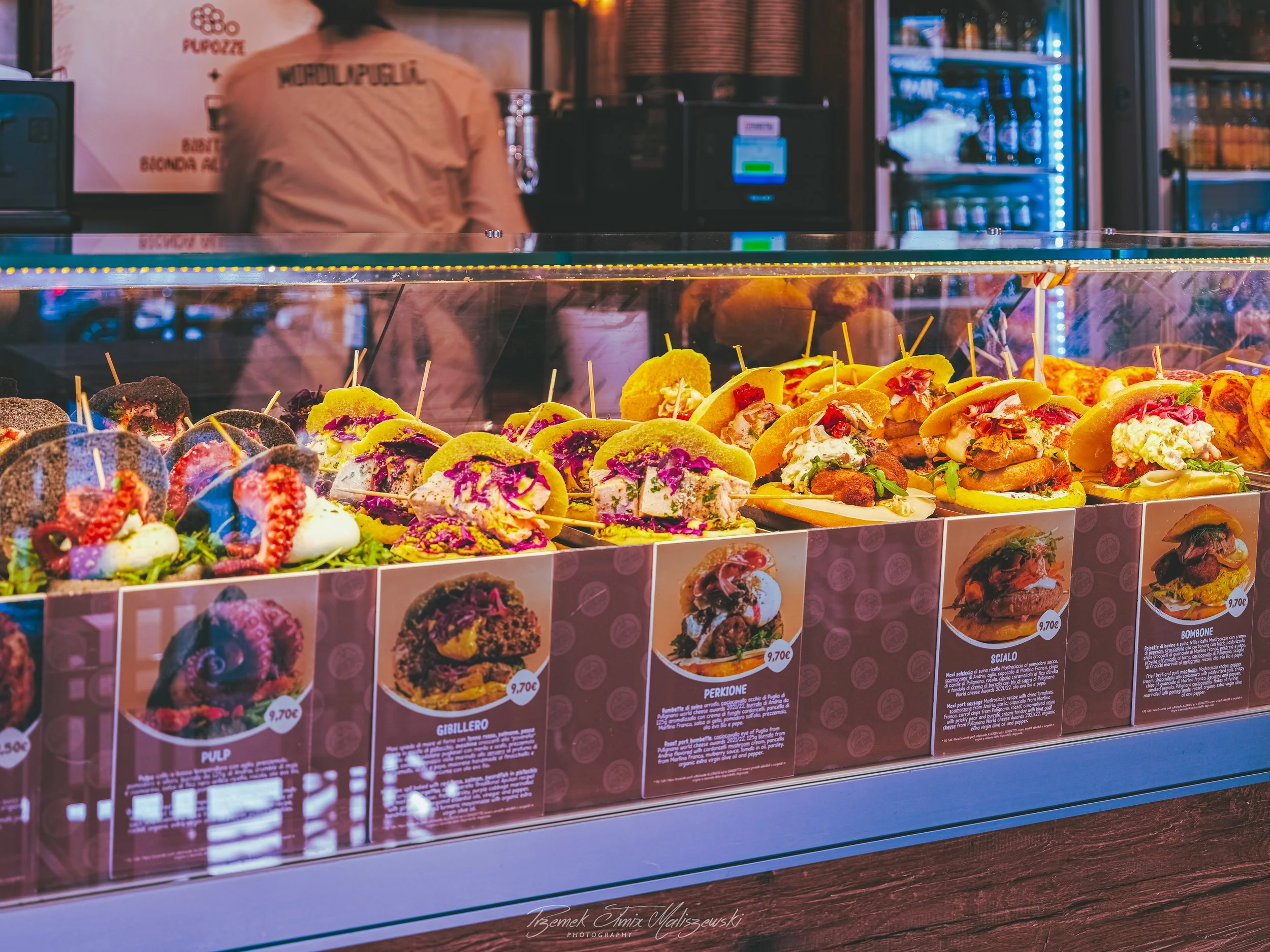
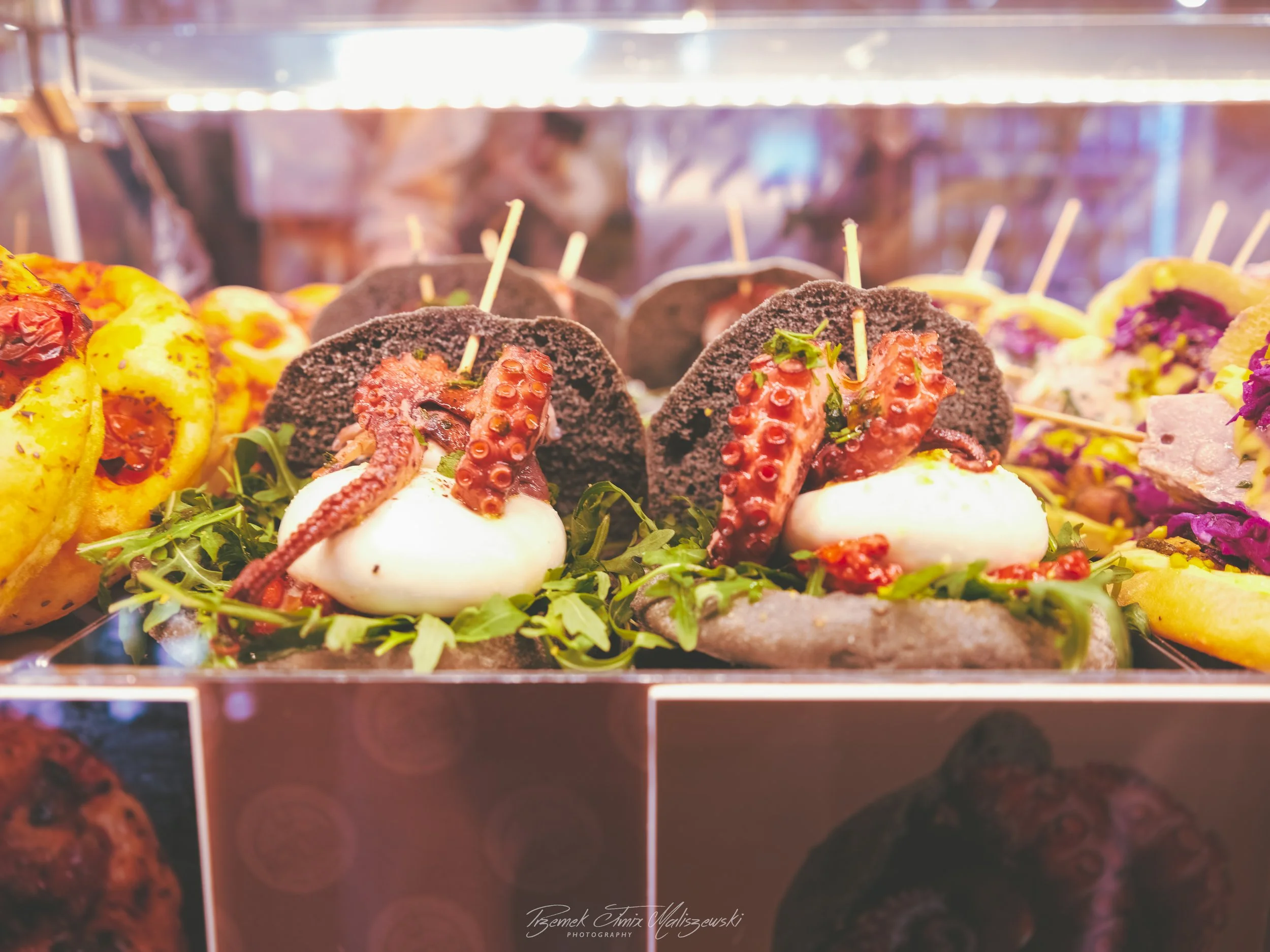
And so, Bari is known for producing pasta. Not just those produced on a large scale, but perhaps above all those produced entirely by hand by women in the alleys of Bari Vecchia. We are talking of course about the famous "little ears" orecchiette. Besides pasta, it's worth trying focaccia barese with olives and tomatoes and all sorts of goodness from frutti di mare. Octopus sandwiches are OK, but that's more Instagram than serious culinary history. In Bari, bread is good, all variations on its theme, pasta, seafood. Olive oil – "duh!" – without it in the Mediterranean basin there is no way anyting in the kitchen can function, and not having it around is a shame and a flop. So yes: olive oil reigns supreme here too. But! Let's not forget about another specialty of the region – wines! – because these are fantastic here.
One of the stations for handmade orecchiette pasta. The ladies worked hard and went to rest. They left the pasta outside. No one is stealing it.
Wines from Puglia are mainly strong, full-bodied, well-structured red wines. Primitivo, Negroamaro, and Nero di Troia reign supreme unquestionably. These are wines in the vast majority very good, at the same time – let me put it this way – compatible with the general idea of red wine held by a broader circle of "wine drinkers," and what is also important – they feature a good price-to-quality ratio. Simply put, people living here know how to make truly good wine that doesn't ruin the wallet. The main grape varieties are primarily the aforementioned Primitivo. Primitivo does not mean "primitive" as many think. It means "early ripening" (and thus early harvested) – primo – first. It is cultivated mainly in Puglia and generally in the south of the country. This is the exact same variety as the Californian Zinfandel and the Croatian Crljenak Kaštelanski (or Trybidrag). Other varieties of the region are the aforementioned Nero di Troia (Uva di Troia), appearing in crops located mainly in the north of the region, yielding wines with a good structure, perceptible tannins, and forest aromas. White and rosé wines are made from varieties such as Verdeca, Fiano, and – I love this name – Bombino Bianco. These are light, fresh, and rather citrusy wines. The most famous appellation is of course Primitivo di Manduria DOC (the Croatian equivalent is kvalitetno vino), meaning Denominazione di Origine Controllata. DOCG of course means a higher class (garantita). A bottle of good wine from Puglia does not have to be expensive. Those available in mass sales, as long as they come from Puglia and have the DOC designation, you can easily try and enjoy. These are red wines and – as I mentioned – of strong body, powerful, concentrated, but pleasant in reception for the majority, as one of the types of wine that is said to be a classic, a kind of archetype, alongside such archetypes as Pinot Noir, Zinfandel, or the Croatian Plavac. Primitivo di Manduria is the most famous and popular primitivo from the region. Another, slightly less known, but considered more elegant is Gioia del Colle DOC.
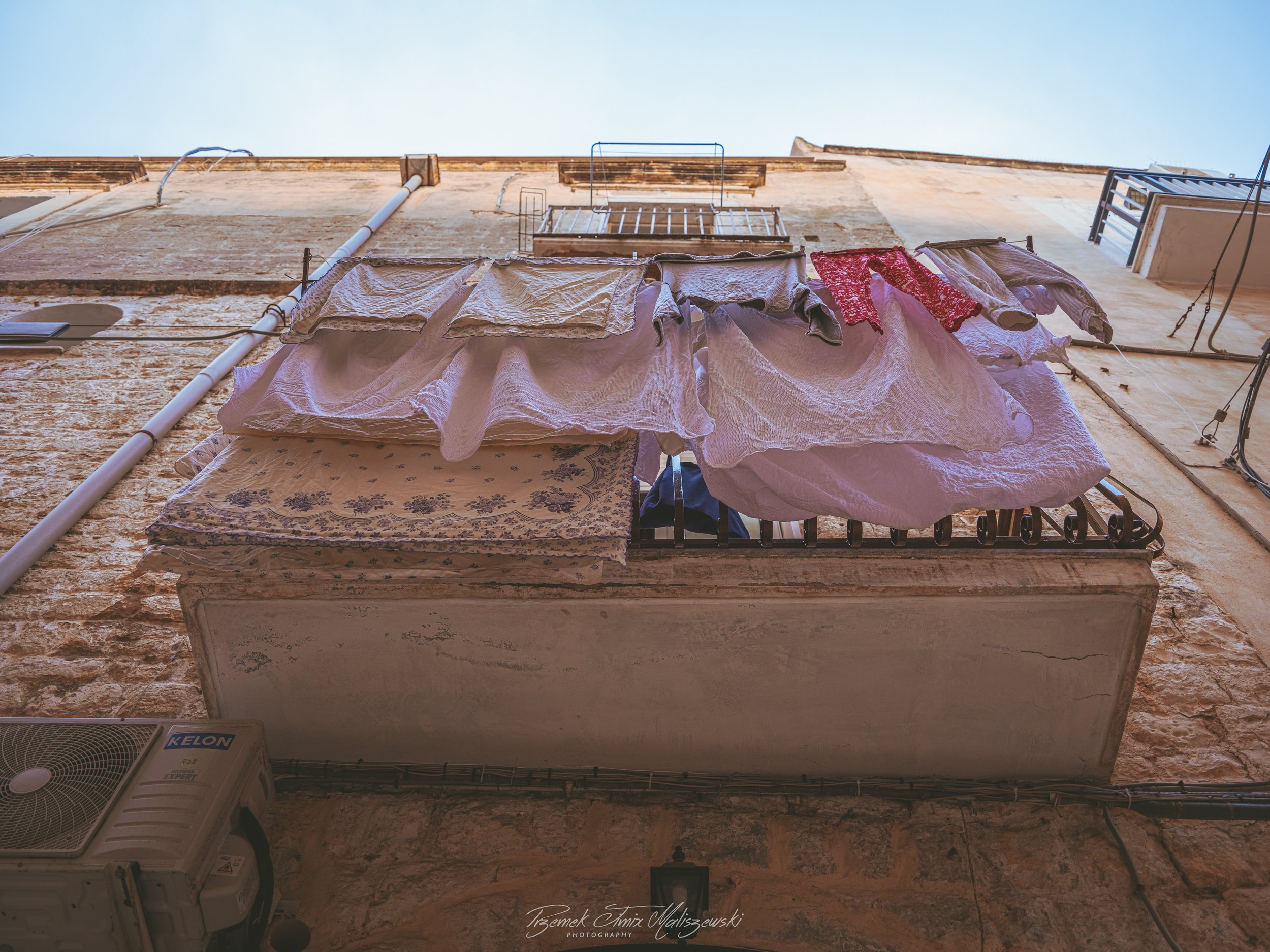
Just like the pasta left out on the street, there are also no takers for the laundry hung out to dry on Via Venezia.
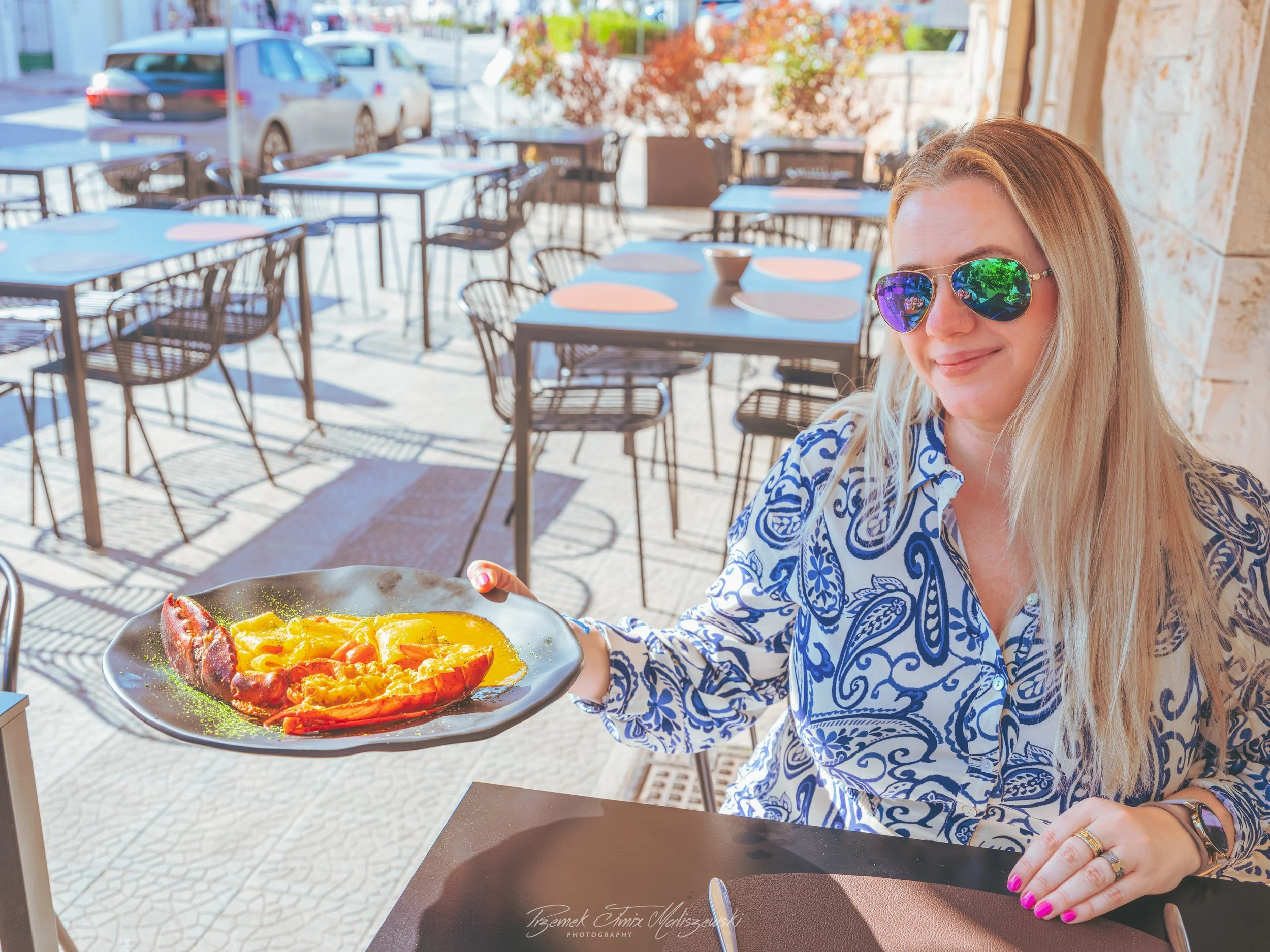
Bari is a paradise for gourmets, and the proximity of the port makes fish and seafood easily available and at reasonable prices. It is worth taking advantage of this while on site. Ending the thread with "our" famous Italian woman, Bona Sforza, I will only mention further that she is laid to rest in the local basilica of St. Nicholas in Bari. Her beautiful tomb was funded by one of her daughters, Anna Jagiellon.
The Basilica of Saint Nicholas in Bari – the resting place of Bona, Duchess of Bari and Rossano, Queen of Poland.
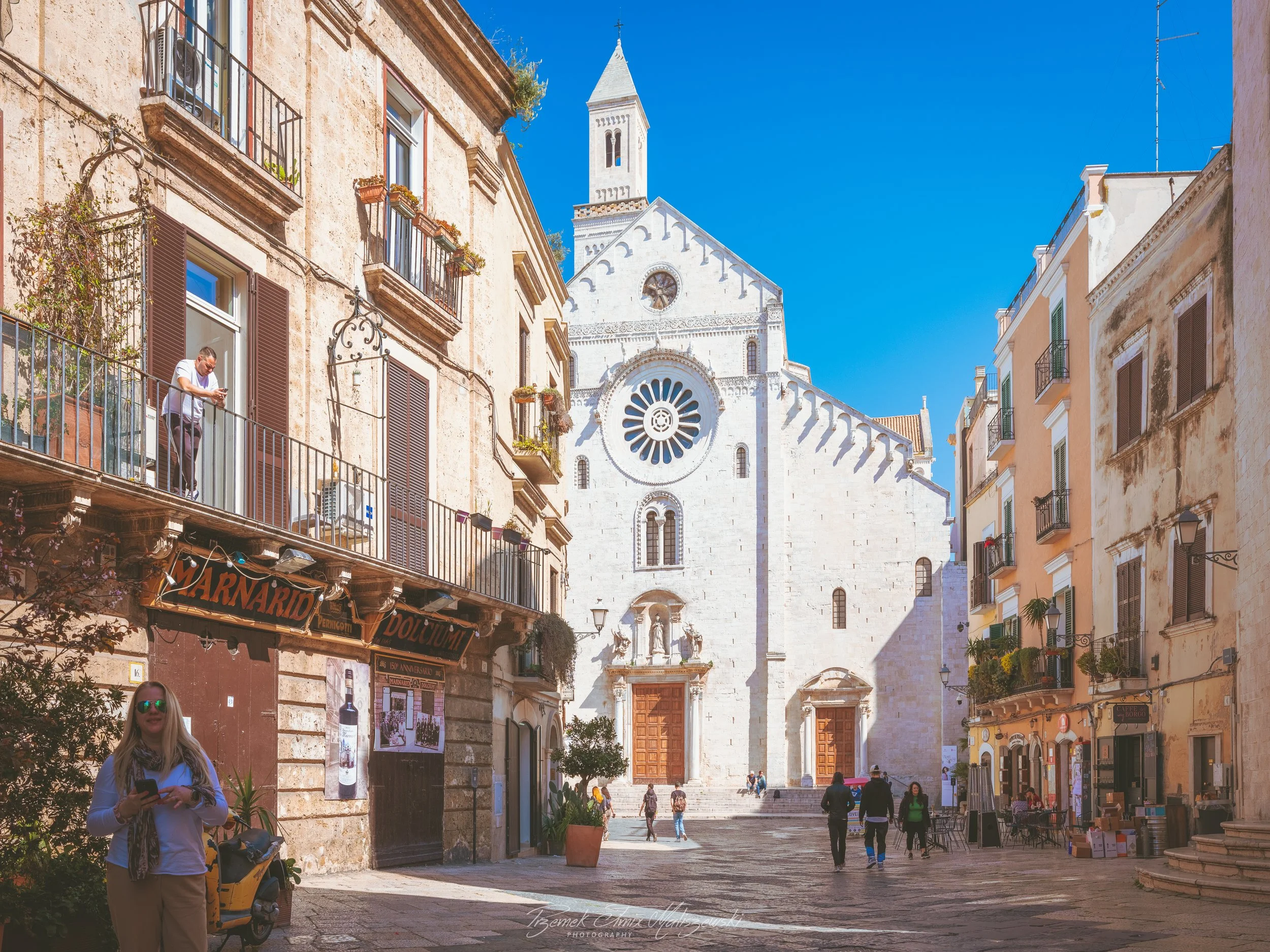
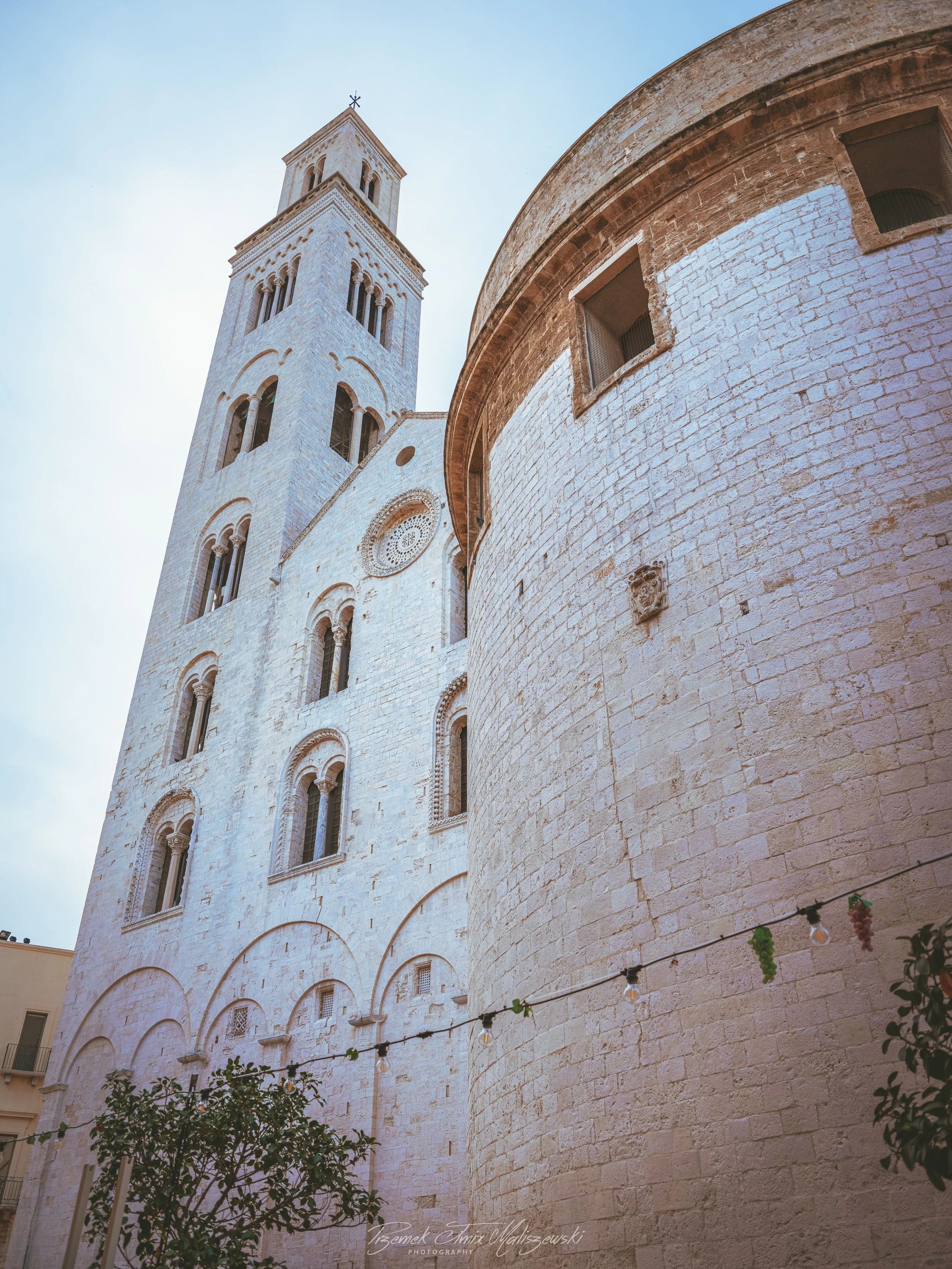
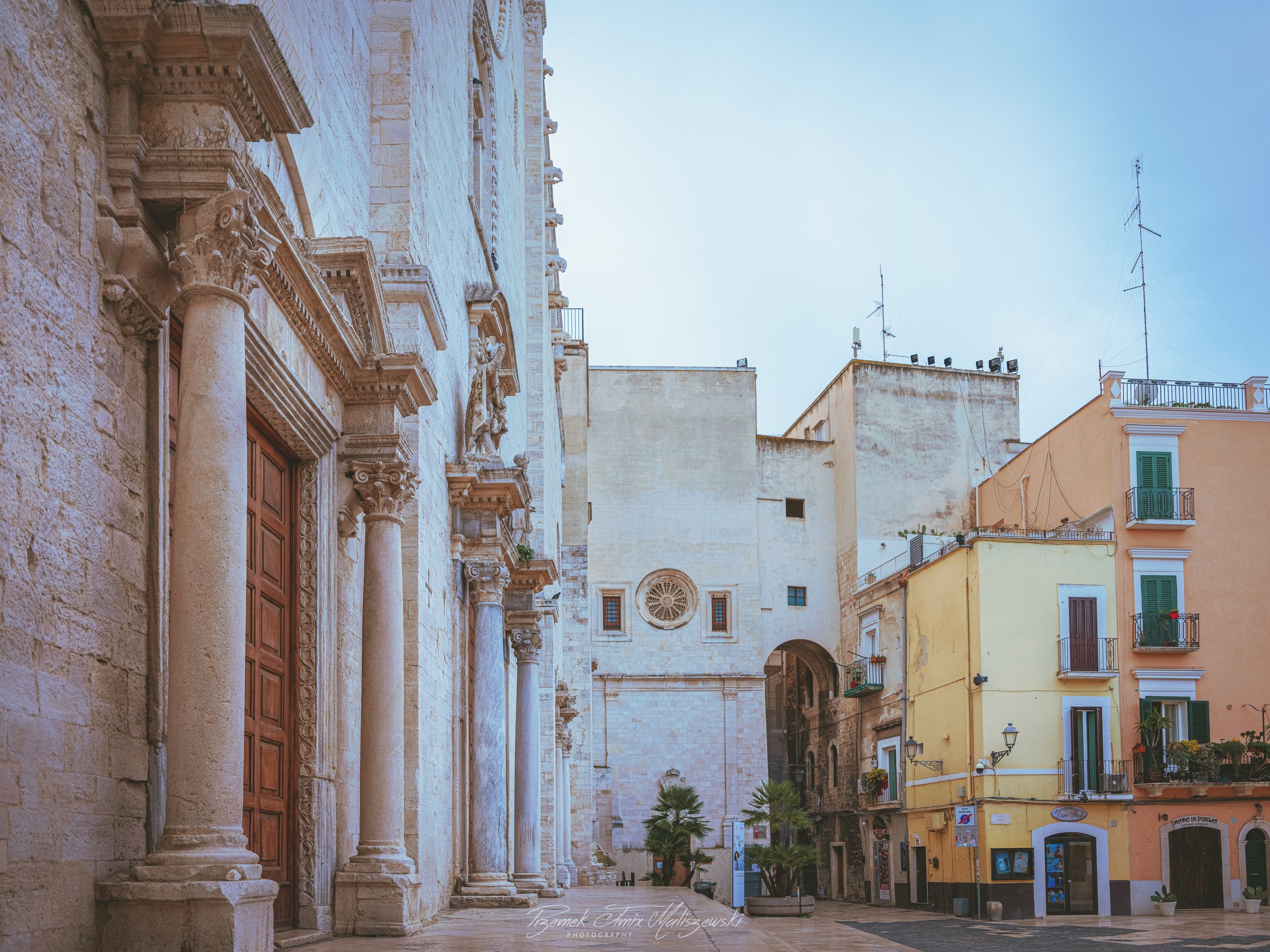
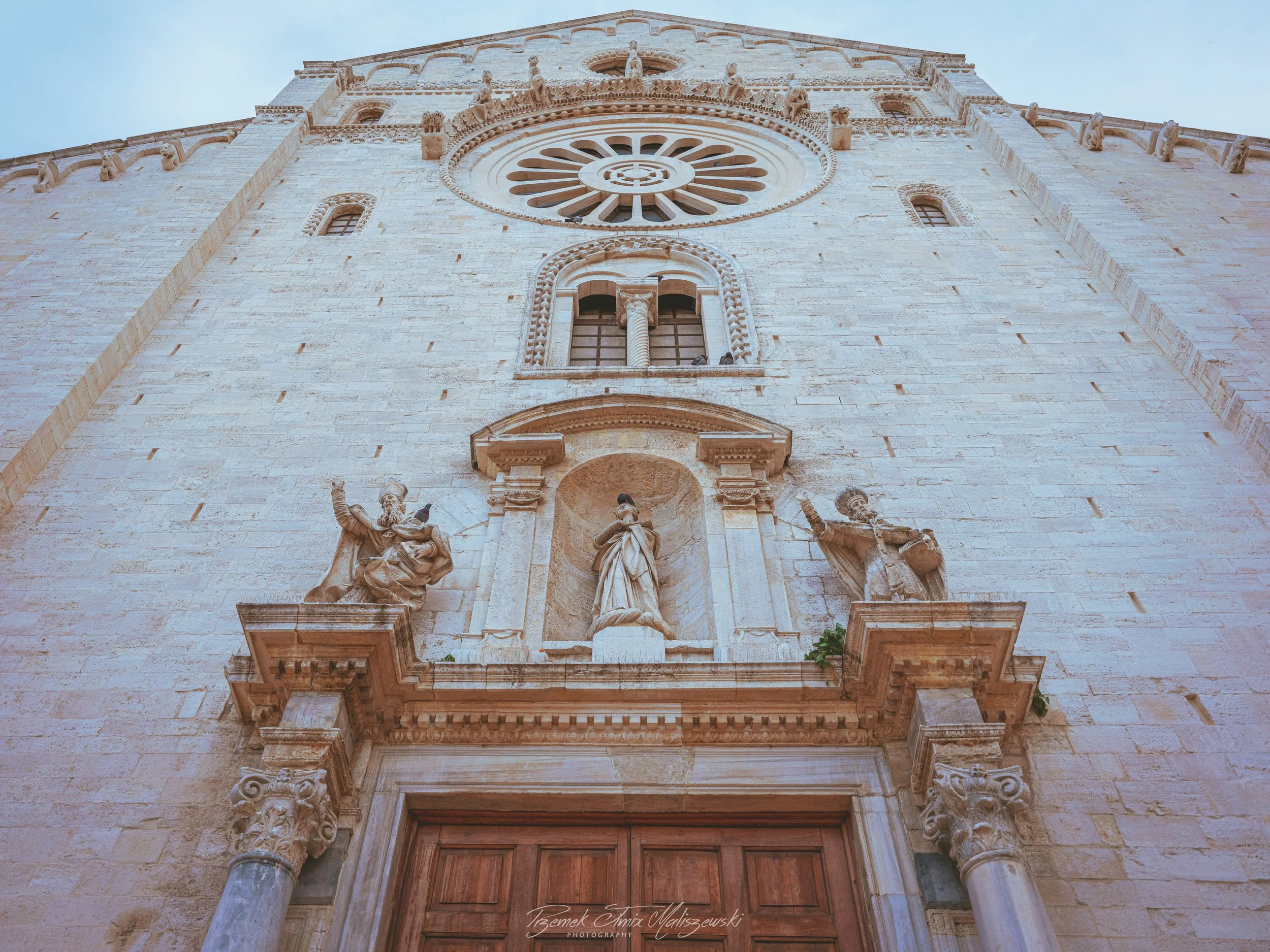
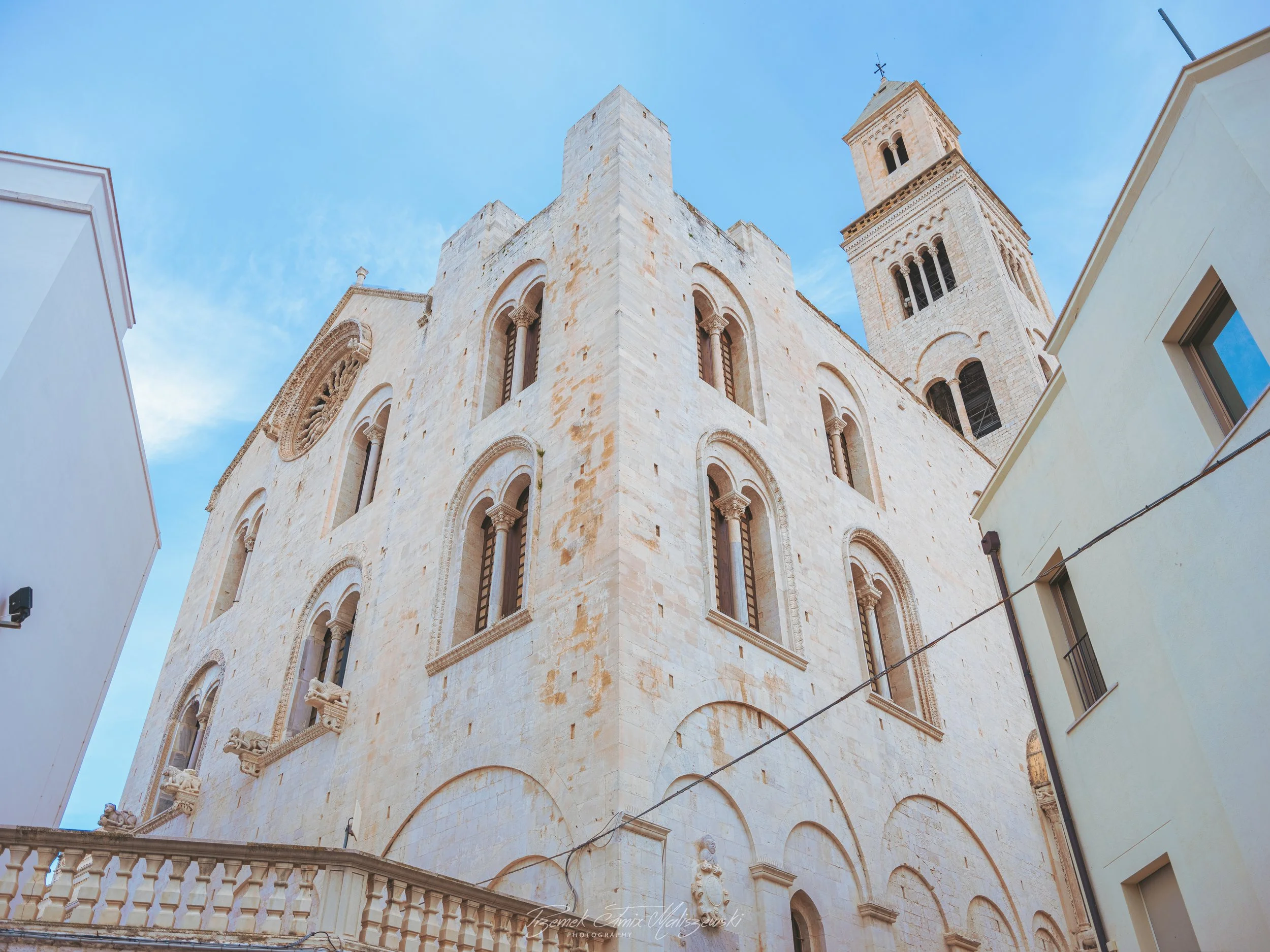
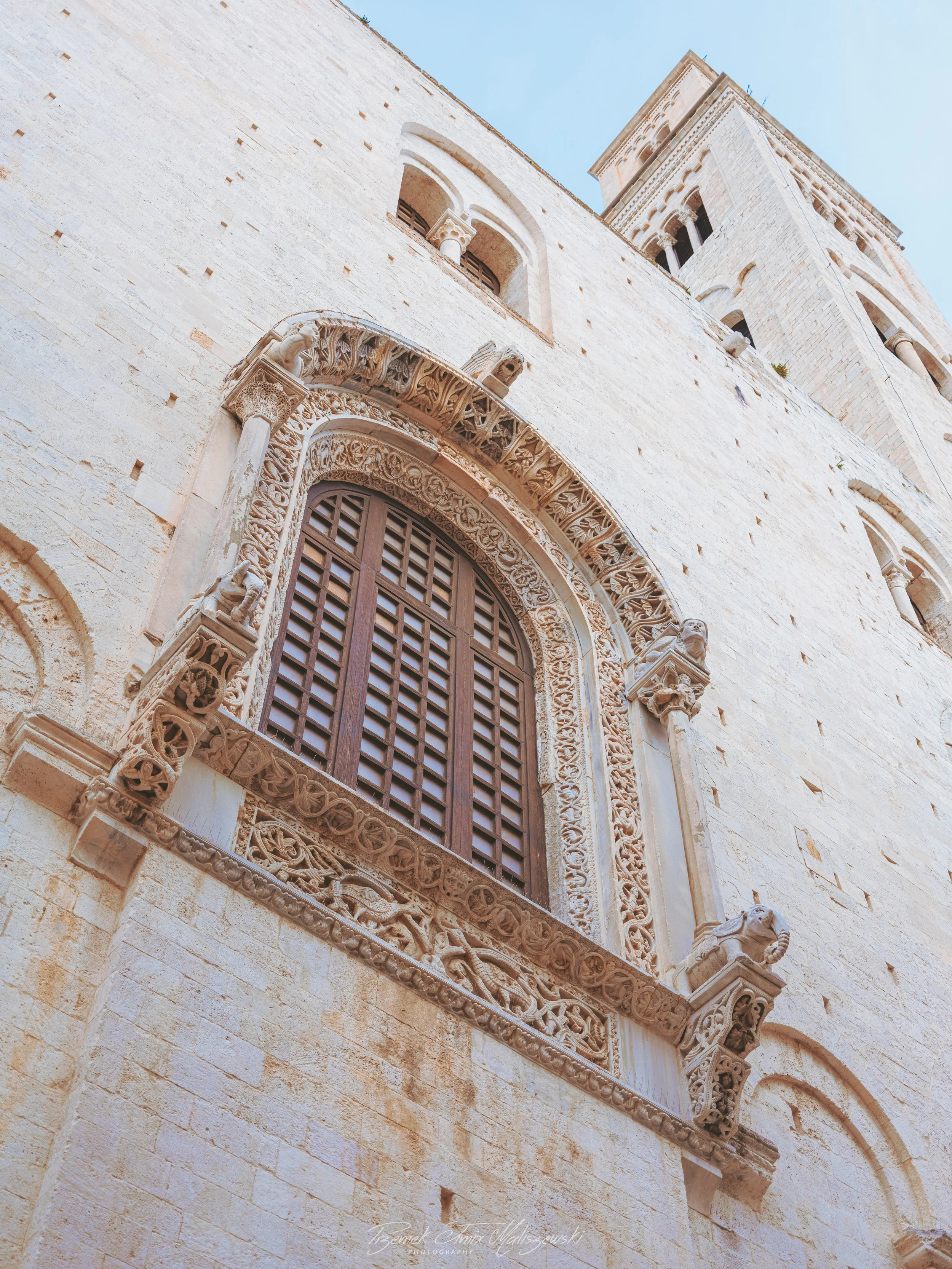
It is worth recalling yet another extremely fascinating historical accent connecting Poland with the city of Bari—the "founding" by Queen Bona of the town of Bar (yes, the very same Bar associated with the Bar Confederation) in the borderlands of the former Commonwealth (present-day Ukraine) in 1537.
The name was given to the village of Riv (from the nearby Riv river) in honor of her hereditary Italian duchy of Bari, after a certain Stanisław II Odrowąż overplayed his hand with his ambitions and was sentenced by the parliamentary court for lese-majesty (offense against the sovereign), as a result of which he and his wife, Anna of Masovia, were stripped of several key estates, including the aforementioned Riv, which the Queen renamed Bar in 1537. This town—once called the "gateway to the Borderlands" and a key stronghold—ensured that a piece of Italian Bari symbolically "took up residence" in the Polish geopolitical space long before any fantasies about incorporating Bona's southern possessions into the Commonwealth might have appeared in the minds of some nobility.
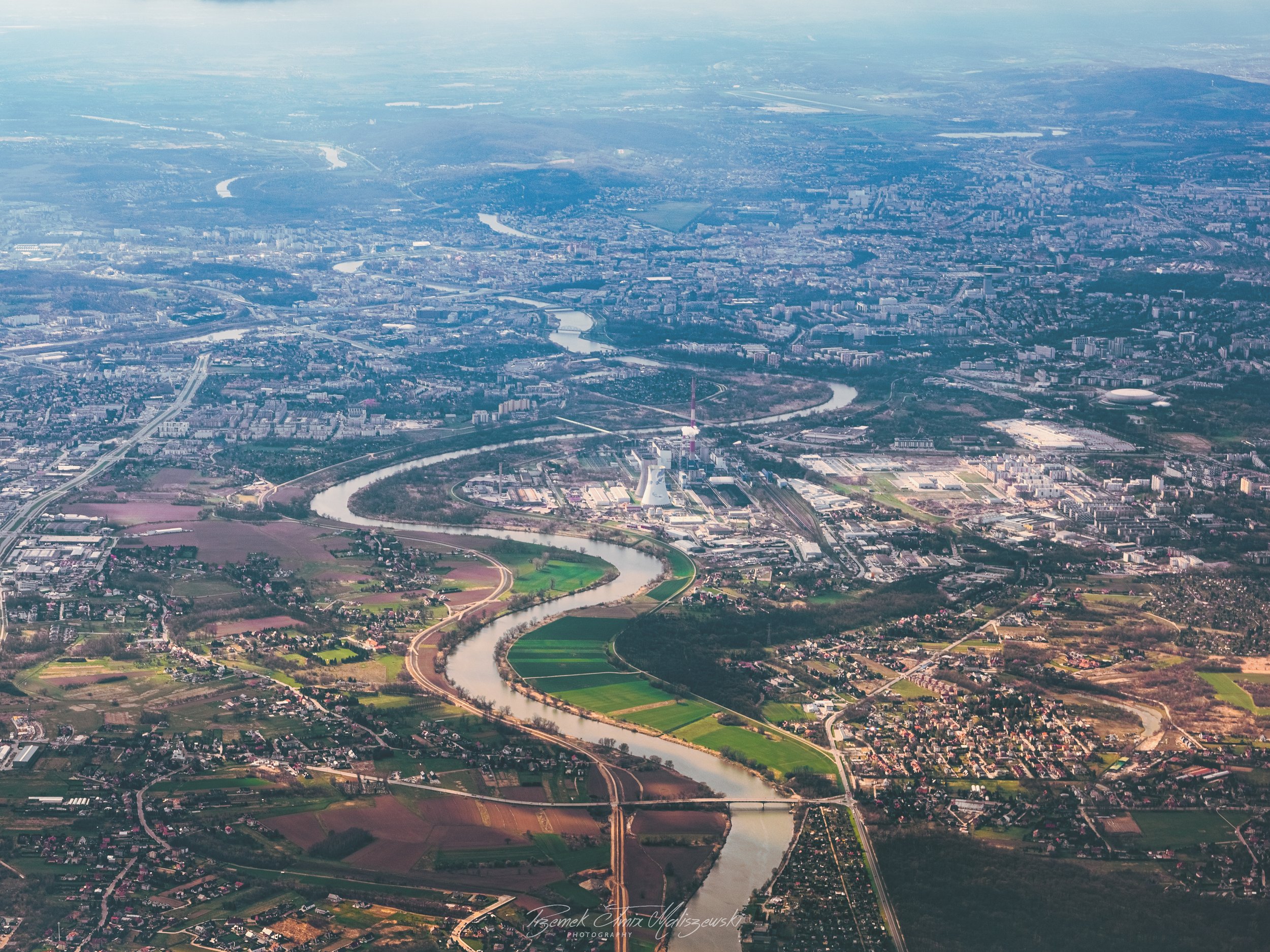
Returning to Kraków-Balice Airport.